Gildan Activewear (GIL): Supplier relationships and the Champion licensing thread investors should own
Gildan Activewear operates as a vertically integrated apparel manufacturer that monetizes through branded sales, private-label contracts and licensed channels. The company manufactures core basics in-house, sells under owned brands (Gildan, American Apparel, Comfort Colors, GOLDTOE, Peds) and captures incremental margin by holding exclusive licensing rights for printwear distribution with select partners. For investors and procurement operators, that mix of manufacturing scale plus selective licensing is the primary commercial lever driving margins and partner dependency.
Explore deeper supplier intelligence at https://nullexposure.com/.
Company snapshot Gildan presents as a mature mid-cap apparel manufacturer with strong margin characteristics and significant institutional ownership. Market capitalization stands near $10.9 billion with TTM revenue of $3.62 billion and gross profit of $1.165 billion. Operating margin is robust at ~20.7% and return on equity exceeds 15%, signaling disciplined cost control and favorable product mix. Valuation indicators show a trailing P/E of 22.8 and a forward P/E of 13.6, reflecting analysts’ expectations of earnings acceleration. These financial anchors frame how Gildan negotiates and values supplier and licensing relationships: scale-backed bargaining power combined with revenue tied to brand placements and channel exclusivity.
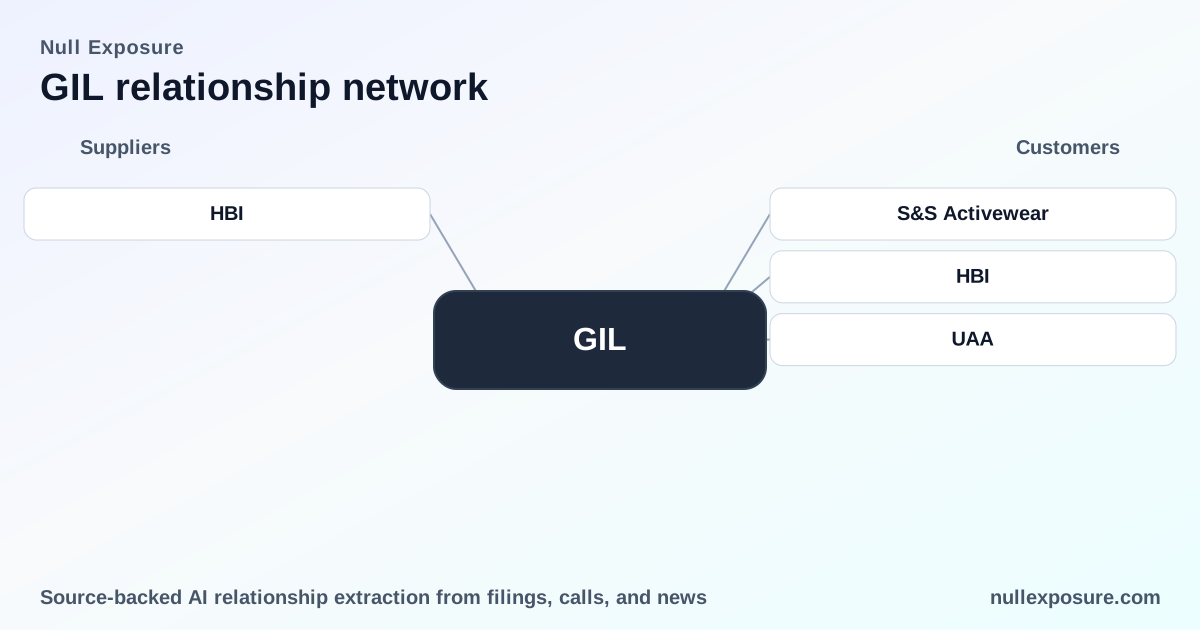
What the public record shows about Champion (every relationship in the results) Gildan’s captured relationships in the provided results are exclusively about Champion (Hanesbrands, ticker HBI) and the printwear licensing arrangement. The two entries in the public feed document the same commercial fact through different press and news channels:
- A GlobeNewswire press release dated October 15, 2025 references Gildan’s portfolio and notes an exclusive licensing agreement for the printwear channel for Champion in the company’s market description. This confirms an operational arrangement where Champion-branded printwear is distributed via a dedicated licensing channel managed by Gildan. (GlobeNewswire, October 15, 2025)
- A QuiverQuant news item tied to Gildan’s third-quarter FY2025 announcement reiterates that Gildan operates under an exclusive licensing agreement for the printwear channel for Champion, reflecting the same contractual posture in investor communications. (QuiverQuant, Q3 FY2025 announcement materials)
Both entries document the same strategic linkage: Gildan holds exclusive printwear licensing rights for Champion, and the company routinely cites this arrangement in investor and media communications.
How the Champion link functions commercially The Champion arrangement is operationally important because it converts brand equity into scalable sales via Gildan’s production and distribution footprint. Exclusive licensing for a channel compresses competition, secures shelf and runway access, and aligns manufacturing throughput to a branded revenue stream, which supports stable gross margins and utilization of owned capacity. For operators, this is a supplier relationship that integrates commercial (brand licensing) and operational (manufacturing and distribution) responsibilities.
Operating-model signals from the constraints set The constraints payload returned with the search produced no explicit contractual constraints. That absence is itself a signal: there are no material, public constraint excerpts in the returned results limiting the interpretation of supplier ties. At the company level, the broader evidence indicates these characteristics:
- Contracting posture: Gildan operates as both manufacturer and license-holder—a hybrid posture that increases control over pricing, quality and channel execution compared with pure contract manufacturers.
- Concentration: Gildan maintains multiple owned brands and licensed channels; the Champion printwear exclusivity is a concentrated, channel-specific exposure rather than a single-customer dependency across the business.
- Criticality: Relationships like the Champion license are commercially critical for the printwear channel, locking in distribution rights that directly affect near-term top-line volume and brand presence.
- Maturity: The firm’s financial profile—healthy margins, positive ROE, and institutional ownership north of 90%—signals a mature, scale-driven business that negotiates from a position of operational leverage.
If you need a formal supplier risk readout or counterparty scoring for operational diligence, start here: https://nullexposure.com/.
Strategic implications and investor risk checklist For investors and procurement leads assessing Gildan as a supplier or partner, the Champion licensing example illustrates the following strategic considerations:
- Revenue stickiness vs. renewal risk: Exclusive channel licenses create durable revenue while contract renewals and brand strategy shifts create discrete points of risk. Monitor renewal timelines and any changes in brand licensing terms.
- Margin amplification through vertical control: Gildan’s integrated manufacturing plus licensing amplifies margins; any supply-chain disruption or reputational issue in licensed brands could transmit quickly to gross margin.
- Concentration by channel rather than single customer: The Champion link is channel-specific; assess total channel exposure to determine whether a single-brand licensing strategy creates outsized sensitivity.
- Balance-sheet and valuation context: Given a forward P/E materially lower than trailing P/E and healthy operating margins, the market prices some near-term improvement; licensors or customers should price in Gildan’s ability to extract margin through exclusive arrangements.
Practical actions for operators and investors
- Request contract lifecycle data and renewal dates for the Champion printwear license to quantify cliff risk and renegotiation windows.
- Reconcile Gildan’s production capacity utilization with licensed-channel volume to validate margin sustainability under demand shocks.
- Monitor investor filings for material changes to licensing terms; public press releases and earnings notices are the first place these changes surface.
Concluding recommendation Gildan’s licensing relationship with Champion demonstrates a deliberate commercial strategy: capture branded channel economics while leveraging in-house manufacturing scale. That structure drives high operating margins and creates focused, channel-specific dependencies that investors should model explicitly into scenario analyses. For operator diligence and forward-looking supplier strategies, prioritize licensing duration, renewal mechanics and capacity alignment.
For a tailored supplier risk report and deeper counterparty profiles, visit https://nullexposure.com/. If you want an in-depth analysis of Gildan’s partner exposures and contractual timelines, begin your subscription and data request here: https://nullexposure.com/.