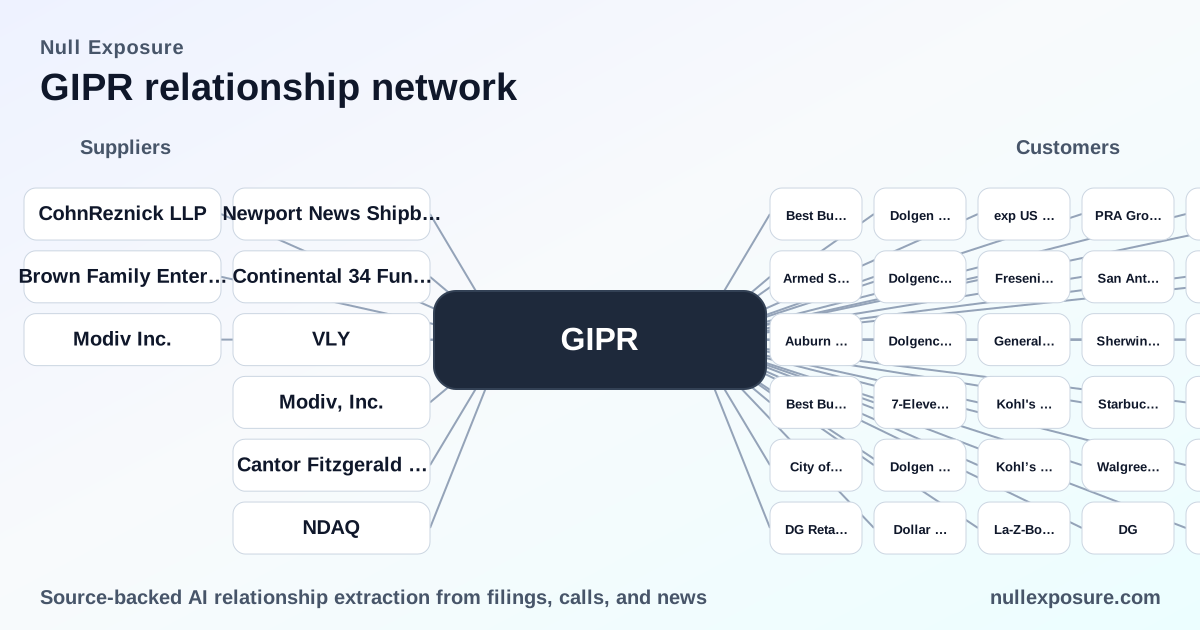
Generation Income Properties (GIPR): supplier map and what it means for investors
Generation Income Properties (GIPR) is a small-cap REIT that acquires single-tenant retail and office properties and monetizes through lease income and opportunistic property sales, funding growth with targeted asset-level loans and occasional portfolio financings. The company’s economics depend on property-level cash flow, access to debt, and the ability to execute bolt-on acquisitions — financing counterparties and a compact roster of service providers therefore shape near-term optionality and downside. For a quick portal to supplier and counterparty intelligence, visit https://nullexposure.com/.
High-level operating model signal: what vendors say about risk and execution
GIPR runs a lean outsourcing model: it uses third-party providers for property management and cybersecurity, and it finances acquisitions through a mix of commercial bank lending and private loans. The company reported approximately $49,000 in property management fees in FY2024, and narrative disclosures indicate engagement of a managed security services provider for monitoring, incident response and employee awareness. These items together are a company-level signal that vendor spend is low and concentrated, operational processes are outsourced rather than vertically integrated, and financial flexibility is highly dependent on lending relationships rather than on high fixed-cost infrastructure.
- Contracting posture: asset-level, collateralized loans and short-term service agreements dominate rather than enterprise-wide outsourcing or long-term strategic suppliers.
- Concentration and criticality: few high-impact counterparties (banks, auditors, strategic advisors); many low-spend vendors for operations.
- Maturity: early-stage supplier maturity — arrangements are tactical (property managers, MSP) and financing-driven rather than process-integrated.
If you want a consolidated supplier risk view that matches this operating posture, see https://nullexposure.com/.
Counterparties that matter today — concise takeaways
Below are the counterparties named in GIPR’s public disclosures and press updates, each summarized in plain English with source context.
BayPort Credit Union (Newport News Shipbuilding Employees Credit Union, Inc.)
GIPR (through an affiliate, GIPVA 2510 Walmer Ave, LLC) has a commercial loan agreement dated September 30, 2019, with BayPort Credit Union, indicating the use of local credit union financing at least for specific property-level debt. This is documented in GIPR’s FY2024 Form 10‑K filing. (Source: FY2024 Form 10‑K, Generation Income Properties)
Continental 34 Fund Limited Partnership
A long-standing sublease (dated January 30, 2003) involving Continental 34 Fund LP is cited in GIPR’s filings, reflecting legacy lease arrangements tied to one of the company’s retail assets where a named landlord/tenant contract still governs occupancy rights. (Source: FY2024 Form 10‑K, Generation Income Properties)
Valley National Bank (VLY)
Valley National Bank is a central financing counterparty: GIPR received a loan covering roughly 50% of the 7‑Eleven asset value (~$750,000) in June 2025, and the company disclosed a $21 million loan from Valley National Bank used in the acquisition of a 13‑property Modiv portfolio. Valley is therefore both a primary lender for smaller collateralized loans and the bank behind major acquisition financing. (Source: company business update, June 2025; press coverage summarizing FY2025 filings)
Modiv, Inc. (Modiv Inc.)
GIPR completed the acquisition of a 13‑property portfolio from Modiv for $42 million (retail and office properties), a material acquisition that expanded the company’s asset base and required financing. This seller-to-buyer relationship is a growth catalyst in FY2025. (Source: company filing summarized in media reporting on FY2025 transactions)
Cantor Fitzgerald & Co.
GIPR’s Special Committee executed an engagement letter with Cantor Fitzgerald & Co. to evaluate a full range of potential strategic outcomes, indicating retained advisory capacity for restructuring or sale processes. This positions Cantor as the company’s strategic financial advisor during a formal review of alternatives. (Source: June 2025 business update press release)
Nasdaq
Generation Income Properties is listed on The Nasdaq Capital Market and is subject to Nasdaq’s continued listing standards, including minimum bid price requirements; press reporting flagged Nasdaq minimum bid-price noncompliance issues in FY2026 context. This makes exchange governance and listing compliance a potential corporate governance and liquidity risk. (Source: press release coverage and Nasdaq-related investor notices, FY2026 reporting)
CohnReznick LLP
Shareholders ratified CohnReznick LLP as GIPR’s independent registered public accounting firm for fiscal year 2025, giving the company continuity in external audit oversight and signaling standard audit governance for a public REIT. (Source: shareholder meeting press release, FY2025)
Brown Family Enterprises, LLC
Brown Family Enterprises provided a $5.5 million loan disclosed alongside other financing activities tied to acquisition funding in FY2025, representing a meaningful private lending relationship supplementing institutional bank debt. (Source: FY2025 filing coverage in media reports)
What these relationships imply for investors and operators
- Financing is the chokepoint. Valley National Bank and private lenders like Brown Family Enterprises underwrote the acquisition-heavy period in FY2025, so access to credit and collateral values will determine near-term liquidity and execution.
- Low vendor spend but outsourced critical functions. The company’s property management fees (approx. $49k in FY2024) and a retained MSP for cybersecurity indicate operational outsourcing at low absolute cost; operational continuity depends on a small number of service contracts rather than large internal teams.
- Advisory and governance signals matter. Engagement of Cantor Fitzgerald and the ratification of CohnReznick create a conventional advisory/audit structure consistent with a company preparing strategic alternatives or potential transaction activity.
- Exchange compliance is a non-operational risk. Nasdaq listing standards are a governance constraint that can compress equity flexibility if listing noncompliance persists.
For a practical supplier risk checklist and to map counterparty exposures across credits, vendors, and advisors, visit https://nullexposure.com/.
Bottom line and recommended investor actions
Generation Income Properties is a small, acquisition-led REIT whose progress is tightly coupled to a handful of lender relationships and a compact set of service providers. Investors should focus on three checkpoints: (1) debt maturity and covenant profile with Valley National Bank and private lenders; (2) occupancy and rent stability across the Modiv-sourced portfolio; and (3) Nasdaq compliance and the outcome of the Special Committee’s strategic review. Monitor financing disclosures and audit commentary closely — they are the most direct indicators of execution risk and potential value realization.
If you need a focused counterparty risk brief for GIPR or a comparative supplier map across small-cap REITs, start with the company overview at https://nullexposure.com/ and request a tailored report.