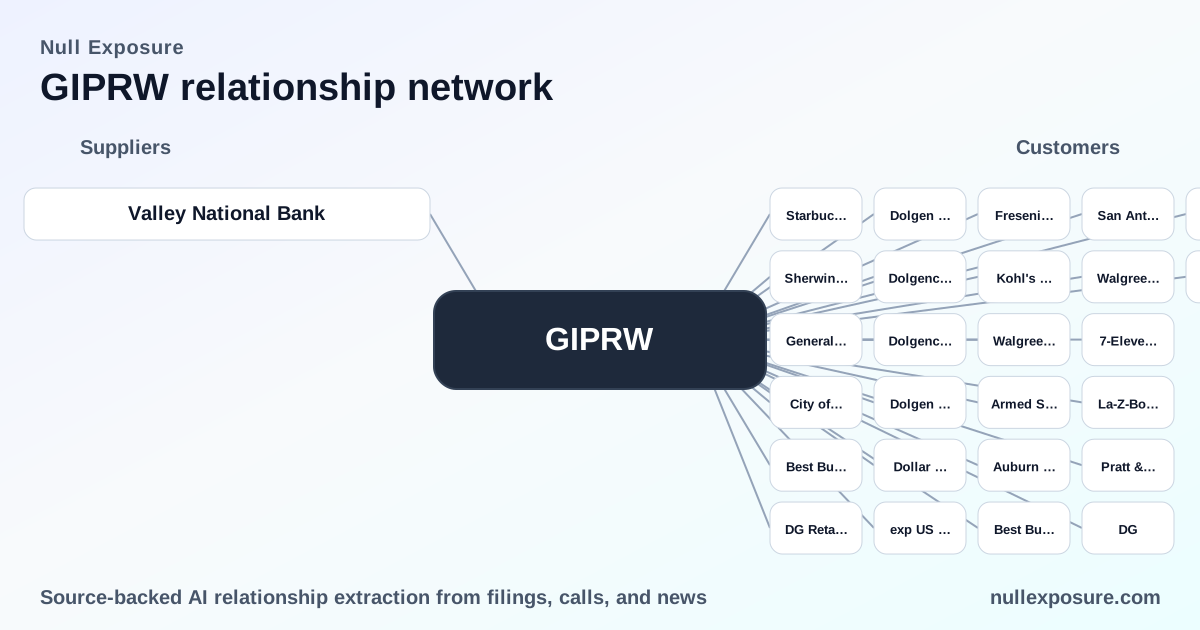
Generation Income Properties (GIPRW) — supplier relationships and what they mean for investors
Thesis: Generation Income Properties (GIPRW) is a Tampa-based REIT (the quoted instrument here is a warrant) that acquires single-tenant income-producing properties and monetizes through long-term leases and financing structures; its supplier footprint is light and centered on financing and outsourced property management, which positions the business for predictable cash flow but creates leverage and long-duration counterparty exposure that investors should monitor. For a deeper supplier map and contract-level intelligence, visit the Null Exposure homepage: https://nullexposure.com/.
How GIPRW operates and where the money comes from
Generation Income Properties acquires single-tenant assets and collects rent under long-term leases; it funds acquisitions with a mix of cash, secured lending and capital markets instruments. The public warrant ticker GIPRW references the REIT’s capital structure rather than an operating company; the operating line items show Revenue TTM roughly $9.95 million and EBITDA about $3.91 million, while profitability metrics are negative (Diluted EPS -3.399 and book value -0.721), reflecting current capital and expense dynamics. These numbers set the backdrop: rent roll provides recurring revenue, financing fills acquisition gaps, and third-party property managers handle day-to-day asset operations (company filings through the latest quarter and FY2024 10‑K).
Explore supplier-level disclosures at Null Exposure: https://nullexposure.com/.
Snapshot of the supplier relationship disclosed in filings
Valley National Bank
Valley National Bank provided a secured debt facility used to finance the cash portion of an acquisition — a $21.0 million secured lending facility that funded part of the purchase price according to Generation Income Properties’ FY2024 Form 10‑K. This is a direct financing counterparty relationship and represents a secured creditor position tied to specific acquisitions (FY2024 10‑K disclosure).
Other supplier signals pulled from the same filings
The FY2024 disclosures also flag property management outsourcing and contract characteristics that shape operating risk.
- The company previously engaged Colliers International Asset Services to provide property management services for two Norfolk, Virginia properties, confirming use of third‑party asset managers for day‑to‑day operations (FY2024 10‑K).
- The filing records approximately $49,000 paid for property management services in fiscal 2024, indicating low absolute spend on third‑party management relative to the enterprise scale (FY2024 10‑K).
- One acquired property is subject to a non‑cancelable ground lease expiring in 2084 (including probable exercise options), which demonstrates long‑term contractual obligations on the land side that affect asset economics and exit flexibility (FY2024 10‑K).
Together these excerpts create a concise supplier picture: a secured bank lender for acquisition funding, outsourced property management arrangements, modest third‑party spend, and long-duration lease encumbrances.
What the constraints imply about GIPRW’s operating model
The document-level constraints translate into actionable operating-model signals:
- Contracting posture — long-term, illiquid obligations exist (ground lease through 2084). Long-duration land leases reduce short-term cash volatility from rent roll changes but increase complexity for sale or recapitalization scenarios.
- Concentration and spend — third-party operating spend is small (sub‑$100k in FY2024), which signals limited vendor concentration risk in dollar terms but also implies the company keeps many functions in-house or maintains a lean outsourcing posture.
- Relationship roles and criticality — named service providers such as Colliers perform property management functions; these roles are operationally important but, given the low spend, are not large-scale revenue drivers for vendors and are replaceable in the short term.
- Maturity and duration — secured financing and a century‑length ground lease point to long-tenor counterparties; lenders and landlords are structurally important to liquidity and exit options.
These are company-level signals drawn from the FY2024 filings (10‑K) and are not assigned to specific counterparties unless named in the text.
Why the Valley National Bank facility matters to investors
The $21.0 million secured facility from Valley National Bank is not a routine trade payables disclosure — it is acquisition leverage. Secured bank financing implies collateralized obligations that sit ahead of equity in the capital stack for the assets pledged. With EBITDA around $3.9M and revenue near $9.95M, the incremental debt load to fund acquisitions is the primary vector where counterparty terms, covenants and collateral definitions translate directly into investor risk. The FY2024 10‑K documents the facility and the financing use.
For a full supplier and contract overview, consult Null Exposure: https://nullexposure.com/.
Practical watchlist for investors and operators
- Monitor loan covenants and the maturity profile of secured facilities; secured lenders can constrain refinancing and sale options.
- Track occupancy and tenant credit for the single‑tenant portfolio because revenue concentration drives cash flow sensitivity.
- Review ground‑lease economics and exercise options through 2084; land lease obligations affect valuation and exit timing.
- Confirm vendor continuity for property management; the low FY2024 spend implies operational switching is feasible, but relationships with managers like Colliers are material for day‑to‑day operations (FY2024 10‑K).
Bottom line: concentrated, finance‑driven supplier footprint
Generation Income Properties runs a lean supplier base focused on financing and outsourced management, with material long‑dated contractual obligations that anchor asset economics. Valley National Bank’s $21.0 million secured facility is the most consequential disclosed supplier relationship, while the engagement with Colliers and the modest FY2024 management spend indicate an operational model that is intentionally light on third‑party spend but dependent on specialized service providers when required (FY2024 10‑K). Investors should prioritize covenant language, ground‑lease mechanics, and tenant credit quality when assessing counterparty risk.
For deeper supplier-level intelligence and contract analytics, visit Null Exposure: https://nullexposure.com/.