General Mills: long-term energy contracting tightens supplier risk profile and cost base
General Mills operates as a global branded food manufacturer, monetizing through grocery retail sales of packaged food, supported by scale in supply-chain sourcing and commodity risk management. The company’s operating model relies on long-term supplier commitments and structured hedges to stabilize input costs, while channeling capital into efficiency projects that lower manufacturing unit costs across decades. For investors and supplier managers, the recent on-site energy agreement in Hannibal represents an intersection of capex-backed outsourcing and traditional buyer leverage that materially alters energy cost predictability for a major manufacturing node. Learn more about supplier relationships and exposure mapping at https://nullexposure.com/.
Why the Hannibal deal matters: a structural shift in how General Mills sources energy
General Mills signed a 25-year on-site combined heat and power (CHP) agreement that transfers energy delivery and long-term operational responsibility to an external provider while preserving local utility capacity arrangements. A quarter-century contract is the type of long-duration commitment that reduces variable energy cost risk for manufacturing but increases supplier dependency and concentration risk at the plant level.
- According to Facilities Dive (March 2026), General Mills expects the CHP arrangement to save the company more than $30 million over the life of the agreement, reflecting capitalized efficiencies and fuel-conversion benefits.
- The structure includes payments to the local utility for capacity maintenance and contractual outage/performance protections intended to keep the municipality financially whole, framing the transaction as a public–private partnership rather than a simple vendor engagement.
This transaction aligns with General Mills’ broader contracting posture—long-term agreements, active supplier engagements, and material spend buckets—discussed below.
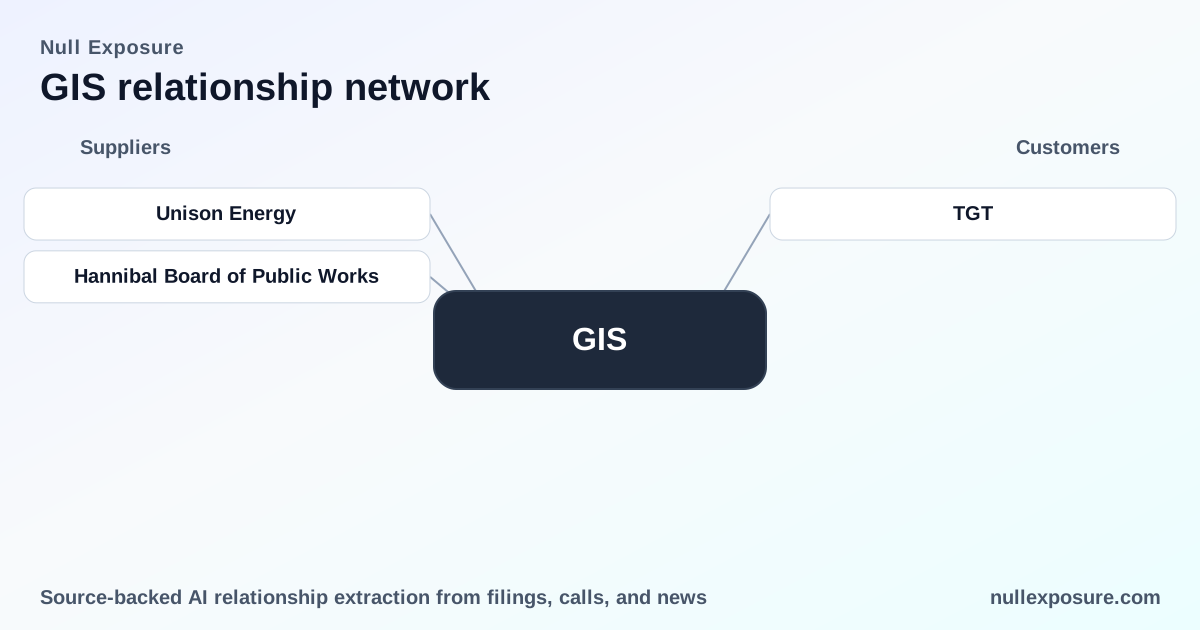
Unison Energy — on-site energy partner for Hannibal plant
Unison Energy will implement and operate the combined heat and power system under a 25-year energy services agreement, delivering on-site electricity and heat that reduces General Mills’ purchased-energy exposure and delivers projected lifecycle savings of over $30 million. According to Facilities Dive (March 2026), Unison’s role is capital- and operations-intensive, effectively outsourcing plant energy to a specialist.
Hannibal Board of Public Works — municipal counterparty in a public–private model
The Hannibal Board of Public Works will be compensated to maintain capacity and preserve local utility revenues, and contract terms include performance and outage provisions designed to protect municipal finances while enabling General Mills to secure long-term cost and environmental benefits. Facilities Dive (March 2026) frames the arrangement as a “strong example of a public–private partnership” that balances corporate efficiency with local fiscal protection.
Company-level constraints and what they signal about supplier relationships
General Mills shows several company-level signals that inform its supplier posture and the financial implications of relationships like the Hannibal deal:
- Long-term contracting posture: The company disclosed a Five-Year Credit Agreement dated October 9, 2024, and noted that it manages exposures through a mix of purchase orders and long-term supplier contracts, indicating institutional preference for extended contractual relationships (8-K filing, Oct 2024).
- Buyer role and active engagements: Disclosures referencing material purchases and contracts used within 12 months point to an active buyer stance that still leverages long-duration agreements where strategic (company filings as of May 25, 2025).
- Material spend and derivative exposure: As of May 25, 2025, General Mills reported net notional commodity derivative exposure of $227.1 million—$134.6 million tied to agricultural inputs and $92.5 million to energy—signaling significant, managed exposure to input-cost volatility and consistent hedging practices (company disclosure, May 2025).
- Balance-sheet actions consistent with scale transactions: A disclosed purchase of GMC Class A Interests for $252.8 million indicates the firm executes large, one-off expenditures where strategic control or financial return justify the outlay (company filing).
These signals together describe a company that prefers durable supplier arrangements to shift volatility off the P&L, but that also concentrates counterparty exposure and ties cash flow to long-lived contract performance.
Explore supplier-risk analytics and exposure scoring at https://nullexposure.com/ to see how similar contracts affect counterparty concentration and cost-of-goods-sold volatility.
Financial and operational implications investors must model
For investors, the Hannibal arrangement generates both immediate and long-horizon effects:
- Cost predictability: The guaranteed performance and fixed/structured pricing in a 25-year CHP contract reduces short-term earnings volatility from energy swings and improves long-run margin visibility for the Hannibal facility.
- Capital-light vs. counterparty concentration trade-off: Shifting ownership and operations of energy assets off General Mills’ balance sheet reduces operational capex but increases reliance on a single energy services provider and the local utility’s capacity guarantees—introducing operational risk that must be stress-tested in scenarios of contract breach, force majeure, or municipal funding shortfalls.
- Measured savings: The company cites more than $30 million in lifecycle savings; investors should treat that as a tangible but modest uplift relative to General Mills’ multi-billion dollar revenue base, while valuing the increased margin stability on a per-plant basis.
- Hedging alignment: The reported energy-derivative notional positions ($92.5 million) indicate General Mills already hedges energy exposure; on-site generation contracts will interact with hedge positions and require active treasury management to avoid over-hedging or basis mismatches (company filings, May 2025).
Key takeaway: the deal reduces near-term earnings volatility but increases supplier concentration risks that need active governance and contractual protections.
Risks to price and supply you should monitor
- Counterparty performance risk: Long-term operational SLAs place outsized importance on service providers’ financial health and technical execution over decades.
- Municipal-credit risk: Because the local utility is a paid counterparty for capacity, municipal budget stress or regulatory changes could alter performance incentives.
- Contract inflexibility: A 25-year term locks pricing and operational structures; favorable near-term conditions are less impactful, and unfavorable trends are harder to mitigate without renegotiation or termination penalties.
Operators should ensure robust termination clauses, performance bonds, and periodic renegotiation triggers are in place; investors should run stress-case cash flows that incorporate multi-year outage scenarios.
Clear next steps for supplier managers and investors
- Map large, long-duration contracts to plant-level P&L and counterparty concentration metrics to quantify single-point-of-failure exposure.
- Reconcile on-site energy contracts with hedging positions to avoid economic double-counting of savings or exposure.
- Require financial covenants, collateral or insurance from energy-service providers and municipal counterparts for contracts that extend multiple decades.
For a detailed supplier-exposure dashboard and counterparty risk scores that translate these documents into investment signals, visit https://nullexposure.com/.
General Mills’ Hannibal transaction is a textbook example of how multinational manufacturers trade capital commitment for operating predictability. The expected savings are real, but so is the increased reliance on specialist providers and municipal arrangements—factors investors and operators must incorporate into long-term cash-flow and operational resilience models. Learn more about supplier relationships and how they affect portfolio risk at https://nullexposure.com/.
Sources: Facilities Dive reporting on the Hannibal CHP agreement (March 9, 2026); General Mills disclosures including the Five-Year Credit Agreement (8-K filed Oct. 15, 2024) and commodity derivative notional values reported as of May 25, 2025.