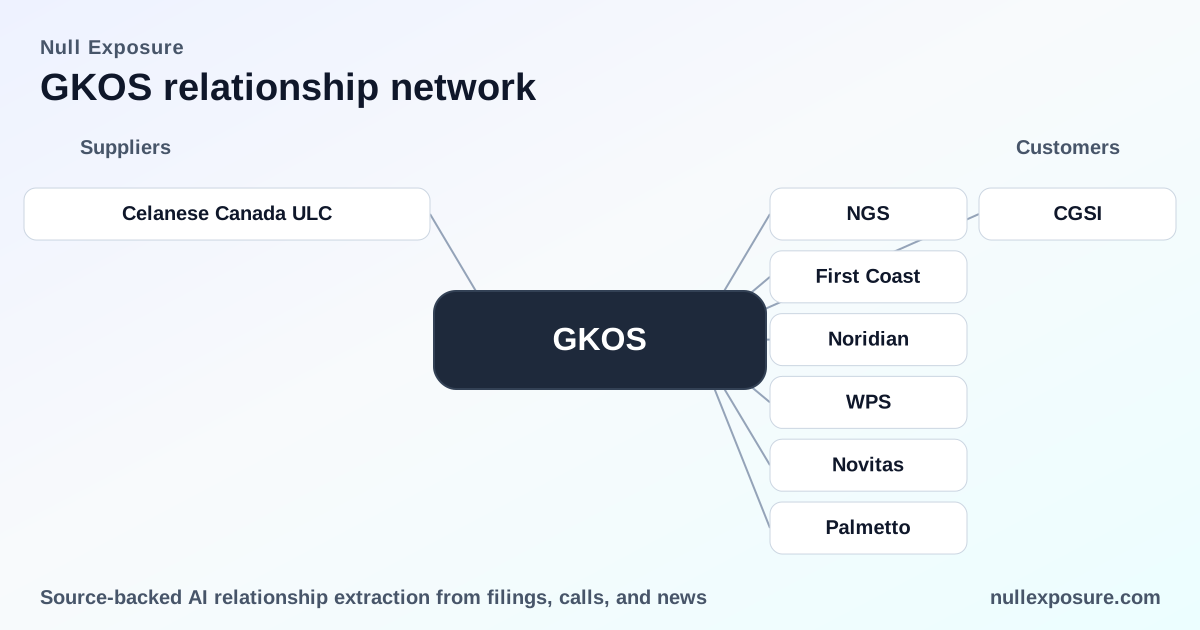
Glaukos (GKOS) — supplier posture and what the Celanese tie means for investors
Glaukos monetizes by selling implantable ophthalmic devices and associated drug-delivery products — notably the iStent family, the KXL system, Photrexa formulations, and the newer iDose TR — through a mix of in-house manufacturing and third‑party suppliers and distributors. Revenue is generated from device and drug sales, supported by global distribution channels and strategic supplier contracts that secure inputs for proprietary components such as the nanoporous membrane used in iDose TR. For investors, the combination of in‑house production plus targeted long‑term supplier agreements creates both resilience and concentrated supply risk that merits active monitoring.
Discover more supplier intelligence at https://nullexposure.com/
Why the Celanese agreement matters to the iDose TR rollout
Effective March 17, 2023, Glaukos executed a sales agreement with Celanese Canada ULC under which Celanese will supply raw materials used to manufacture the nanoporous membrane that is a core component of the iDose TR. The contract term is four years after the iDose TR launch date in February 2024, which positions Celanese as a multi‑year partner for a product line that is strategically important to Glaukos’s drug‑delivery offering. According to Glaukos’s FY2024 Form 10‑K (filed for the year ended December 31, 2024), this agreement is explicit and contractually bounded, reducing near‑term sourcing uncertainty for that component.
How to read the broader supplier signals (company‑level constraints)
Glaukos combines internal manufacturing with selective outsourcing. The FY2024 10‑K shows the company manufactures iStent and iDose TR at its San Clemente facility and operates KXL manufacturing in Burlington, MA, while contracting third‑party manufacturers in the U.S. and Germany for other formulations. At the same time, Glaukos relies on a limited number of third‑party suppliers, in some cases sole suppliers, for components across product lines — a structural concentration that increases the business impact of any supplier interruption.
Key operating characteristics to note:
- Contracting posture: The company holds multi‑year, supplier‑level contracts where component criticality is high (for example, the Celanese sales agreement for iDose TR raw materials runs four years post‑launch). These long‑term contracts signal strategic locking of inputs rather than opportunistic spot purchases.
- Concentration and criticality: Glaukos explicitly warns that supply and/or manufacturing disruptions could reduce gross margins and negatively impact operating results, indicating supplier inputs are material to product revenue and margin stability.
- Geographic footprint and logistics: Distribution is global — the company uses third‑party logistics providers across the Netherlands, Germany, the U.K., Japan, Australia, Canada and Brazil — while U.S. distribution runs from San Clemente or a third‑party DC in Memphis, Tennessee. This mixed model supports global reach but adds cross‑border logistics dependency.
- Maturity and committed spend: The company reported noncancelable, firm purchase commitments of $1.5 million due beyond one year as of December 31, 2024, which places long‑term committed spend in a modest $1–10M band. That figure suggests targeted, product‑specific commitments rather than broad, high‑value multi‑year procurement.
Together these signals describe a supplier model that is deliberate and product‑focused: Glaukos secures critical, product‑specific inputs through multi‑year agreements while retaining manufacturing capability for core devices — reducing some execution risk but retaining concentrated supplier exposure that can affect margins and supply continuity.
Explore supplier mapping and risk scoring at https://nullexposure.com/
Investment implications (concise)
- Positive: Long‑term supplier contracts for critical inputs (e.g., Celanese for the iDose membrane) reduce execution risk around initial product launches and improve forecastability of input costs and availability.
- Negative: Reliance on limited or sole suppliers across product lines creates asymmetric operational risk; even small disruptions can disproportionately affect high‑margin product shipments and near‑term earnings.
- Monitor: Purchase commitments, any expansion of the Celanese arrangement, and inventory or lead‑time disclosures in quarterly filings as forward indicators of supply resilience or strain.
The relationships we identified
Celanese Canada ULC — Effective March 17, 2023, Glaukos entered into a sales agreement with Celanese to make available and supply raw materials used to create a nanoporous membrane utilized in the iDose TR; the Sales Agreement term is four years after the iDose TR launch (February 2024). This is documented in Glaukos’s FY2024 Form 10‑K. (Glaukos FY2024 10‑K, filed December 31, 2024.)
How this set‑up changes the risk/reward calculus
Glaukos’s supplier strategy is a hybrid: retain control where volume and IP are core (in‑house manufacturing) and secure specialized raw materials via long‑dated supplier contracts where scale and uniqueness matter. That model supports disciplined margins and market rollout control but concentrates risk in a small number of critical suppliers.
For investors, the practical framework is:
- Treat long‑term supplier agreements as stability signals for product launches, reducing short‑term stocking risk.
- Treat the documented reliance on limited/sole suppliers as a latent downside to be actively hedged through monitoring of vendor performance, alternative qualification, and inventory disclosures.
- Use the noncancelable commitment figure and spend band as a relative barometer for the company’s financial exposure to these arrangements; current commitment levels are modest but product‑specific.
What to watch next and actionable steps
- Monitor quarterly filings for any amendment or expansion of the Celanese agreement or the disclosure of alternative suppliers for the iDose TR membrane.
- Watch inventory and days‑on‑hand commentary around product launches; those metrics will surface supply tightness before revenue misses.
- Check logistic partners’ footprints and any freight/lead‑time commentary in filings or earnings calls to assess the resilience of the global distribution network.
For a deeper supplier analysis and ongoing alerts on GKOS counterparties, visit https://nullexposure.com/
In sum, Glaukos has taken a pragmatic approach: lock in specialized inputs through multi‑year contracts while maintaining manufacturing control for core devices. That structure improves launch execution for products like iDose TR, but concentrated supplier relationships and modest committed spend keep supply‑chain risk front and center for active investors.