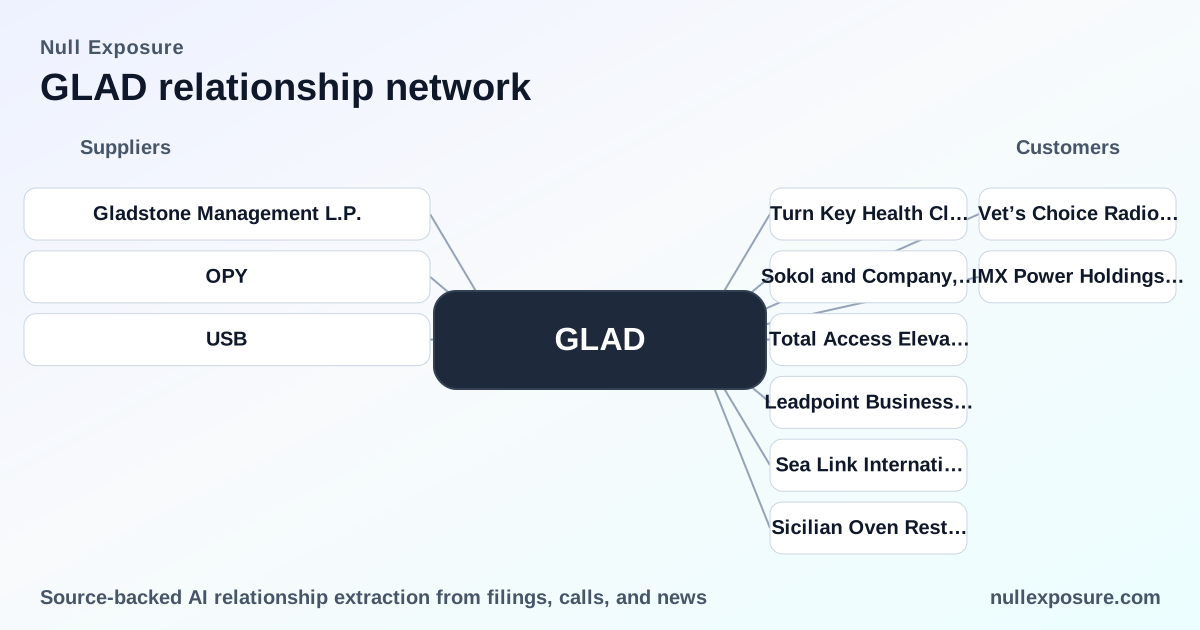
GLAD: Supplier relationships that shape capital, custody and distribution
Gladstone Capital Corporation (GLAD) is an externally managed business development company that originates and acquires senior secured loans, mezzanine debt and equity stakes in lower‑middle‑market companies and monetizes through interest, fees, realized gains and dividend distributions to shareholders while paying management and incentive fees to its adviser. Key supplier relationships — an external manager, an underwriting partner and a trustee — underpin GLAD’s capital markets access, servicing and liability management. Learn how these relationships change the risk profile and operational dependency of the firm at https://nullexposure.com/.
The three relationships that matter to investors
Below I review every supplier relationship noted in the record, with a concise plain‑English summary and source for each.
Gladstone Management L.P.
Gladstone Capital is externally managed under an agreement with Gladstone Management L.P., which runs day‑to‑day investment sourcing, credit decisions and portfolio oversight; the manager earns base management fees and incentive fees for those services. According to a MarketBeat instant alert referencing FY2026 disclosures, the firm offers senior secured loans, mezzanine debt and equity investments via that external management arrangement (MarketBeat, March 2026: https://www.marketbeat.com/instant-alerts/gladstone-capital-corporation-nasdaqglad-receives-average-recommendation-of-hold-from-brokerages-2026-03-02/).
Oppenheimer & Co. Inc.
Oppenheimer acted as the sole book‑running manager on a Gladstone Capital offering, providing underwriting and distribution services for the issuance. A Yahoo Finance press release covering the FY2025 offering confirms Oppenheimer & Co. Inc.’s role as sole book‑runner in the deal (Yahoo Finance, FY2025 disclosure: https://finance.yahoo.com/news/gladstone-capital-corporation-announces-proposed-200500711.html).
U.S. Bank Trust Company, National Association (Trustee)
U.S. Bank Trust acted as the indenture trustee for Gladstone’s debt notes and executed a notice of redemption to holders of the 2026 and 2028 notes under the relevant supplemental indentures, facilitating liability management and bondholder communications. Notices of redemption and related trustee duties are documented in press releases for FY2025 (CapeCodTimes press release and an additional Yahoo Finance notice, FY2025: https://capecodtimes.com/press-release/story/53897/gladstone-capital-announces-intent-to-redeem-all-outstanding-5125-notes-due-2026-and-775-notes-due-2028/ and https://finance.yahoo.com/news/gladstone-capital-announces-intent-redeem-200000274.html).
What the contractual and portfolio signals reveal about GLAD’s operating model
The disclosed relationships and internal constraints together outline a clear operating posture:
-
Externally managed, service‑oriented model. GLAD relies on an adviser/administrator arrangement for investment sourcing, portfolio management and back‑office services — a classic BDC structure where strategic control of investments is outsourced and the company compensates the manager via base and incentive fees. This raises operating leverage on the adviser’s competency and continuity (evidence in FY2025/2026 filings).
-
Long‑tenor capital arrangements. The credit facility language indicates long‑term borrowing capacity with a revolving period through October 31, 2027 and final maturity obligations through October 31, 2029 if not renewed, which anchors liquidity planning and refinancing risk to multi‑year horizons.
-
Concentrated transaction scale. Average investment by obligor at cost was $15.9 million as of September 30, 2025, placing most portfolio commitments squarely in the $10m–$100m spend band and implying meaningful bilateral exposure per portfolio company.
-
Geographic focus and sector mix. Investment fair values are reported by U.S. geographic regions, and the portfolio shows concentration in manufacturing (~23.6% at one point) and services/healthcare & education (~31.8%), signaling industry‑specific credit sensitivity even within a broadly U.S.‑centric footprint.
-
Active portfolio posture. As of September 30, 2025 GLAD held 54 proprietary investments with an aggregate fair value of $859.1 million, up from 47 the prior year — a signal of active deployment and reinvestment rather than a run‑off strategy.
Collectively, these elements indicate a highly active, manager‑dependent BDC with meaningful single‑obligor exposures and a medium‑term refinancing calendar that investors must monitor.
How each supplier relationship changes risk, control and distribution
-
Gladstone Management L.P. (external manager): This is a critical operational dependency — investment decisions, sourcing and portfolio monitoring are executed by the adviser, and fee flows to that adviser influence NAV performance and net returns. Any disruption or change in the advisory agreement would directly affect GLAD’s ability to execute its strategy (MarketBeat FY2026).
-
Oppenheimer & Co. (underwriter): As sole book‑runner, Oppenheimer provides distribution capacity and execution for equity/debt offerings; its effectiveness impacts GLAD’s ability to access capital on favorable terms and to limit dilution when raising funds (Yahoo Finance FY2025).
-
U.S. Bank Trust (trustee): The trustee is the operational mechanism for debt redemptions and indenture compliance; trustee actions govern bondholder communications and the mechanical execution of liability management (CapeCodTimes and Yahoo Finance FY2025).
Concentration and contractual constraints investors should prioritize
-
Contracting posture: The firm operates under long‑term credit commitments and an external management agreement, so investors must monitor covenant timelines (Revolving Period End Date October 31, 2027; final payment deadline October 31, 2029) and the adviser’s contractual incentives.
-
Concentration risk: Average obligor exposure (~$15.9m cost) and a portfolio that is actively expanding to 54 holdings indicate material per‑counterparty concentration relative to a typical diversified credit fund.
-
Criticality of suppliers: The adviser and trustee are mission‑critical — the adviser for performance and origination, the trustee for liability execution — which elevates operational risk if either relationship weakens.
-
Maturity and activity profile: An active deployment stance with rising proprietary investments signals higher near‑term capital needs and refinancing sensitivity.
If you need a deeper counterparty breakdown or monitoring dashboard tied to these supplier signals, see how our coverage frames operational counterparties and financial plumbing at https://nullexposure.com/.
Investment implications and next steps for operators and allocators
For allocators, GLAD’s structure delivers scalable yield exposure to private credit but with outsized reliance on its adviser and a medium‑term capital calendar. Underwriting diligence should focus on: adviser continuity and incentives, covenant timelines on the credit facility, and the trustee/underwriter arrangements that control redemption mechanics and capital access.
Recommended immediate actions:
- Request the latest advisory agreement amendments and fee schedule.
- Monitor upcoming debt redemption notices and the credit facility renewal window.
- Stress test portfolio NAV under scenarios of adviser turnover or a missed revolving renewal.
For deal teams and service providers, consider how contract terms and operational SLAs could be strengthened to reduce single‑vendor criticality.
Final note: GLAD’s supplier map is straightforward but consequential — the adviser, book‑runner and trustee collectively determine origination capacity, capital access and liability management. Keep these three relationships front and center in any investment or operational evaluation. Explore more supplier‑level intelligence and tracking at https://nullexposure.com/.