Global Engine Group Holding (GLE): Supplier relationships, capital posture, and what investors should know
Global Engine Group Holding Limited operates as an integrated ICT and system-integration services provider headquartered in Kwun Tong, Hong Kong. The company monetizes by contracting with enterprise and public-sector customers to deliver information and communications technology solutions, systems integration projects, and technical consultancy, converting project wins and recurring service contracts into top-line revenue. For investors, GLE is a small-cap, recently listed ICT integrator with thin margins, concentrated ownership, and vendor/legal relationships consistent with a newly public company.
Learn more about supplier and advisor relationships that shape counterpart risk and governance at https://nullexposure.com/.
Snapshot: balance sheet posture and commercial reality
Global Engine is a micro-cap public company with Market Capitalization roughly $9.9 million and TTM revenue of $23.1 million. The business shows negative profitability (TTM profit margin -25.3%, EBITDA -$5.9 million) and low institutional ownership (0.69%) alongside high insider ownership (42.75%), which drives governance concentration and founder-aligned decision-making. The share float is small (4.3 million shares) versus 13.66 million shares outstanding, producing low liquidity and amplified share-price moves on modest flows.
From an operating-model perspective:
- Contracting posture: As a systems integrator, GLE relies on project-based contracts and professional services billing—a model that emphasizes execution risk, milestone invoicing, and seasonality tied to large engagements.
- Concentration and criticality: The company’s small scale and concentrated ownership elevate counterparty and governance risk; supplier and adviser relationships are critical to access capital and manage regulatory/compliance workflows as a newly listed entity.
- Maturity: Financials and the presence of recent IPO advisors indicate an organization in transition from private to public operations, with evolving disclosure, investor-relations, and compliance obligations.
Who Global Engine hires and what those relationships signal
Below are every supplier/adviser relationship found in public releases and how each functionally affects the company.
-
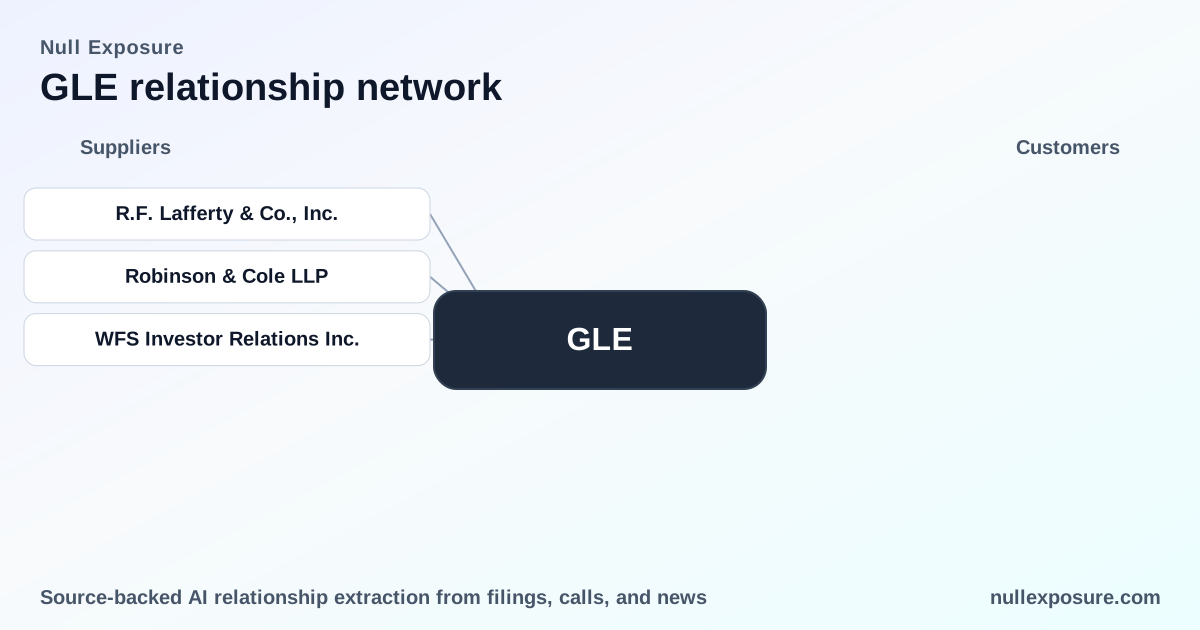
R.F. Lafferty & Co., Inc. — Sole underwriter for the IPO. The company engaged R.F. Lafferty as the sole underwriter for its initial public offering that closed in September 2024, signaling reliance on a boutique underwriter to access U.S. capital markets. According to the company’s GlobeNewswire press release dated September 23, 2024, R.F. Lafferty acted as the offering’s sole underwriter (FY2024).
Source: GlobeNewswire press release, September 23, 2024. -
Robinson & Cole LLP — U.S. counsel to Global Engine for the offering. Global Engine retained Robinson & Cole to provide U.S. legal counsel for the IPO, with Winston & Strawn LLP serving as counsel to the underwriter, establishing a standard legal support structure for cross-border listings and regulatory compliance obligations tied to U.S. securities laws. This engagement is documented in the same September 23, 2024 press release (FY2024).
Source: GlobeNewswire press release, September 23, 2024. -
WFS Investor Relations Inc. — Investor relations provider. The company lists WFS Investor Relations (Janice Wang, Managing Partner) as its investor-relations contact across multiple announcements, including the IPO closing (FY2024), the Corpotech stake acquisition notice (FY2024), and a Nasdaq minimum-bid-price deficiency notice (FY2025). WFS handles external investor communications and is a focal point for market engagement and regulatory disclosures.
Sources: GlobeNewswire press releases, December 30, 2024 and October 31, 2025 (mentions of WFS IR); also referenced in the September 23, 2024 IPO announcement.
What the relationships mean for investors: capital access, compliance, and IR signals
These relationships form a coherent corporate-services footprint for a newly public company:
- Capital access: Engaging a sole underwriter (R.F. Lafferty) for an $8 million IPO suggests a targeted capital raise strategy rather than a large, syndicate-driven market offering. That structure reduces dilution but increases reliance on a single financing intermediary for market distribution and aftermarket support.
- Compliance posture: External U.S. counsel (Robinson & Cole) alongside underwriter counsel (Winston & Strawn) demonstrates the company took the expected legal steps to satisfy cross-border listing requirements and to manage SEC/market disclosure obligations at IPO time.
- Market communications: Ongoing use of WFS Investor Relations for press distribution and investor contact signals that market-facing communications are outsourced to a boutique IR firm, which is common for small caps but concentrates messaging control outside the management team.
A company press release on October 31, 2025 also disclosed a Nasdaq minimum-bid-price deficiency notice, which is a governance and market-risk signal: the stock faced listing-standard pressure within a year of listing, making investor relations and share-price stabilization materially important.
Source: GlobeNewswire press release, October 31, 2025.
If you want a deeper supplier and advisor risk profile for GLE and comparable small-cap ICT integrators, visit https://nullexposure.com/ for modelled exposures and relationship summaries.
Risk implications tied to supplier/adviser choices
- Liquidity and market risk are elevated. The small float, limited institutional ownership, and an underwriter-led IPO increase sensitivity to retail flows and PR events.
- Execution and project risk remain core operational risks. As a systems integrator, revenue depends on successful project delivery and contract performance; external advisers do not mitigate delivery risk.
- Governance concentration drives event risk. With insiders holding over 40% of shares, control is concentrated and governance outcomes track founder priorities more than broad institutional oversight.
Investment takeaway and recommended investor actions
Global Engine is a micro-cap ICT integrator with early-stage public-market dynamics: limited capital market scale, negative margins, and concentrated ownership create both upside if growth accelerates and downside if project execution or listing standards deteriorate. The company’s supplier/adviser relationships are standard for a recent IPO—boutique underwriter, established U.S. counsel, and outsourced investor relations—but they also highlight the limited bench of capital-market partners available to a micro-cap issuer.
Key considerations for investors:
- Monitor Nasdaq compliance developments and IR releases from WFS for any remediation plans or financing activity.
- Track project win announcements and customer concentration to evaluate whether revenue growth can translate into operating leverage.
- Account for high insider ownership and low institutional coverage when assessing liquidity and governance risks.
For an actionable supplier-risk checklist and deeper counterparty mappings for GLE, visit https://nullexposure.com/ — the homepage has tools and summaries tailored for investors evaluating small-cap supplier relationships.
Overall, Global Engine’s advisor roster suits a newly public micro-cap but underscores the company’s dependence on a small set of external providers for capital access and market communications—factors investors must weigh alongside the company’s operational execution and path to profitability.