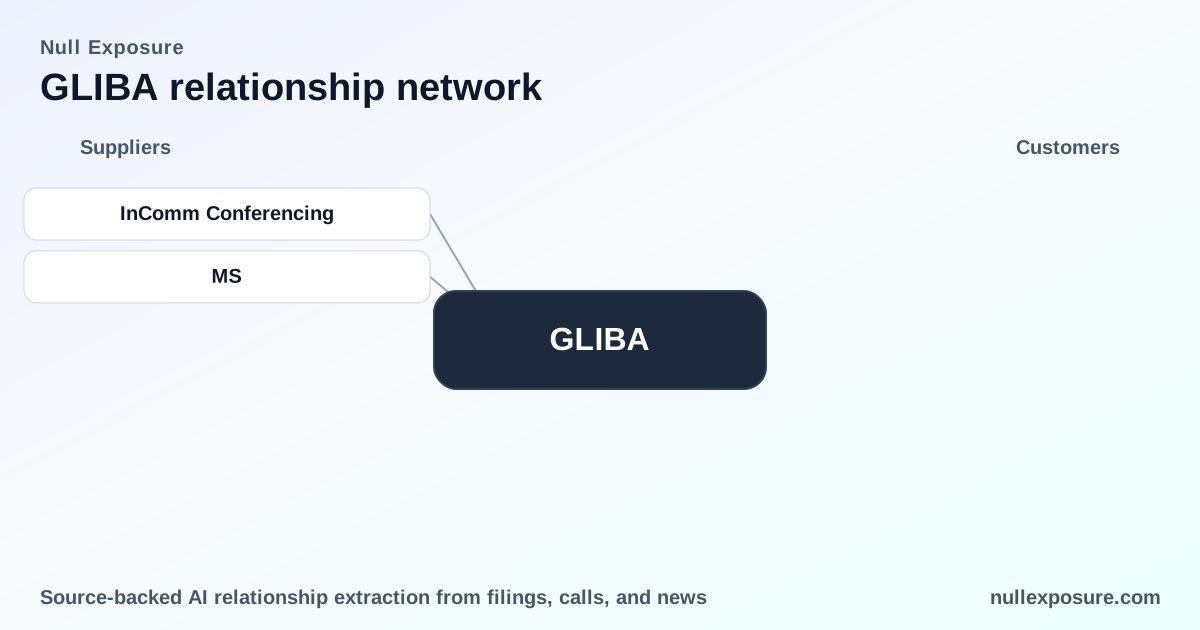
GCI Liberty (GLIBA): supplier relationships that shape operations and capital strategy
GCI Liberty operates as a vertically integrated telecommunications and media company, monetizing through subscription-based connectivity (cable and broadband), advertising and media asset licensing, and fees tied to network access and infrastructure. Revenue generation is anchored in long-term infrastructure commitments and recurring service economics, while capital raises and advisor relationships support periodic balance-sheet actions such as rights offerings. Investors should evaluate supplier relationships for operational continuity, cost concentration, and strategic control over public-company functions.
Explore further supplier intelligence at https://nullexposure.com/.
Two active supplier relationships on the public record right now
GCI Liberty’s public disclosures and press releases mention a small set of external partners tied to investor communications and capital markets activity. Below are the relationships present in recent public materials.
InComm Conferencing — investor call hosting
InComm Conferencing serviced GCI Liberty’s third-quarter earnings call logistics, with telephone access numbers and a confirmation code provided in the press release. According to the MarketScreener announcement dated March 9, 2026, InComm handled the conference call routing and access details for the event. (Source: MarketScreener, March 9, 2026)
Morgan Stanley & Co. LLC — financial advisor for rights offering
Morgan Stanley served as GCI Liberty’s financial advisor for a $300 million rights offering, indicating the company’s use of top-tier investment banking relationships to execute capital transactions. A Yahoo Finance report on March 9, 2026, identified Morgan Stanley & Co. LLC as the financial advisor for the rights offering. (Source: Yahoo Finance, March 9, 2026)
What the relationships tell investors about operating posture
These two publicly documented supplier links, while limited, reveal clear themes in how GCI Liberty organizes critical functions.
- Investor communications are outsourced to specialist vendors. The InComm conferencing engagement is a low-strategy operational vendor relationship focused on executional support for earnings calls rather than core network delivery.
- Capital-market work is executed with major banks. Using Morgan Stanley for an equity rights offering signals GCI Liberty’s reliance on established investment banks to access institutional distribution and advisory capabilities.
Company-level constraints and what they imply for supplier risk
Beyond discrete vendors, GCI Liberty’s public filings and disclosures convey structural constraints that define supplier risk and vendor management.
-
Long-term contracting posture. GCI Liberty reports future lease payments and tower obligations with initial terms of one year or more as material commitments, which indicates a procurement profile dominated by multi-year infrastructure contracts that lock in costs and counterparty exposure over time. (GCI Liberty filings, FY2025)
-
Material exposure to federal support and grants. Management warns that an extended pause in federal universal service support programs or infrastructure grants would have a material adverse effect on GCI Holdings’ business and liquidity, signaling that certain supplier and funding channels are economically critical to operations. This is a company-level materiality signal rather than a vendor-specific note. (GCI Liberty filings, FY2025)
-
Service-provider role and operational integration. GCI Liberty uses third-party service providers for legal, tax, accounting, treasury, IT, cybersecurity and investor relations functions. The company runs a third-party risk management program to evaluate cybersecurity practices for higher-risk vendors and those that touch systems or data—an explicit recognition of vendor-criticality for regulatory and operational continuity. The filings also disclose a Services Agreement under which Liberty Media provides public-company support services, and GCI Liberty reimburses out-of-pocket expenses and pays a services fee reviewed quarterly for reasonableness—pointing to deliberate operational outsourcing and cost-review governance for core administrative functions. (GCI Liberty filings, FY2025)
-
Vendor spend concentration across mid- and large-bands. Reporting on future lease and tower obligations shows spend signals in both the $10M–$100M and $100M+ bands, indicating that a material portion of supplier dollars is concentrated in infrastructure and long-lived vendor contracts rather than low-dollar transactional suppliers. Treat this as a company-level signal of capital intensity and vendor dependency. (GCI Liberty filings, FY2025)
Investment implications: what managers and investors should watch
-
Operational continuity risk is infrastructure-centric. With long-term leases and tower obligations, physical-network suppliers and landlords are critical counterparties; any disruption or renegotiation pressure could move margins and capex requirements materially.
-
Funding and grants are strategic levers. The explicit materiality tied to federal support programs makes political and regulatory developments a direct supplier-risk proxy; legislative or agency-level changes are a top-down supplier-impact vector.
-
Outsourced public-company functions concentrate counterparty risk. The Services Agreement with Liberty Media centralizes legal, tax, and investor relations workflows under a single provider, which improves efficiency but increases single-vendor operational exposure and the importance of contractual governance (quarterly fee reasonableness reviews mitigate, but do not eliminate, that exposure).
-
Capital strategy uses top-tier advisors. Engaging Morgan Stanley for a rights offering demonstrates access to institutional distribution and professional underwriting/advisory execution—supporting confidence in the company’s ability to implement capital transactions when needed.
For a deeper review of supplier ties and to monitor changes over time, visit https://nullexposure.com/.
Practical due-diligence checklist for operators and investors
- Confirm the duration and renewal terms of major lease and tower agreements; long initial terms create lock-in and refinancing considerations.
- Review the Services Agreement mechanics with Liberty Media, focusing on scope, fee-review rights, termination provisions, and data-access controls tied to IT and cybersecurity responsibilities.
- Track regulatory developments around universal service programs and infrastructure grants; shifts in funding policy translate into supplier and cash-flow risk.
- Assess bank-advisor relationships and deal history to determine the company’s capacity to execute future capital raises efficiently.
Bottom line
GCI Liberty runs a capital- and infrastructure-intensive business model supported by long-term vendor commitments and targeted outsourcing of public-company functions. The supplier map disclosed publicly is narrow but consequential: operational risk concentrates in infrastructure vendors and administrative support providers, while capital-market advisors like Morgan Stanley enable strategic financing actions. Investors evaluating GLIBA supplier relationships should prioritize contract terms, spend concentration and the resilience of funding channels.
Return to the supplier intelligence hub at https://nullexposure.com/ for ongoing updates and deeper supplier-by-supplier analysis.