Galmed Pharmaceuticals (GLMD) — supplier map and what it means for investors
Galmed Pharmaceuticals Ltd is a clinical-stage biopharmaceutical company developing therapies for liver and cardiometabolic diseases and oncology adjuncts. The company currently monetizes through licensing, strategic collaborations, and milestone-driven partnerships rather than product revenue, and its valuation and upside are tightly coupled to successful clinical milestones and the commercialization paths negotiated with specialized suppliers and partners. For a focused supplier-risk profile and continuous monitoring, see https://nullexposure.com/.
Why suppliers and partners drive Galmed's value trajectory
Galmed operates with a partner-first commercialization model: internal R&D advances candidates to inflection points, then externalizes formulation, diagnostic, and execution capabilities via licensing and strategic alliances. That structure produces several investor-relevant characteristics:
- Contracting posture: Galmed executes licensing and term-sheet agreements rather than large in-house manufacturing or broad commercial infrastructure. Supplier contracts are structured to capture development milestones and downstream royalties, reflecting a capital-light commercialization posture.
- Concentration risk: With zero reported revenue and a small market capitalization (~$4.1 million), Galmed is dependent on a limited set of specialized suppliers for key capabilities (formulation technology, companion diagnostics, trial platforms). Supplier outcomes have outsized impact on clinical timelines and value realization.
- Criticality of relationships: External partners supply mission-critical technologies — delivery systems for peptides, companion diagnostic tools, and clinical execution platforms — that directly affect regulatory and commercial pathways.
- Maturity and leverage: Galmed is early-stage; partnerships are compensatory levers for capability gaps rather than incremental vendors. Contracts are strategic instruments to convert clinical data into licensing or co-development economics.
These signals position supplier diligence as a core part of investment due diligence: evaluate contract terms, exclusivity, sublicensing rights, and milestone schedules as much as the clinical science. For a comparative supplier-risk scoring framework, visit https://nullexposure.com/.
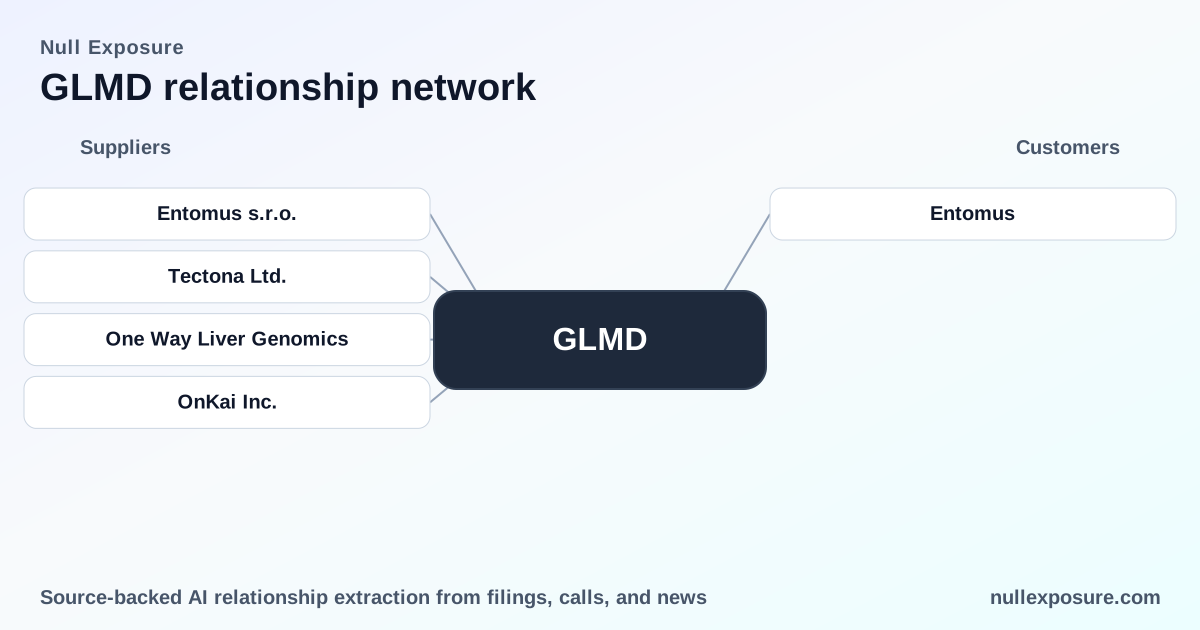
Supplier relationships on file: four active partners
Galmed’s public disclosures list four relationships that intersect with core development or commercial capability. Each relationship below is summarized in plain English with the source cited.
Entomus s.r.o. — sublingual peptide delivery license (FY2025)
Galmed signed a binding term-sheet with Entomus for a license to develop and commercialize a Self-Emulsifying Drug Delivery System (SEDDS) enabling sublingual absorption of GLP‑1 peptides such as semaglutide and liraglutide, positioning Galmed to extend its formulation toolkit for peptide-based indications. This was announced in a PR Newswire release dated March 2026: https://www.prnewswire.com/news-releases/galmed-signed-term-sheet-for-the-development-of-novel-semaglutide-sublingual-formulation-302439641.html.
Tectona Ltd. — specialist manager for advisory and execution (FY2025 reporting)
Galmed has engaged a specialist manager, Tectona Ltd., for advisory and execution services connected to its oncology combination programs, enhancing trial execution and data commercialization capabilities. Coverage of the engagement appeared in a market report dated November 17, 2025: https://ts2.tech/en/galmed-pharmaceuticals-glmd-soars-on-new-cancer-drug-combo-data-what-todays-breakthrough-means-for-investors-november-17-2025/.
One Way Liver Genomics — companion diagnostic collaboration (FY2020)
Galmed entered a licensing and share purchase agreement with One Way Liver Genomics to develop a non‑invasive, blood‑based companion diagnostic for Aramchol, supporting patient selection and regulatory positioning for the asset. The agreement is referenced in a pharmaceutical industry pipeline analysis covering the NASH market (noting the FY2020 arrangement): https://www.pharmaceuticalonline.com/doc/analysis-of-the-non-alcoholic-steatohepatitis-nash-drug-pipeline-market-sizing-up-the-first-wave-0001.
OnKai Inc. — clinical trial platform partnership (FY2023)
Galmed formed a strategic partnership with OnKai to leverage OnKai’s platform for future clinical trials, expressly aimed at strengthening trial readiness and operational capacity ahead of next-stage studies. This partnership was publicly announced via PR Newswire in 2023: https://www.prnewswire.com/news-releases/galmed-pharmaceuticals-forms-a-strategic-partnership-with-onkai-301816388.html.
What these relationships collectively tell investors
The four relationships form a coherent strategic pattern: Galmed outsources specialized, high-value capabilities—formulation science (Entomus), clinical and commercial execution (Tectona, OnKai), and diagnostics (One Way). This pattern translates into concrete business-model implications:
- Value capture is license- and milestone-driven. Each partner contributes a discrete, monetizable capability that enables Galmed to extract licensing value or de-risk assets ahead of larger transactions.
- Operational dependency is high but targeted. Dependencies are concentrated on a few counterparties that supply unique technical or executional competencies rather than commodity services.
- Time-to-value is partner-dependent. Clinical readouts and regulatory filings rely on partner performance; delays or failures at the supplier level will directly affect Galmed’s cash runway and valuation trajectory.
Midway through an investment thesis, attention must be paid to contractual details: exclusivity windows, termination triggers, IP ownership and sublicensing rights, milestone definitions, and commercial royalty schedules. For ongoing tracking of supplier events and contract filings, see https://nullexposure.com/.
Constraints and company-level supplier signals
No explicit supplier constraints were listed in the public relationship data set, which itself is informative. Company-level signals that investors should model into risk frameworks include:
- Zero reported revenue and negative EPS indicate Galmed depends on external financing and partner milestones for liquidity events.
- Small market capitalization and low institutional ownership (market cap ~ $4.1M; institutional ownership ~3.4%) increase sensitivity to single-counterparty shocks and raise the importance of legal protections in contracts.
- Clinical-stage maturity elevates the strategic role of suppliers: they are not vendors but de facto co-developers whose technical IP and execution materially affect regulatory pathways.
These signals require investors to emphasize counterparty credit, contract enforceability, and timeline contingencies in valuation and risk models.
Investment implications and what to watch next
For investors and operators evaluating GLMD supplier risk, prioritize the following:
- Track milestone schedules for the Entomus SEDDS license and the One Way diagnostic workstream; these are high-leverage value inflection points.
- Obtain clarity on exclusivity and downstream royalty economics in the Entomus and One Way agreements; those terms determine the share of future commercial economics captured by Galmed.
- Monitor operational performance and deliverables from Tectona and OnKai against clinical timelines; execution slippage directly compresses optionality.
Galmed’s strategy of leveraging specialized partners creates a capital-efficient path to de-risking assets, but it also concentrates execution risk in a handful of suppliers. Investors should balance upside from successful partnership milestones with the counterparty and timeline risks inherent to an outsourcer model. For a supplier-focused surveillance solution and alerts on contract events, visit https://nullexposure.com/.
Bold takeaways: Galmed is partner-dependent by design; its near-term valuation catalysts are supplier-driven milestones; contract economics and execution cadence determine whether those catalysts convert into value.