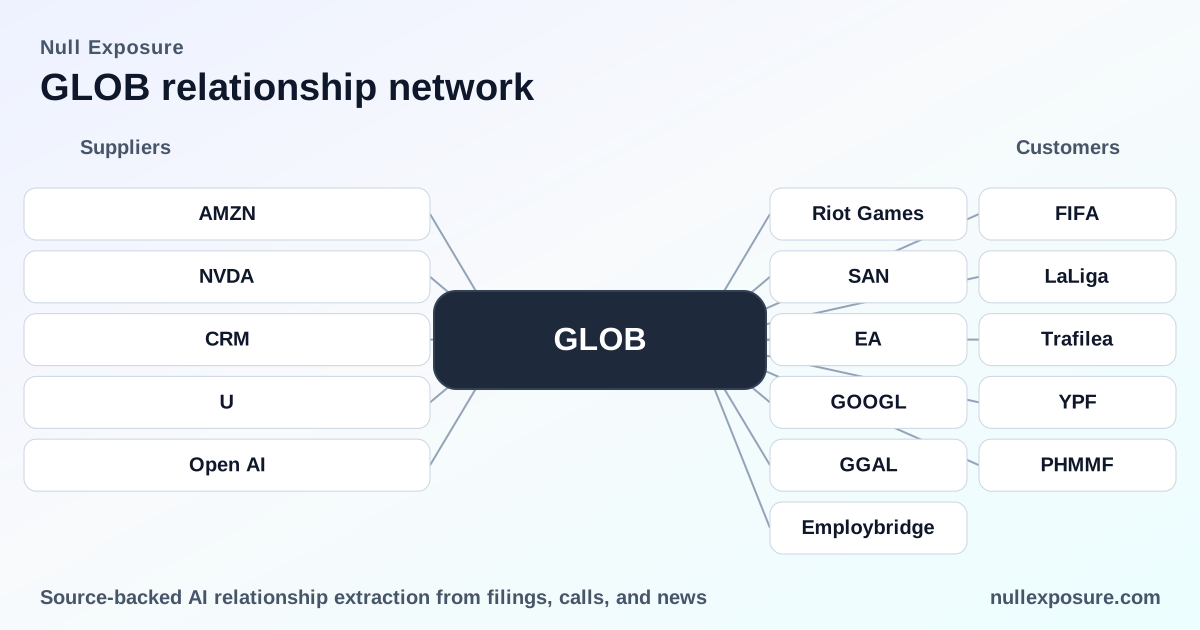
Globant (GLOB) — Supplier relationships and platform dependencies investors should price
Globant is a digital-native technology services firm that monetizes by selling transformation programs, platform integrations, and managed engineering services to large enterprises; revenue is generated through project and recurring service contracts, augmented by productized IP and platform partnerships. Investors should treat Globant as a services-led growth company whose margin and growth trajectory is increasingly tied to strategic vendor certifications and AI/cloud partnerships. Explore supplier and partner exposures and implications at https://nullexposure.com/.
How Globant makes money and why suppliers matter
Globant operates as a professional services and engineering organization: it sells consulting-led transformation, software engineering engagements, and platform enablement to enterprise clients. Revenue of roughly $2.45 billion (TTM) and an EBITDA of $393.6 million show scale with service profitability; operating margin sits near 19% while net profit margin is modest at ~4.2%, reflecting reinvestment in talent and capability buildout (latest quarter 2025-12-31 market data). These unit economics make large technology partnerships important — they both expand addressable projects and shorten delivery times by reusing platform-specific accelerators.
Partnerships with cloud, AI and platform vendors are an operational lever: they provide go-to-market credibility, access to co-sell channels, and technical accelerators that convert sales opportunities into billable work faster. For procurement and investor diligence, partner certifications are an operational signal of capability and of potential vendor concentration on future projects. Learn more about supplier-level exposure at https://nullexposure.com/.
Platform partnerships underpin solution delivery
Globant emphasizes alliances with major cloud and AI platform providers as central to its delivery model. Recognition from platform vendors is a commercial asset: it speeds client approvals, enables co-marketing, and supports premium pricing on integration-heavy work. The firm’s recent third-party recognitions therefore translate directly into sales velocity for cloud and AI transformation programs.
A mid-article reminder: assess partner-level SLAs and co-sell dependencies when underwriting deal pipelines — see https://nullexposure.com/ for supplier relationship analytics.
Relationship specifics you need to know
Below are the supplier and partner relationships surfaced in recent reporting. Each entry contains a concise, plain-English summary and a source reference.
-
AWS (AMZN): Globant lists AWS as a global partner used to combine cloud capabilities with its delivery offerings, indicating active integration and likely use of AWS infrastructure and services to deliver client solutions. Source: company partner statement cited in a press summary dated 2025-12-02 (SahmCapital).
-
NVIDIA (NVDA): Globant identifies NVIDIA as a global partner, signaling engagement around AI infrastructure, GPU-accelerated workloads, or model deployment frameworks aligned with enterprise AI projects. Source: partner statement in the 2025-12-02 coverage (SahmCapital).
-
Salesforce (CRM): Globant was recognized by Salesforce for achieving expert-level implementation in MuleSoft Anypoint, Data Cloud and Agentforce — the highest Salesforce Solution Partner distinction — confirming deep integration capability on enterprise CRM, integration, and data platforms. Source: Salesforce recognition reported on 2025-12-02 (SahmCapital).
-
Unity (U): Globant lists Unity among global partners, reflecting capabilities in real-time 3D experiences and interactive product engineering that support digital experience and metaverse-type client engagements. Source: partner statement in the 2025-12-02 coverage (SahmCapital).
-
Open AI (no ticker): Globant cites a global partnership with OpenAI, indicating incorporation of generative AI models and related tooling into client solutions and commercial offerings. Source: company partner statement referenced on 2025-12-02 (SahmCapital).
Company-level constraints and operating model signals investors should price
There are no explicit constraints called out in the relationship payload, so evaluate company-level signals from the reported financial and ownership profile:
-
Contracting posture: Globant’s economics reflect a mix of project-based engagements and recurring managed services, implying revenue variability tied to new client wins and upsells. Quarterly revenue growth was negative year-over-year (-4.7%) while quarterly earnings grew +9.5%, a pattern consistent with operational leverage and margin recovery rather than accelerating top-line expansion (latest quarter 2025-12-31 market data).
-
Concentration and ownership: Institutional ownership is reported at a high figure (112.2%), which is anomalous but signals significant institutional interest; insider ownership is low (~2.7%). These capital-structure signals matter for liquidity and takeover defensibility but require verification against filings.
-
Criticality and vendor maturity: The firm’s recognition by established platform vendors (Salesforce, AWS, NVIDIA, Unity, OpenAI) is a maturity signal for delivery competency. Platform certifications are a competitive moat for integration-heavy work but also create commercial exposure when platform roadmaps change.
-
Financial maturity: Valuation multiples (EV/EBITDA ~5.9, Forward P/E ~7.1 vs Trailing P/E ~19.4) indicate the market is pricing near-term earnings inflection while implying moderate EV leverage; treat margin expansion expectations as central to upside.
Risk and opportunity synthesis for investors and procurement teams
-
Opportunity: Certified platform partnerships accelerate deal conversion and enable higher-margin, productized services around AI and data platforms. Recognition from Salesforce and declared partnerships with AWS, NVIDIA, Unity and OpenAI increase the company’s addressable market for AI-enabled transformation.
-
Risk: Platform dependency and integration concentration create operational sensitivity — changes in partner pricing, licensing terms, or technical direction can compress margins or prolong delivery timelines. Recent negative revenue growth is an execution signal investors must monitor.
-
Governance/operational focus: Procurement should validate multi-vendor delivery capabilities and ensure client contracts do not tie execution to a single platform supplier.
What investors and operator teams should do next
- Track partner-level certifications and co-sell pipeline as leading indicators of revenue acceleration.
- Require procurement-level clauses that secure access to underlying cloud resources and avoid single-vendor lock-in in large engagements.
- Monitor quarterly revenue trends relative to margin expansion; margin recovery without top-line growth warrants investigation into demand sustainability.
For more supplier-focused intelligence and actionable relationship analytics, visit https://nullexposure.com/.
In closing, Globant’s supplier ecosystem is a strategic asset that underwrites its AI and cloud delivery narrative but introduces vendor exposure that investors must actively price. Procurement and investment diligence should prioritize partner SLAs, certification sustainment, and the company’s ability to convert platform recognition into repeatable, high-margin revenue. For tailored supplier risk analysis and ongoing monitoring, go to https://nullexposure.com/.