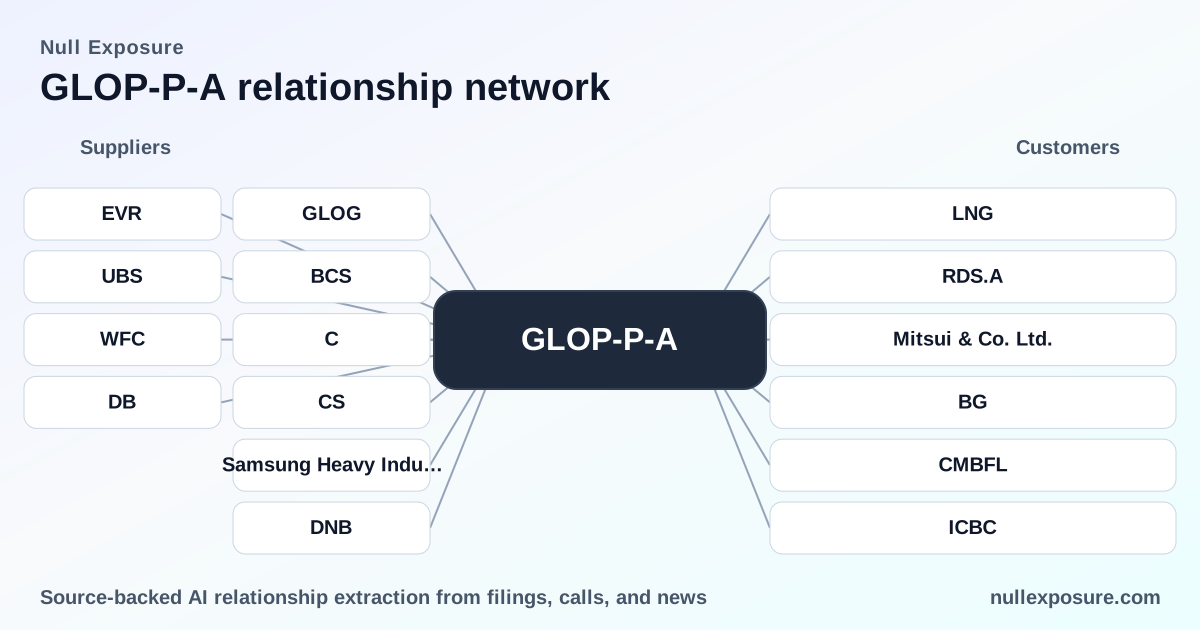
GasLog Partners (GLOP-P-A): Sponsor-driven fleet growth and yield-first monetization
GasLog Partners LP’s Series A preference units (ticker: GLOP-P-A) provide investors with cumulative fixed-to-floating dividends backed by a partnership whose growth and cashflow engine is affiliated vessel acquisitions and long-term charters. The Partnership monetizes through ownership of LNG carriers that generate contracted charter revenues, and it grows primarily via drop-down purchases and share acquisitions from sponsor GasLog Ltd, creating a sponsorship-dependent pipeline that supports distributions to preferred holders.
For a concise, relationship-focused diligence package and structured supplier mapping, visit https://nullexposure.com/ for the full vendor and counterparty view.
How the supplier network drives the partnership’s economics
GasLog Partners’ operating model is sponsor-led and asset-centric: the Partnership acquires vessels (often from GasLog Ltd) and then monetizes those assets through time-charters to energy majors and spot markets. This results in a contracting posture that is deal-driven and capital-intensive, with strategic dependencies on (1) the sponsor for drop-down inventory, (2) shipbuilders for vessel renewal and expansion, and (3) investment banks for capital markets access. Concentration is material — a small set of counterparties and the sponsor dominate the Partnership’s growth vector — and the overall maturity profile is typical of midstream shipping: long-lived assets financed through a mix of equity and public offerings.
No explicit constraints or supplier-level limitations are listed in the available relationship data, which itself is a company-level signal that public reporting emphasizes transactions and capital markets arrangements rather than restrictive supplier covenants.
Deal-by-deal read: every relationship in the public record
Below are the individual relationships pulled from public reporting and industry coverage; each entry includes a plain-English summary and the cited source.
GasLog Ltd — LNG Industry (April 2015)
GasLog structured long charters so specific vessels would be eligible for an eventual drop-down into GasLog Partners, giving the Partnership three years to exercise purchase options at fair market value. This highlights the sponsor-to-partnership transfer mechanism that underpins growth (LNG Industry, FY2015).
GasLog Ltd — LNG Industry (June 2015)
GasLog Partners agreed to buy 100% of the shares in three LNG vessels (Methane Alison Victoria, Methane Shirley Elisabeth and Methane Heather Sally) from GasLog, reinforcing the sponsor dropdown play as a repeatable expansion tactic (LNG Industry, FY2015).
GasLog Ltd — VesselFinder (FY2019)
GasLog Partners entered an agreement to purchase the entity owning and chartering the GasLog Glasgow for $214 million, an example of the Partnership acquiring single-asset vehicles from its sponsor to consolidate cashflow (VesselFinder, FY2019).
GasLog Ltd — MarineInsight (FY2019)
Both Boards and the Conflicts Committee approved the acquisition of GasLog Glasgow from GasLog Ltd, illustrating governance steps taken when affiliated-party transactions occur and the formal approvals that accompany major sponsor drops (MarineInsight, FY2019).
GasLog — VesselFinder (FY2018)
GasLog Partners arranged to acquire the Methane Becki Anne, which had been on charter to Shell, showing the Partnership’s role in taking over commercially productive assets from sponsor entities (VesselFinder, FY2018).
Samsung Heavy Industries — MonacoLife (FY2018)
GasLog Ltd contracted Samsung Heavy Industries for a new-build 180,000 cubic metre LNG carrier (XDF propulsion), slated for delivery in 2019, indicating the sponsor’s capex program and the supply chain counterpart that underpins fleet renewal (MonacoLife, FY2018).
Citigroup Global Markets Inc. — MarineLink (FY2014)
Citigroup acted as a joint book-running manager for a Partnership offering, evidencing the use of major investment banks to underwrite and distribute equity or debt that funds vessel acquisitions (MarineLink, FY2014).
Credit Suisse Securities (USA) LLC — MarineLink (FY2014)
Credit Suisse was a joint book-running manager on the same offering, underscoring syndicate participation from bulge-bracket banks in GasLog Partners’ capital raises (MarineLink, FY2014).
Wells Fargo Securities, LLC — MarineLink (FY2014)
Wells Fargo served as a joint book-runner for the Partnership’s offering, contributing to distribution breadth and placement capability in equity markets (MarineLink, FY2014).
Barclays Capital Inc. — MarineLink (FY2014)
Barclays acted as a joint book-runner on the transaction, further demonstrating the syndication strategy used to finance asset growth (MarineLink, FY2014).
Evercore Group L.L.C. — MarineLink (FY2014)
Evercore participated among the joint book-running managers, reflecting advisory and underwriting roles employed in the Partnership’s market access (MarineLink, FY2014).
UBS Securities LLC — MarineLink (FY2014)
UBS served as a joint book-runner, adding to the roster of global banks supporting the Partnership’s capital transactions (MarineLink, FY2014).
Deutsche Bank Securities Inc. — MarineLink (FY2014)
Deutsche Bank participated as a co-manager on the offering, indicating additional distribution support from European investment banks (MarineLink, FY2014).
DNB Markets, Inc. — MarineLink (FY2014)
DNB Markets acted as a co-manager alongside global banks, showing regional capital markets involvement in the Partnership’s financing strategy (MarineLink, FY2014).
What this network means for investors
- Sponsor concentration is the single most important operational characteristic: multiple entries show GasLog Ltd as the originator of assets that the Partnership acquires. That creates a reliable pipeline for growth but also raises related-party governance and execution risk.
- Capital markets access is institutionalized: a broad syndicate of major banks served as book-runners and co-managers for public offerings, which supports liquidity and capital raising capability for large transactions.
- Shipbuilding and capex dependencies are strategic: relationships with shipyards such as Samsung Heavy Industries are critical for fleet renewal and long-term competitiveness.
Key investor takeaways: preferred-unit holders benefit from predictable, asset-backed cashflows, but those benefits are conditional on the sponsor’s willingness and ability to execute drop-downs, access to capital markets, and the broader LNG shipping cycle.
For an expanded supplier map and transaction-level diligence tied to your portfolio's exposure, start here: https://nullexposure.com/.
Risk checklist for operators and portfolio managers
- Sponsor-related governance: affiliated transactions require transparent conflicts committee processes and fair valuation mechanics.
- Capital markets dilution/refinancing: dependence on underwriters and syndication increases sensitivity to market windows.
- Capex and delivery risk: new-build schedules with shipyards can shift the Partnership’s growth timing.
Bottom line: GLOP-P-A is a yield vehicle underwritten by an asset roll-up strategy from GasLog Ltd and supported by institutional underwriters and shipbuilders; investors should treat sponsor drop-downs and capital markets access as the primary operational levers that drive return and risk.
For partner-level monitoring and to subscribe to vendor alerts for GasLog Partners, visit https://nullexposure.com/ for continuous coverage and supplier relationship analytics.