Global Partners LP (GLP): Supplier relationships that move the terminals — and the cash flow
Global Partners LP operates an integrated midstream and marketing business: it buys, stores, blends and distributes refined petroleum products, owns and leases terminals and retail sites, and monetizes through wholesale margins, terminalling/storage fees and retail fuel and convenience operations. With roughly $18.6 billion of trailing revenue and a $1.6 billion market cap, GLP scales returns by layering asset-backed cashflow (terminals and storage) over variable trading and retail margin. For investors and operators, the supplier and counterparty map tells you where supply optionality, operational criticality and renewal risk concentrate. Learn how these relationships shape risk-adjusted yield at https://nullexposure.com/.
Why supplier relationships matter for GLP's return profile
GLP's economic model combines fixed-asset cash generation from terminals and retail with variable margin from physical trading and branded retail. That hybrid means supplier and terminal counterparties are both operationally critical and strategically fungible: a supply interruption can hit throughput and retail margins, while opportunistic acquisitions and branded supply deals expand cash yields.
Key company-level signals from GLP’s filings and reporting:
- Contracting posture is mixed — the business runs both spot and long-term supply and transport contracts, giving flexibility to capture arbitrage while retaining committed capacity. This mix supports trading upside and exposes the company to price volatility and counterparty credit exposure (per GLP’s FY2024 Form 10‑K).
- Global sourcing is standard: products are sourced from the U.S., Canada, South America, Europe and occasionally Asia, creating a broad supplier universe but also exposure to cross-border logistic complexity.
- Heavy reliance on third‑party transport and terminals makes service providers operationally critical; GLP uses marine, pipeline, rail and truck providers and leases terminalling capacity that expires on staggered schedules.
- Contract renewals are a near-term consideration: several lease and terminalling agreements are scheduled to expire through 2028, signalling renewal and replacement risk that can affect storage availability and costs.
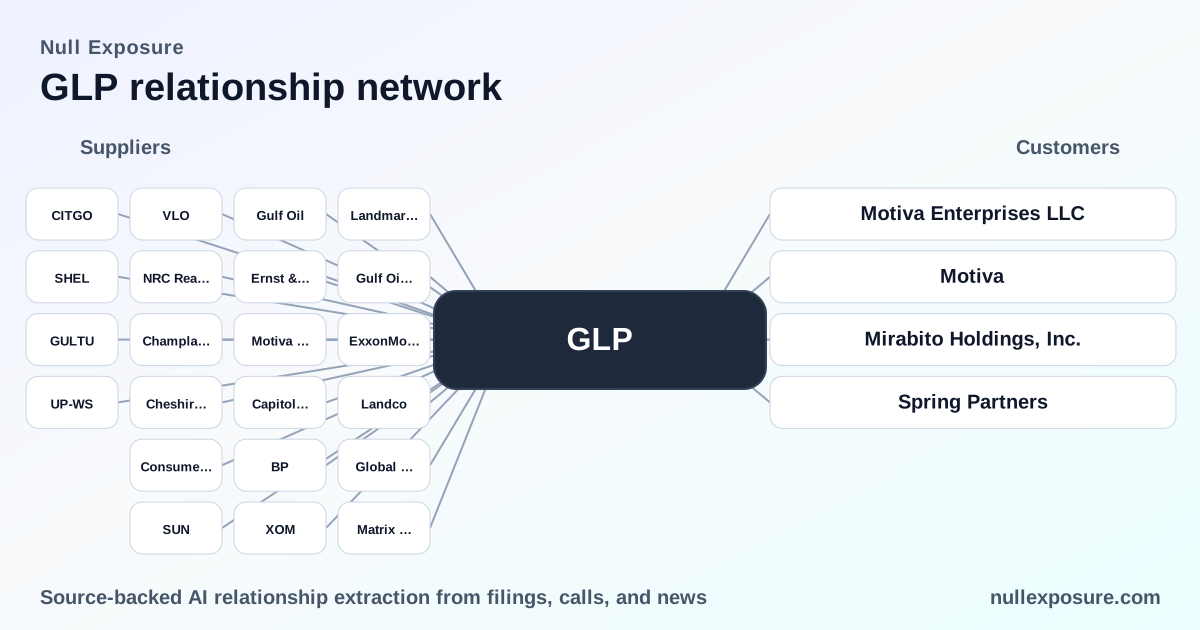
Deep-dive mapping of counterparties follows; the list below documents every referenced supplier and related relationship disclosed in the public results.
Deal-by-deal: every supplier and counterpart you need to know
- Landmark Industries, LLC — GLP disclosed purchasing a portfolio of 64 Houston-area convenience and fueling facilities from Landmark on June 1, 2023, expanding its retail footprint in a high-throughput U.S. market, per GLP’s FY2024 Form 10‑K.
- Gulf Oil Limited Partnership — GLP acquired four refined-product terminals from Gulf Oil on April 9, 2024 (Chelsea MA, New Haven CT, Linden NJ and Woodbury NJ) under a purchase agreement, according to the FY2024 10‑K.
- ExxonMobil Oil Corporation — On November 1, 2024 GLP closed the purchase of a liquid energy terminal in East Providence, Rhode Island from ExxonMobil, as disclosed in GLP’s FY2024 10‑K.
- Landco — A joint venture was formed to invest in Everett Landco, LLC, created to acquire specified real estate from ExxonMobil (an Everett, MA terminal), referenced in the FY2024 10‑K.
- Global Petroleum Corp. — GLP has long leased a large Boston Harbor terminal from Global Petroleum; the facility was reported to hold ~2.1 million barrels of refined product storage, per a Fuels Market News report (2015).
- Matrix Private Equities Inc. — Matrix provided M&A advisory and valuation services to GLP in a transaction involving Warren Equities/Xtra‑Mart, according to CSP Daily News coverage (2015).
- Gulf Oil (offshore-technology report) — Industry reporting noted GLP closed a $212.3 million acquisition of four liquid energy terminals from Gulf Oil, a material terminals transaction highlighted in press coverage (Apr 2024).
- Ernst & Young LLP — EY maintained a relationship with GLP historically; Jamie Pereira was a key partner on GLP’s account while at EY, per a CityBiz announcement (2021), reflecting long-standing auditor/consulting familiarity.
- Motiva Enterprises — Press reporting indicated GLP acquired 25 liquid energy terminals from Motiva, representing a significant terminal consolidation event reported in industry coverage (Apr 2024).
- Capitol Petroleum Group — GLP agreed to purchase 97 Mobil- and Exxon-branded gas stations from Capitol Petroleum, according to a company press release cited in CarWash.com (2015).
- Gulf Oil Limited Partnership (Rigzone) — Rigzone also covered the $212.3 million closing of four terminals bought from Gulf Oil, corroborating the transaction reported in GLP filings and trade press (Apr 2024).
- ExxonMobil Oil Corporation (MobilityPlaza) — MobilityPlaza reported completion of the East Providence terminal acquisition from ExxonMobil, aligning with GLP’s 10‑K disclosure (2024).
- NRC Realty & Capital Advisors LLC — NRC was engaged to handle the sale of 24 New York retail stores for GLP, per CSP Daily News reporting (2019), indicating use of external brokerage for portfolio dispositions.
- Champlain Oil Company — GLP announced an agreement to acquire retail fuel and convenience assets from Champlain Oil in Vermont and New Hampshire, reflecting targeted geographic retail consolidation (Fuels Market News, 2018).
- Cheshire Oil Company, LLC — GLP signed to purchase 10 company-operated gas stations and convenience stores from Cheshire Oil, cited in fuels-industry reporting (2018).
- Consumers Petroleum of Connecticut Inc. — GLP completed the purchase of retail and convenience-store assets that included 26 Wheels stores in Connecticut, per CSP Daily News (2022).
- BP — GLP markets fuel through major brands, including BP, alongside its Xtra Fuels platform, as covered in CSP Daily News industry reporting (2015).
- Exxon (brand) — GLP also markets product under Exxon/Mobil brands in certain retail agreements, per CSP Daily News (2015).
- Mobil — See Exxon/Mobil note: GLP distributes fuel through Mobil-branded outlets in addition to proprietary locations, per the 2015 coverage.
- Valero — GLP’s retail channel includes Valero-branded sales in partnership arrangements, according to CSP Daily News (2015).
- Sunoco — GLP sells under Sunoco branding in parts of its retail portfolio, per the same industry reporting (2015).
- CITGO — CITGO-branded marketing relationships are reported among GLP’s brand mix, per CSP Daily News (2015).
- Shell — GLP distributes through Shell-branded retail as part of its multi-brand marketing strategy, per the 2015 report.
- Gulf (brand) — In addition to asset purchases from Gulf Oil entities, GLP markets product under the Gulf banner in certain markets, reported in CSP Daily News (2015).
- Wheels — The Wheels retail banner figures in GLP’s Connecticut retail assets (26 stores), per CSP Daily News (2022).
What the relationship map says about operating constraints and maturity
GLP runs a mature, transaction-driven growth model that blends asset-backed acquisitions with brand and supply partnerships. From the evidence:
- Contract mix (spot vs long-term): GLP explicitly uses both spot and long-term agreements for supply and transport, enabling arbitrage capture while retaining committed capacity for retail and terminalling — a deliberate tradeoff between volatility and throughput security.
- Counterparty scale and credit posture: GLP deals with very large counterparties and major financial institutions as clearing brokers for derivatives and trading; this indicates institutional counterparties and advanced credit/clearing relationships underpin trading activity.
- Geographic sourcing and complexity: Sourcing from multiple continents increases optionality but raises logistics and counterparty diversity requirements.
- Renewal and concentration risk: Several leases and terminalling agreements are scheduled through 2028, making contract renewals and replacement capacity a short-to-medium-term operational risk that investors should monitor.
If you want a concise risk map tied to GLP’s financials and counterparties, explore our supplier-risk insights at https://nullexposure.com/.
Investor implications and next steps
- Growth via acquisition of terminals and retail is GLP’s primary lever to expand stable cashflow; recent Motiva and Gulf purchases materially increase storage/throughput capacity.
- Operational dependency on third-party transport and lease renewals creates concentrated execution risk through 2028; diligence on lease renewal terms and counterparty credit is essential.
- Brand diversification and retail deals reduce single-brand dependence but increase integration complexity across acquired portfolios.
For investors and operators evaluating GLP counterparty exposure, the priority actions are simple: review the FY2024 10‑K lease schedules and examine counterparty credit profiles for GLP’s clearing brokers and large terminal sellers. To get an executive-ready supplier risk briefing, visit https://nullexposure.com/ for tailored analysis.
Bottom line: GLP’s supplier network combines scale, optionality and near-term renewal risk — attractive for yield-driven investors if execution on integrating acquired terminals and managing lease renewals remains disciplined.