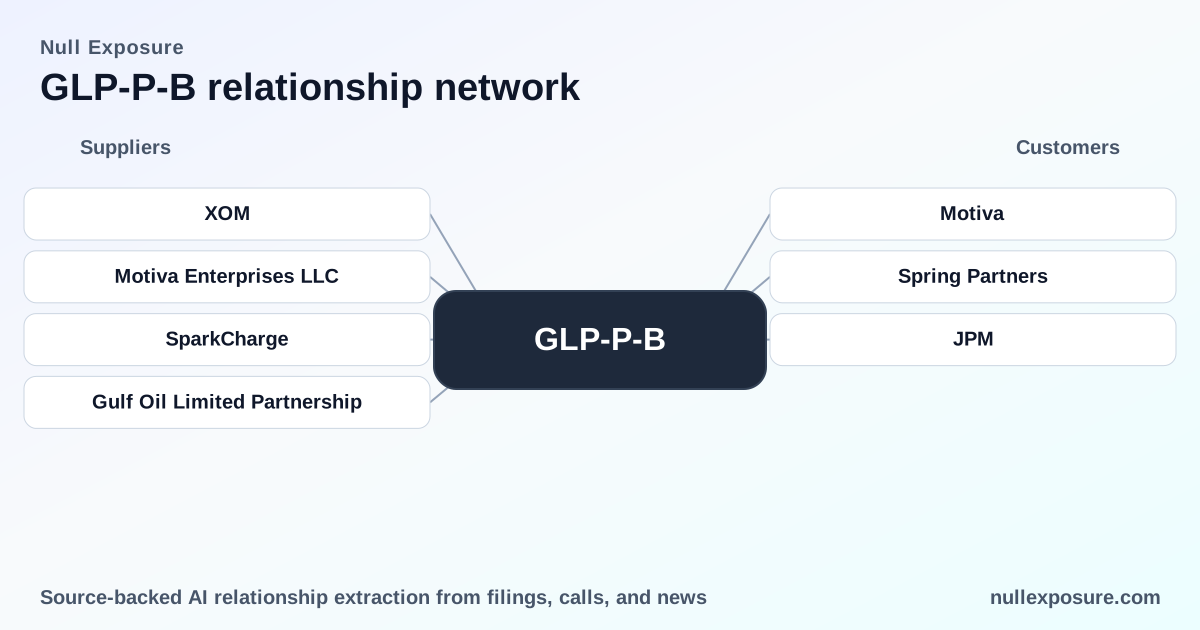
GLP-P-B: Supplier relationships show an asset-heavy play backed by strategic terminal acquisitions and EV partnerships
GLP-P-B operates as an asset-backed, income-oriented vehicle that monetizes through ownership and long-term leasing/operational control of logistics and terminal assets; revenue generation is driven by contracted throughput fees, long-term leases with anchor customers, and incremental services such as EV charging and site-level retail. Recent supplier intelligence positions the firm as an acquisitive operator consolidating fuel and liquid energy terminals from major refiners while adding charging partnerships to capture downstream demand. For a full view of supplier signals and actionable relationship tracking, visit https://nullexposure.com/.
Why these supplier moves matter to investors
The pattern in reported relationships indicates a deliberate commercial posture: buy physical terminals from large refiners, lock in long-term cash flow through leases and throughput contracts, then layer ancillary revenue streams (e.g., EV charging and retail services). That model converts volatile commodity exposure into stable asset-backed income, which is precisely the profile income investors prize in preferred-equity instruments.
- Contracting posture: The company transacts with large, established counterparties (major oil companies and service innovators), preferring outright acquisitions and institutional partnerships over short-term supply agreements.
- Concentration and counterparty strength: Deal flow from a small set of large sellers implies counterparty concentration, but those counterparties are investment-grade, which supports counterparty credit quality for lease and purchase negotiations.
- Criticality: Terminals and charging installations are core infrastructure for fuel and electrification supply chains; control of these sites gives the firm pricing and logistical leverage.
- Maturity of strategy: Multiple closings in 2023–2024 show an execution phase beyond pilot projects into scale deployment.
If you need deeper counterparty mapping or covenant-level signals on GLP-P-B, see our platform at https://nullexposure.com/.
Relationship rollcall — what the reporting shows
Below are all supplier relationships identified in the collected results, each summarized in plain language with source attribution.
ExxonMobil (terminal acquisition referenced by CSP Daily News)
GLP-P-B (reported as the acquirer) took ownership of an ExxonMobil terminal in East Providence, Rhode Island, reinforcing a strategy of buying downstream storage assets from integrated oil majors. According to CSP Daily News (reported March 2026), the company stated, “We acquired the ExxonMobil terminal in East Providence, Rhode Island.” — https://cspdailynews.com/company-news/global-partners-delivers-year-over-year-gains-across-key-financial-metrics
Exxon Mobil Oil Corporation (reported in Rigzone)
Massachusetts-based Global Partners LP closed on the acquisition of a liquid energy terminal in East Providence that had been owned by Exxon Mobil Oil Corporation, reflecting an execution on targeted terminal consolidation. Rigzone reported this completion in November 2024, noting Global Partners’ purchase of the terminal from Exxon Mobil Oil Corporation. — https://www.rigzone.com/news/global_partners_closes_rhode_island_terminal_acquisition-08-nov-2024-178624-article/
Motiva Enterprises LLC (portfolio terminal acquisition)
Global Partners completed the acquisition of a portfolio of 25 liquid energy terminals from Motiva Enterprises LLC in December 2023, a material expansion of terminal footprint that accelerates scale and throughput capabilities. Rigzone’s November 2024 coverage references the December 2023 closing of 25 terminals acquired from Motiva. — https://www.rigzone.com/news/global_partners_closes_rhode_island_terminal_acquisition-08-nov-2024-178624-article/
SparkCharge (EV-charging partnership)
GLP-P-B’s operating group entered a partnership with SparkCharge to deploy mobile, grid-free DC fast chargers at convenience and retail sites, signaling product diversification into electrification services at forecourts. CSP Daily News (March 2026) reported that the company partnered with Somerville-based SparkCharge to install mobile DC chargers as part of a grant-funded initiative. — https://cspdailynews.com/technologyservices/global-partners-receives-1m-grant-ev-charging-sites
Gulf Oil Limited Partnership (four-terminal acquisition)
Global Partners completed a $212.3 million acquisition of four liquid energy terminals from Gulf Oil Limited Partnership in April (year reported in the source), adding strategically located assets to its storage and distribution network. Rigzone’s reporting referenced the company’s $212.3 million purchase from Gulf Oil during the acquisition cycle covered in 2024. — https://www.rigzone.com/news/global_partners_closes_rhode_island_terminal_acquisition-08-nov-2024-178624-article/
What the relationships imply for risk and upside
- Upside: Ownership of terminals acquired from integrated majors converts commodity-exposed business into fee-like revenue streams and offers opportunities for yield enhancement through site redevelopment and added services (EV charging, retail convenience). This is favorable for preferred-stock investors seeking predictable cash flow.
- Risk: Concentrated transaction counterparties and asset concentration in terminal infrastructure create exposure to regional throughput declines or regulatory changes affecting fuel demand. Counterparty credit looks strong given vendors are major refiners, but volume risk and capex on electrification conversion remain execution items to monitor.
- Operational profile: The firm demonstrates a capital-intensive, buy-and-operate strategy rather than an asset-light distribution play; that implies capital commitment, steady depreciation, and the need for active asset management competence.
How to use this intelligence
- For capital-allocation decisions, prioritize monitoring lease tenor and throughput contract terms for each acquired terminal; these determine the firmness of income backing preferred coupons.
- Watch EV charging partnerships as incremental revenue and a signal that management is monetizing future mobility demand at existing sites.
- Track counterparty roll-up: a steady flow of transactions from large refiners is a positive signal for access to deal flow but increases the need to evaluate regional concentration.
Explore ongoing supplier signals and counterparty-level detail at https://nullexposure.com/ to convert relationship intelligence into investment actions.
Bottom line
The supplier picture for GLP-P-B is clear: an asset-centric operator acquiring terminals from major refiners while layering electrification partnerships to diversify revenue. That operating model produces the kind of stable, contract-anchored cash flows preferred by income-focused investors, but it requires active monitoring of throughput contracts, regulatory exposure, and execution on new service lines such as EV charging. For a deeper due-diligence package and continuous relationship tracking, visit https://nullexposure.com/.