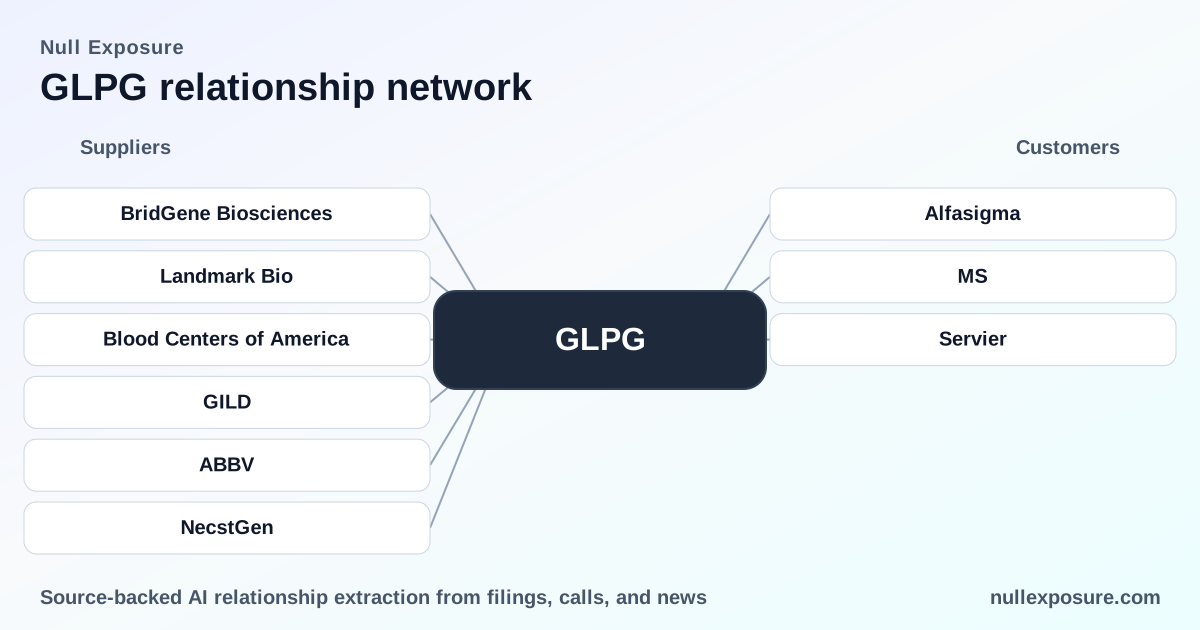
Galapagos NV (GLPG) — supplier relationships that scale a clinical-stage cell-therapy push
Galapagos NV operates as a clinical-stage biopharma developer of small molecules and increasingly cell-based therapies, monetizing through a mix of upfront payments, staged milestone receipts and eventual commercial royalties where programs succeed. The firm combines in-house R&D with outsourced development and manufacturing partnerships to accelerate CAR‑T and other cell therapy programs while conserving capital; its revenue base today is collaboration-driven, and its balance sheet and negative operating earnings reflect a model still several clinical inflection points from sustainable product sales. For more granular supplier exposure analysis, visit the NullExposure homepage.
How Galapagos runs the program engine — commercial model in plain terms
Galapagos converts discovery and early clinical assets into value by entering risk‑sharing alliances: the company pays or receives upfronts and milestones depending on the deal structure and de‑risks capital spend by outsourcing specialized activities (chemoproteomics discovery, GMP manufacturing, point‑of‑care cell production). This hybrid model preserves cash but creates operational reliance on third‑party suppliers for execution of clinical batches and translational work, which accelerates timelines but concentrates execution risk outside the corporate fence.
Key financial context underpins this posture: market capitalization roughly $2.26B, revenue TTM $287M, negative EBITDA of about $277M and EPS of -7.98, signaling a funding-and-collaboration driven lifecycle rather than product revenue maturity.
If you track supplier counterparties in biopharma, this is a high‑leverage exposure profile — for a consolidated view, check the NullExposure homepage.
Company-level operating constraints and what they signal to buyers and investors
- Contracting posture: outsourced and partnership-centric — Galapagos relies on third parties for discovery platforms and GMP manufacturing, reducing fixed costs but increasing supplier criticality.
- Concentration: reliance on a small number of strategic collaborations and milestone structures is a revenue and pipeline concentration risk for the company-level model.
- Criticality: supplier relationships are mission-critical — manufacturing and discovery partners are on the critical path for clinical progress.
- Maturity: clinical-stage with no large-scale commercial manufacturing footprint; the company is transitioning from discovery to complex cell-therapy development.
These are company-level signals about how Galapagos runs trials and budgets, not assertions about any single counterparty. For detailed supplier tracking and alerts that matter to financiers and operators, see NullExposure.
The supplier landscape — who Galapagos is working with (each relationship covered)
Below are every supplier relationship identified in public coverage and what each means operationally.
BridGene Biosciences — discovery partnership with staged economics
Galapagos contracted BridGene to use its chemoproteomics platform, executing an initial collaboration with a reported $27 million upfront and preclinical payments, and an expanded arrangement that could total up to $159 million in milestones and clinical/commercial payments. This is a discovery-stage outsourcing arrangement that transfers early‑stage target validation risk to a specialist provider. (PR Newswire, FY2024; FierceBiotech coverage, FY2024.)
Landmark Bio — GMP manufacturing for CAR‑T clinical batches
Landmark Bio will perform GMP manufacturing of clinical trial batches for Galapagos’ CAR‑T hematology‑oncology programs in the Boston area under a multi‑year agreement, enabling point‑of‑care production capacity in a U.S. cluster. This is a direct manufacturing outsourcing relationship that supports clinical supply continuity. (PR Newswire, FY2023.)
Blood Centers of America — distributed point‑of‑care manufacturing network
Galapagos struck an agreement with Blood Centers of America to open dozens of manufacturing sites for its cell‑based medicines across the U.S., effectively creating a distributed network for point‑of‑care cell processing and patient access. This expands Galapagos’ manufacturing footprint through third‑party facilities rather than capital‑intensive in‑house builds. (Stat News, May 2024 / FY2024 coverage.)
Gilead Sciences — strategic collaboration and credibility boost
Galapagos’ partnerships with large pharmas such as Gilead supply strategic development resources and market validation for its pipeline, particularly for advancing cell therapy programs through later clinical stages. This partnership functions as both a development lever and a signal to investors about program quality. (DirectorsTalkInterviews, FY2026 commentary.)
AbbVie — another strategic development partnership
AbbVie’s collaboration with Galapagos is cited alongside Gilead as a strategic alliance enhancing pipeline advancement and credibility; such ties provide external financing through shared project costs and can accelerate pivotal studies. Large‑cap pharma partnerships reduce execution risk by adding development capacity and regulatory experience. (DirectorsTalkInterviews, FY2026 commentary.)
NecstGen — translational and access partnership
NecstGen partnered with Galapagos to advance therapies from preclinical stages to clinical trials and to increase patient access, functioning as a translational bridge and potentially as an access channel for investigational products. This supports Galapagos’ goal of earlier and broader clinical testing cadence. (RegMedNet, FY2025.)
What the supplier set implies about risk and value creation
- Execution risk is concentrated outside Galapagos’ own labs and suites, so program timelines and cost outcomes depend on counterparty performance.
- Revenue is collaboration-driven and milestone-weighted, visible in limited product revenues versus significant R&D investment — reflected in negative operating margins and EBITDA.
- Manufacturing strategy favors speed and distributed capacity over capex, which reduces fixed costs but increases coordination complexity and compliance exposure across multiple operators.
Investors should factor these supplier dynamics into valuation risk: upside derives from successful clinical readouts and milestone realization, downside from manufacturing or translational setbacks that can delay or impair value capture.
Strategic implications for operators and investors
For operating teams negotiating with Galapagos as a supplier or partner, the company’s structure signals a preference for flexible, milestone‑oriented contracts and point‑of‑care manufacturing solutions. For investors, the combination of strategic pharma partners, specialized discovery deals, and a broad manufacturing network is a positive for de‑risking clinical execution — but it does not eliminate the binary outcomes inherent to clinical development.
If you need ongoing surveillance on supplier changes and counterparty risk for GLPG, start with the NullExposure homepage to capture real‑time relationship signals and filings.
Bottom line
Galapagos is leveraging an outsourced supplier ecosystem to accelerate cell‑therapy programs while preserving capital — a model that creates optionality and speed but concentrates operational risk in third parties. The supplier slate (BridGene, Landmark Bio, Blood Centers of America, Gilead, AbbVie and NecstGen) maps to a coherent strategy: specialty discovery, GMP and distributed point‑of‑care manufacturing, and large‑cap validation. Monitor milestone timelines and manufacturing deliverables as the primary levers that will convert collaboration economics into investor returns.