Greenwich LifeSciences (GLSI): Supplier relationships that determine trial execution and commercial optionality
Greenwich LifeSciences is a clinical-stage immunotherapy developer that monetizes by advancing GP2 through late-stage trials toward potential commercialization while funding operations through equity raises and ATM facilities. The company holds an exclusive license for GP2 and runs the FLAMINGO-01 global trial with academic and commercial manufacturing partners; near-term value realization depends on successful trial enrollment, regulated manufacturing supply and continued access to capital markets. For a concise, investor-grade view of counterparties and how they influence execution risk, visit https://nullexposure.com/.
Why supplier and partner mapping matters for GLSI investors
Greenwich is not a vertically integrated drugmaker: intellectual property, drug supply and clinical conduct are outsourced. That structure compresses capital needs but increases dependence on a small set of external relationships whose contracting posture and concentration profile directly affect timelines and commercialization optionality. The company’s financials show no product revenue and negative operating metrics, so supplier continuity and capital access are primary drivers of upside and downside.
Company-level constraints that shape supplier risk
- Exclusive license: Greenwich is the licensee of GP2 under an arrangement with The Henry M. Jackson Foundation (HJF); that license is central to the firm's commercial rights and IP protection. According to company disclosures, the exclusive license to GP2 was granted by HJF in April 2009 and remains the company’s foundational asset — evidence cited in company filings and public disclosures.
- Single-source drug component: GM-CSF in lyophilized form is available exclusively from one manufacturer, creating single-supplier concentration for a component critical to ongoing clinical trials and potential commercialization. This is described in the company’s risk disclosures as a dependence that is operationally material.
- Spot purchasing and short-term occupancy: Greenwich relies on purchase orders rather than long-term supply contracts for GM-CSF and operates on a month-to-month sublease that expires mid‑2026, signaling short-term contracting posture for some operational inputs and facilities.
- Contractor reliance for trials and manufacturing: The company does not operate its own manufacturing and depends on third-party contract manufacturers and clinical research organizations, a typical clinical-stage model that transfers execution risk to vendors but lowers fixed costs.
- Materiality signal: The company has stated that, aside from employment/shareholder agreements and the GP2 license, it did not have material contractual obligations as of Dec 31, 2024 — a disclosure that frames contractual risk but does not eliminate dependency-related operational vulnerability.
Collectively, these constraints mean Greenwich’s critical path to value is: successful site enrollment + uninterrupted supply of GP2 and adjuncts + capital access.
Relationship roll call — each counterparty and what they do
-
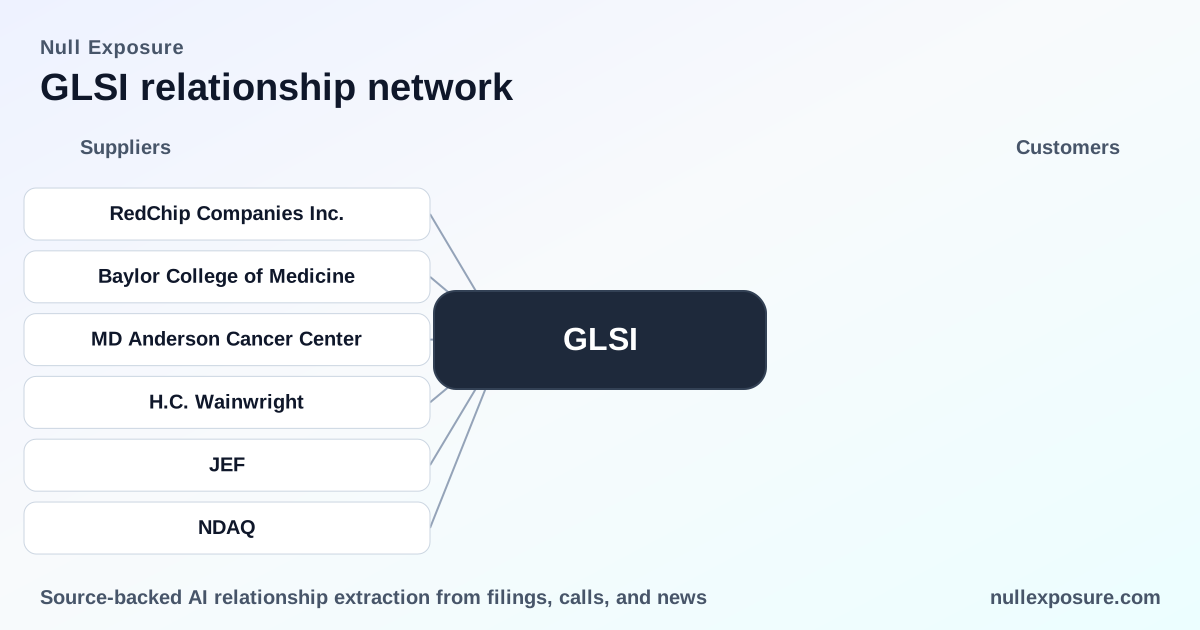
RedChip Companies Inc. — RedChip is repeatedly listed as Greenwich’s investor and public relations contact across multiple press releases in FY2025–FY2026, indicating an ongoing outsourced IR/communications relationship that supports market visibility and investor outreach. — Source: GlobeNewswire and Yahoo Finance press releases (Dec 2025–Mar 2026).
-
Baylor College of Medicine — Baylor is identified as a leading clinical site/organizer for the FLAMINGO-01 trial, coordinating US and European sites as part of the global site network, which underscores academic trial leadership and access to trial infrastructure. — Source: GlobeNewswire announcement on accepted abstracts for AACR (Feb 2026).
-
MD Anderson Cancer Center — MD Anderson is leading multiple trial sites (16 sites cited) in past Phase IIb work and is referenced in FLAMINGO-01 context, supplying clinical credibility and experienced operational capacity that matter for enrollment quality and regulatory dialogue. — Source: GlobeNewswire and QuiverQuant summaries describing Phase IIb and trial leadership (FY2025–FY2026).
-
H.C. Wainwright — H.C. Wainwright has executed ATM financing for Greenwich, selling shares and generating gross proceeds used to fund operations; this firm is an active capital markets counterparty and underwriter for equity raises (notably in FY2025). — Source: RTTNews and QuiverQuant reporting on ATM sales and financing activity (2025–2026).
-
Jefferies — Jefferies is referenced as an initial ATM placement partner historically used by Greenwich; management notes that the company utilized Jefferies initially and subsequently H.C. Wainwright to fund the firm, signaling a multi-syndicate financing strategy. — Source: QuiverQuant report on financial updates and ATM history (FY2026).
-
Nasdaq (Nasdaq Capital Market) — Greenwich’s listing on the Nasdaq Capital Market since September 25, 2020 provides the public listing venue, liquidity reference and reporting framework for investors; the listing is the platform through which equity financings and market access occur. — Source: RTTNews coverage of the company’s Nasdaq listing (FY2025).
(Each relationship above is drawn from cited public releases and market reports over FY2025–FY2026.)
What these relationships imply for operations and downside
- Concentration risk is real and measurable: the exclusive GM‑CSF manufacturer represents a single point of failure for trial continuity and initial commercialization supply. Without a confirmed secondary supplier or firm long-term supply agreements, operational continuity depends on that vendor.
- Contracting posture is lightweight: spot purchase behavior for GM‑CSF and month-to-month occupancy show a preference for flexible, short-term contracts over long-term supplier commitments — this conserves cash but increases exposure to price and availability shocks.
- Funding is market-dependent: Greenwich’s working capital strategy is equity-led (ATMs executed via Jefferies and H.C. Wainwright), so capital markets sentiment directly controls runway. Recent ATM proceeds in 2025 funded trial operations. — Source: RTTNews (2025) and QuiverQuant (2026).
- Academic partnerships reduce some execution risk: leadership by Baylor and MD Anderson provides structured trial governance and investigator networks that materially support enrollment and data credibility.
- IP control is concentrated: the HJF license is the company’s core commercial right for GP2; that legal arrangement underpins any future revenue capture.
Practical next steps for investors and operators
- For investors: monitor supplier contracts and FDA manufacturing approvals (for example the commercial lot approvals referenced) and track ATM capacity and insider dilution events; these will determine both execution risk and funding runway.
- For operators: secure secondary sources for GM-CSF or convert spot purchases into term agreements, and document manufacturing contingency plans tied to regulatory approvals.
- For both: request clarity on the HJF license term structure, patent maintenance responsibilities and any exclusivity carve-outs.
If you want a mapped, investor-ready supplier table and monitoring plan for GL SPs, see our work at https://nullexposure.com/.
Conclusion and actionable signal
Greenwich LifeSciences operates a capital-efficient, outsourced model where clinical and supply partners — not internal manufacturing — control timelines and commercialization feasibility. The most consequential risks for investors are single-source supply for a critical adjunct, short-term procurement posture, and reliance on equity ATMs for financing; the most material mitigants are strong academic leadership at Baylor and MD Anderson and an active capital markets program. For a structured diligence checklist and ongoing counterparty monitoring for GLSI, visit https://nullexposure.com/ for subscription-grade signals and supplier scoring.