Monte Rosa Therapeutics (GLUE): Supplier relationships and where counterparty risk lives
Monte Rosa Therapeutics develops precision small-molecule drugs that harness the body’s degradation machinery to selectively remove disease-relevant proteins. The company currently monetizes through a combination of R&D progress that converts into milestone and licensing opportunities and through public-market capital raises that fund clinical development and near-term operations; revenue in the trailing twelve months was $181.5 million, reflecting non-traditional biotech cash flows rather than stable product sales. For investors and operators evaluating counterparty exposure, the most relevant supplier signals are third‑party manufacturing dependence, a mixed contract posture (purchase-order sourcing today with ongoing reliance on CMOs), and active capital markets engagement for liquidity. For a concise supplier risk brief, see the Null Exposure homepage: https://nullexposure.com/.
What Monte Rosa’s supplier map looks like in plain English
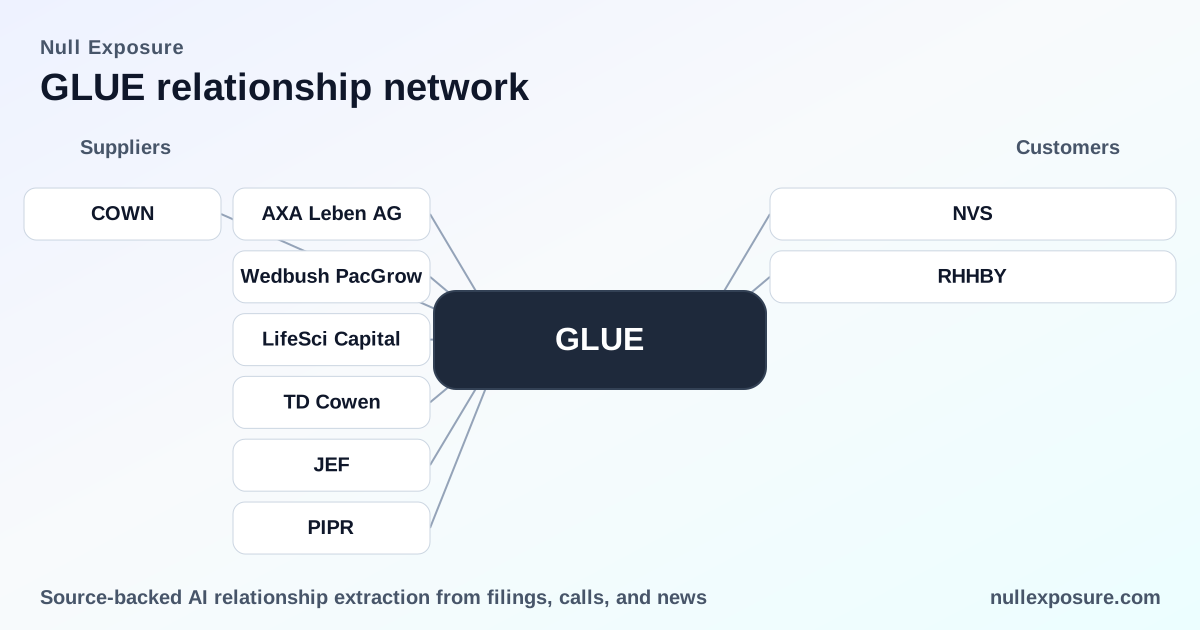
Monte Rosa does not own manufacturing plants and outsources production and development services to a network of contract manufacturers and CROs; this is a deliberate operating model that conserves capital but concentrates operational risk into vendor relationships. The company’s public disclosures and recent press coverage show two distinct relationship categories: an internal human‑capital/pension linkage in Switzerland and a set of investment‑bank counterparties running a $300 million equity offering in January 2026. Understanding these two buckets — operational suppliers vs. capital markets counterparties — is critical for pricing near‑term dilution risk and longer‑term manufacturing continuity.
- Operational exposure: Monte Rosa contracts with CMOs and CROs for clinical and commercial manufacture; supply delays are explicitly described as potentially material. This is a company‑level signal drawn from filings (10‑K/FY2024).
- Capital markets counterparties: Multiple underwriters are listed across press releases for a January 2026 offering; these firms handle distribution, pricing and syndicate mechanics that directly affect dilution and liquidity.
Explore a deeper supplier-risk view at Null Exposure: https://nullexposure.com/
The relationships you need to know — each one, described
AXA Leben AG
Monte Rosa maintains a mandatory pension for its employees in Switzerland through affiliation with AXA Leben AG, indicating a localized employee-benefits relationship rather than a commercial supplier for drug production. This is disclosed in the company’s FY2024 10‑K filing. (Source: FY2024 10‑K, Monte Rosa Therapeutics.)
Jefferies (JEF)
Jefferies served as one of the joint book‑running managers for Monte Rosa’s proposed public offering of common stock and pre‑funded warrants announced in early January 2026; the firm’s role places it at the center of syndicate pricing and distribution. (Source: GlobeNewswire press release, Jan 7, 2026; coverage aggregated by QuiverQuant and InvestingNews, Jan 2026.)
TD Cowen (COWN)
TD Cowen is listed alongside Jefferies and Piper Sandler as a joint book‑running manager for the January 2026 offering, establishing TD Cowen as a principal underwriter in the transaction and a conduit for institutional demand. (Source: GlobeNewswire press release, Jan 7, 2026; SahmCapital and QuiverQuant reporting, Jan 2026.)
Piper Sandler (PIPR)
Piper Sandler acted as a joint book‑running manager on the same offering, giving the firm placement influence over the deal and execution responsibilities with respect to allocations and syndicate coordination. (Source: GlobeNewswire press release, Jan 7, 2026; QuiverQuant, Jan 2026.)
Wedbush PacGrow
Wedbush PacGrow participated as a passive bookrunner in the January 2026 offering, a role focused on distribution support rather than lead underwriting, as described in multiple press reports covering the offering’s pricing. (Source: SahmCapital press note and InvestingNews coverage, Jan 2026.)
LifeSci Capital
LifeSci Capital is identified as a passive bookrunner for the January 2026 offering; its placement confirms participation from specialized life‑science capital markets desks in the syndicate. (Source: GlobeNewswire press release and QuiverQuant reporting, Jan 2026.)
Operating-model constraints that shape supplier risk
The company’s disclosures embed several constraints that determine how supplier relationships translate into risk for investors and operators:
- Contracting posture — mixed and flexible. Monte Rosa sources on a purchase‑order (spot) basis today but also states it relies on third parties for manufacturing broadly; this creates a hybrid posture where tactical spot buys coexist with longer‑term dependency on CMOs. (Company filing excerpts, FY2024.)
- Concentration and criticality — material exposure. The filing warns that delays from third‑party suppliers could have a material adverse impact, signaling high criticality of manufacturing counterparty performance. This is a company‑level materiality signal rather than an attribute of any single named supplier.
- Role clarity — manufacturer and service‑provider reliance. Monte Rosa explicitly relies on CMOs and CROs to deliver drug substance and finished product; the relationship role classifications in the filings read as strategic and ongoing (active). (Company filing excerpts, FY2024.)
- Geography and regulatory footprint — global compliance pressure. Third‑party manufacturers are subject to FDA and comparable foreign inspections, pointing to global regulatory risk embedded in manufacturing partners. (Company filing excerpts, FY2024.)
- Maturity — active development phase. The company’s supplier relationships are described as active and intended to continue, consistent with a development‑stage biotech that outsources rather than vertically integrates.
These constraints imply that operational continuity depends on disciplined supplier selection, contractual controls around lead times and capacity, and contingency plans for regulatory inspections.
How these relationships translate to investor risk and opportunity
Capital markets counterparties matter for two investor considerations: liquidity and dilution control. The January 2026 offering priced at $300 million, with Jefferies, TD Cowen and Piper Sandler as joint book‑runners and Wedbush PacGrow and LifeSci Capital as passive bookrunners; syndicate composition influences pricing leverage and investor reach. (Source: GlobeNewswire, SahmCapital, QuiverQuant, Jan 2026.)
Operational suppliers matter for execution risk. Because Monte Rosa outsources manufacturing on a purchase‑order basis while committing to ongoing reliance on CMOs, buyers of the equity must price both the near‑term financing dilution and the medium‑term execution risk from third‑party manufacturers. The company’s revenue stream is still driven by development milestones and capital markets, not recurring product sales (Revenue TTM cited in company overview).
If you want a consolidated, machine‑readable supplier exposure profile for portfolio monitoring, Null Exposure can map these linkages into a single view: https://nullexposure.com/
Final takeaways and recommended next steps
- Primary operational risk is concentrated: Monte Rosa’s reliance on third‑party manufacturers is explicit and described as material if disrupted. That creates an asymmetric downside for clinical timelines and launch readiness.
- Capital markets execution is diversified across boutiques and bulge‑bracket participants: The January 2026 syndicate includes both life‑science specialists and broader investment banks, which reduces single‑counterparty placement risk for the capital raise.
- Pension and HR linkages are localized: The AXA Leben AG relationship is a standard employee pension affiliation in Switzerland and not a manufacturing counterparty.
For investors and corporate operators conducting diligence, focus on supplier contractual terms (lead times, capacity commitments, inspection history) and underwriter placement strategy for future financings. If you want a tailored supplier‑risk briefing or continuous monitoring of Monte Rosa’s counterparty map, visit Null Exposure and request a supplier concentration report: https://nullexposure.com/.