Galaxy Digital (GLXY): Supplier relationships that shape the data‑center and digital‑asset platform
Galaxy Digital operates at the intersection of digital‑asset trading, custody, and capital-intensive data‑center infrastructure. The company monetizes through trading and principal markets activity, asset management and custody fees, and by developing owned data‑center capacity that supports mining and hosted services; recent financing and exchange actions explicitly tie liquidity and capital allocation to its data‑center buildout and share‑count management. For investors and operators, the critical lens is execution risk on capital projects, counterparty credit lines, and custody/market relationships that support custody liquidity and operational scale. For deeper coverage and ongoing counterparty tracking, visit https://nullexposure.com/.
Business snapshot and financial context Galaxy reports very large top‑line activity but thin headline profitability: TTM revenue and gross profit figure prominently, while EPS is negative and return on equity is negative, signaling an asset‑heavy business undergoing strategic allocation. Key public metrics worth scanning quickly:
- Market capitalization: $9.0 billion.
- Revenue (TTM): $61.4 billion.
- EPS (TTM): -$0.61; Profit margin: -0.39%.
- Institutional ownership: ~78% (high concentration). These characteristics underline a hybrid business model: capital markets revenue fuels operating liquidity while data‑center scale requires multi‑hundred‑million to billion‑dollar financing packages.
How relationships drive the model Counterparties and regulatory touchpoints are not peripheral for Galaxy — they are foundational. Relationships with power grid operators, custody services, banks and exchanges directly influence the company’s ability to scale mining and hosting infrastructure, manage balance‑sheet risk, and return capital to shareholders.
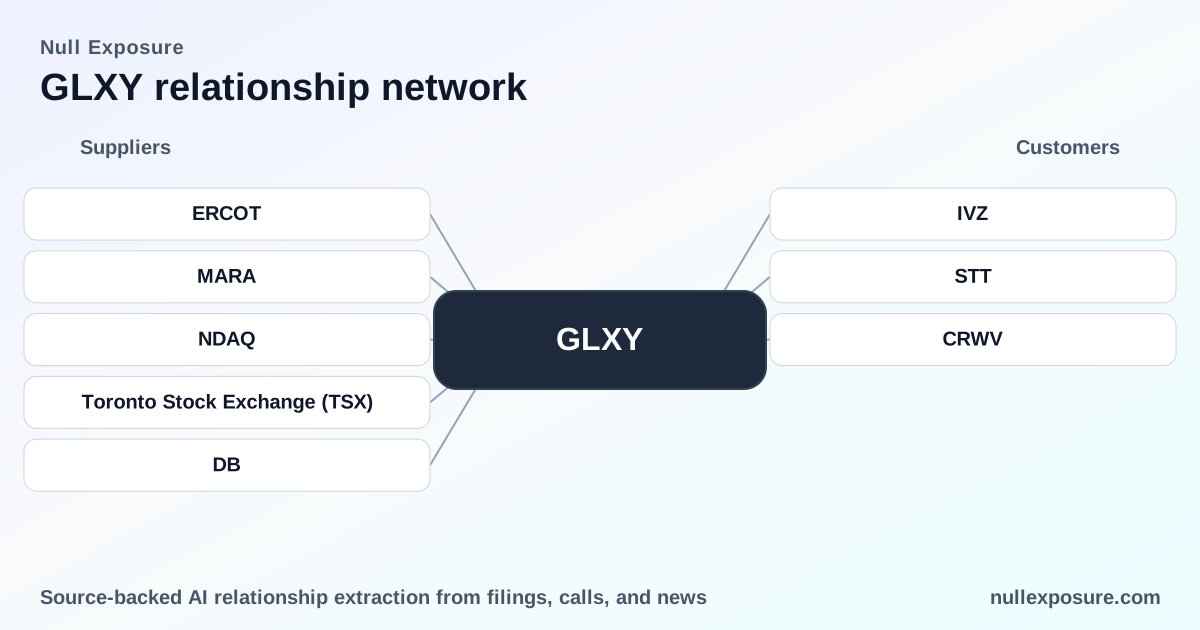
Core supplier and counterparty relationships (what investors need to know)
ERCOT — power capacity approval for 830 MW Galaxy received ERCOT approval for an additional 830 megawatts of power capacity, a direct operational enabler for its data‑center expansion and hosted mining footprint as discussed on the 2025 Q4 earnings call. This approval materially increases Galaxy’s operational headroom in the Texas market and reduces a key gating constraint for bringing data‑center projects online. (Source: 2025 Q4 earnings call, disclosed March 2026.)
MARA Holdings — large institutional Bitcoin transfers MARA Holdings transferred 1,318 BTC (about $87 million) to Galaxy Digital alongside Two Prime and BitGo, reflecting Galaxy’s active custody and trading role for large institutional holders and demonstrating liquidity flows through Galaxy’s custody and settlement channels. This kind of transfer underscores Galaxy’s function as both a custodian and an on‑ramp for institutional digital‑asset portfolios. (Source: CryptoBriefing report, March 9, 2026.)
Nasdaq Global Select Market — NCIB execution channel Galaxy confirmed that purchases of Class A common stock under its normal course issuer bid will be executed through the Nasdaq Global Select Market, with programmatic limits capped at 5% of outstanding Class A shares over a twelve‑month window. The Nasdaq channel is Galaxy’s primary on‑exchange mechanism for share‑count management and signals a preference for liquidity‑driven repurchases executed in open markets. (Source: InvestingNews summary of TSX/Nasdaq notices, March 9, 2026.)
Toronto Stock Exchange (TSX) — NCIB acceptance The TSX accepted Galaxy’s notice of intention to make a normal course issuer bid (NCIB), enabling parallel repurchase activity on the Canadian exchange and giving the company flexibility to manage capital structure across dual listings. This acceptance provides operational optionality for cross‑listed share repurchases and supports coordinated capital return strategies. (Source: InvestingNews report, March 9, 2026.)
Deutsche Bank AG — $1.4 billion credit facility for data center project Galaxy entered a $1.4 billion credit agreement with Deutsche Bank AG to fund its data‑center project, converting project execution risk into a bank‑backed financing structure and de‑risking near‑term capital needs for buildout. The size and structure of this facility materially influence Galaxy’s contracting posture — transferring construction and timing risk into a financed obligation while increasing counterparty credit concentration. (Source: TradingView coverage summarizing Galaxy’s SEC 10‑K, March 2026.)
Operating model constraints and company‑level signals The constraints block returned no discrete supplier constraints; treated as a company‑level signal, this absence still informs evaluation: Galaxy’s disclosures and recent actions point to a company that relies on negotiated credit facilities, exchange mechanisms, and market custody partners rather than fixed, long‑term supplier contracts. From this, infer the following model characteristics:
- Contracting posture: Opportunistic and bank‑intermediated; large projects are financed via syndicated credit (Deutsche Bank facility) rather than fully prepaid supplier agreements.
- Concentration: Capital and execution concentration are material — a single large bank financing and major grid approvals (ERCOT) are pivotal to project timelines.
- Criticality: High; power capacity approvals and large custodial flows are mission‑critical for the data‑center and trading/custody verticals.
- Maturity: Mixed — market operations and custody are mature revenue streams, while data‑center buildout represents a capital‑intensive growth phase with execution risk and elevated leverage implications.
Implications for investors and operators
- Execution risk dominates near term. The Deutsche Bank financing and ERCOT approval are positive catalysts, but they also concentrate counterparty and operational risk into a small set of counterparties and regulatory processes.
- Liquidity and custody relationships matter. Large transfers from institutional holders such as MARA demonstrate reliance on Galaxy as a settlement and custody intermediary; maintaining uptime, security, and settlement performance is essential to preserve this business line.
- Capital‑allocation flexibility is active. Dual‑exchange NCIB approvals show management’s intent to manage share count and return capital within market constraints while continuing to finance growth.
Middle call‑to‑action For a systematic view of counterparty risk and supplier relationships across capital projects and custody operations, see ongoing coverage at https://nullexposure.com/.
Risks and watchpoints for diligence
- Counterparty concentration: A $1.4 billion bank facility and large grid approvals create single‑point dependencies that increase systemic timing risk.
- Profitability vs scale: Very large revenue figures coexist with negative EPS and slim profit margins, indicating sensitivity to trading conditions and capital costs.
- Operational criticality of power: ERCOT’s approvals unlock megawatts, but any delay or revocation would directly impede revenue from hosted services and mining.
Final recommendations Investors should treat Galaxy’s supplier and counterparty map as a set of strategic levers: bank financing, grid approvals, custody partners, and exchange mechanisms each materially affect valuation and execution risk. Track the Deutsche Bank financing terms, ERCOT interconnection milestones, and custody flow volume from institutional holders like MARA as leading indicators of operational progress.
Closing call‑to‑action To monitor evolving counterparties, financing events, and operational approvals that drive Galaxy’s valuation, subscribe or explore detailed partner tracking at https://nullexposure.com/.