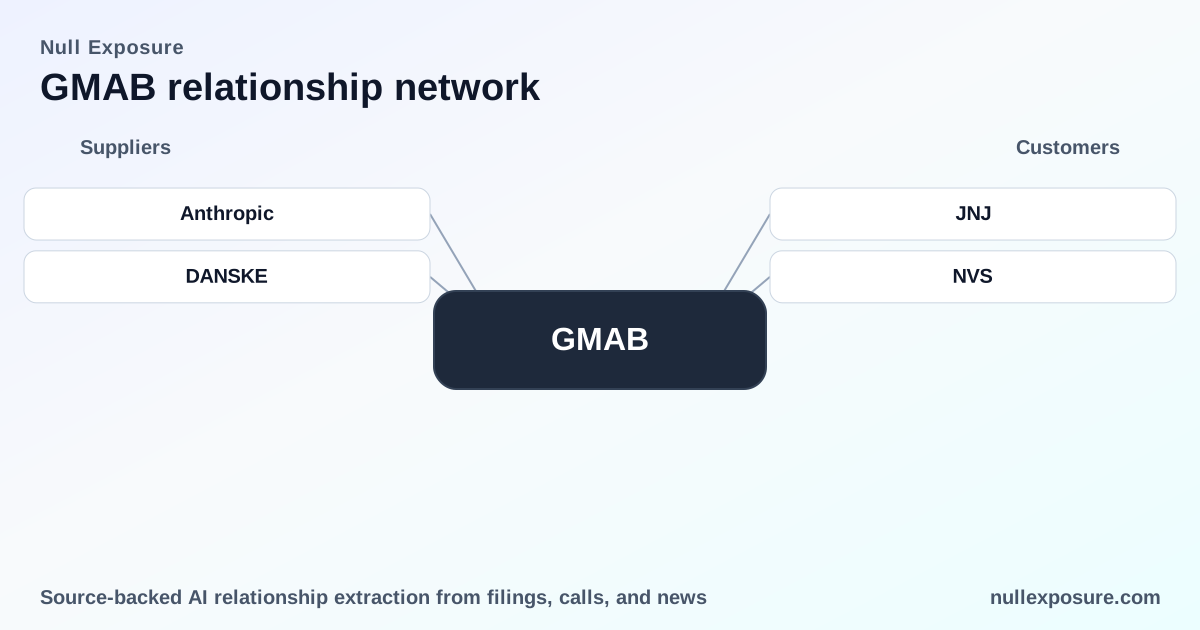
Genmab AS (GMAB) — Supplier Relationships That Shape R&D and Capital Strategy
Genmab operates as a developer of antibody therapies primarily out of Denmark and monetizes through a mix of product revenues, milestone and royalty streams from licensing and partner commercialization, and strategic capital-return programs. The company sustains growth through collaborative R&D and selective outsourcing while returning capital to shareholders via buybacks executed through banking counterparties. For investors, the combination of high gross margins, recurring royalty potential, and tactical supplier partnerships is the core value driver.
If you want continuous monitoring of how supplier relationships influence equity risk and operational resilience, visit https://nullexposure.com/ for more coverage.
How Genmab makes money and why supplier ties matter
Genmab’s financials reflect a commercial-stage biotech with robust profitability: TTM revenue of $3.72 billion, gross profit of $3.48 billion, and an operating margin around 23%. The company converts laboratory innovation into recurring cash flows by licensing antibody candidates, collecting royalties on partner commercial sales, and selling its own products when applicable. Supplier and service relationships are strategic — they can accelerate clinical development, supplement specialized capabilities (e.g., AI-assisted R&D), or affect capital deployment when chosen for corporate finance actions like buy-backs.
These relationships are not incidental: partners that touch R&D workflows or capital-return execution influence time-to-market, trial costs, and shareholder optics, all of which feed directly into valuation multiples (Genmab trades at a trailing P/E ~17.25 and forward P/E ~16.03).
Operational posture: contracting style, concentration and maturity signals
Genmab operates with a hybrid contracting posture: it partners for capabilities outside core antibody discovery and development while retaining strategic ownership of its most valuable assets through licensing and collaboration terms. Financial metrics show a mature, cash-generative profile relative to pure discovery-stage peers; positive EBITDA (~$1.29B) and healthy margins indicate commercial maturity and the ability to fund external partnerships.
Institutional ownership is modest (~12% reported), insiders show no material reported stake in the supplied data, and the company has executed structured capital-return programs — all signals consistent with a company balancing growth investment and shareholder returns. There are no constraint entries in the supplier-scope data for GMAB, which reads as no reported supplier-specific contract limitations surfaced in the reviewed supplier data.
If you want supplier-level monitoring and alerts that map directly to these operational signals, see https://nullexposure.com/ for a tailored view.
What investors should track: the current supplier relationships
Below I cover every supplier-related relationship surfaced in the supplier-scope results. Each relationship summary is concise and includes the primary public report.
Anthropic — agentic AI for R&D acceleration
Genmab entered a collaboration to design and implement Claude-powered agentic AI systems to support its clinical programs, effectively outsourcing a slice of R&D workflow automation and pattern discovery to a specialist AI research firm. According to The Healthcare Technology Report (reported March 9, 2026), the parties will jointly tailor agentic AI tools to accelerate Genmab’s clinical program management and research throughput; similar mentions of the partnership were reported in January coverage referencing Anthropic’s Claude models (FinViz / InsiderMonkey commentary, Jan 2026). (Sources: The Healthcare Technology Report, March 9, 2026 — https://thehealthcaretechnologyreport.com/genmab-collaborates-with-anthropic-to-advance-rd-through-agentic-ai/; FinViz / InsiderMonkey coverage, Jan 2026 — https://finviz.com/news/280683/genmab-as-gmab-shares-gain-analyst-support-as-deutsche-bank-sees-oncology-upside and https://www.insidermonkey.com/blog/genmab-a-s-gmab-shares-gain-analyst-support-as-deutsche-bank-sees-oncology-upside-1677883/).
Danske Bank — execution agent for share buy-back program
Genmab has contracted Danske Bank to execute a non-discretionary instruction in relation to its share buy-back program, meaning Danske acts as the execution agent for the company’s capital-return mechanics. This was announced via GlobeNewswire on February 17, 2026, and reproduced by related press outlets (Manila Times, Feb 18, 2026). The relationship is operationally straightforward: a financial institution executes a board-authorized buy-back program under specified terms. (Sources: GlobeNewswire press release, Feb 17, 2026 — https://www.globenewswire.com/news-release/2026/02/17/3239686/0/en/Genmab-Announces-Initiation-of-Share-Buy-Back-Program.html; Manila Times reproduction, Feb 18, 2026 — https://www.manilatimes.net/2026/02/18/tmt-newswire/globenewswire/genmab-announces-initiation-of-share-buy-back-program/2279868).
Why these relationships change the investment case
- Anthropic partnership accelerates R&D efficiency. Outsourcing advanced AI capabilities for clinical and preclinical workflows is a productivity lever: improved target prioritization, trial optimization, and data synthesis can compress timelines and reduce incremental development cost. That translates directly to faster realization of milestone and royalty streams associated with successful programs.
- Danske Bank buy-back execution supports capital-return signaling. A non-discretionary buy-back executed through a major bank is a deliberate share-support mechanism; it reduces float and amplifies EPS accretion without altering the risk profile of the underlying drug pipeline.
Both relationships are tactical and limited in scope — one operational (R&D enablement), one financial (capital return) — and together they indicate deliberate management choices to accelerate value creation while supporting the share price.
Risk checklist for operators and investors
- Concentration of strategic support: Reliance on specialized third parties for AI-driven research components increases operational dependency; investors should watch contractual terms around IP ownership and data access.
- Execution risk on buy-backs: Buy-back signaling is positive for shareholders but can be sensitive to market timing and regulatory execution rules in various jurisdictions.
- Maturity vs. growth trade-off: With strong margins and positive EBITDA, Genmab is moving from pure R&D to a commercial posture; capital allocation choices (R&D vs. buybacks) will materially affect longer-term revenue growth.
Bottom line and recommended next steps
Genmab’s supplier relationships are targeted and strategic: an AI partner to accelerate the science, and a bank to execute shareholder returns. These relationships do not restructure the core business model but amplify two primary value levers — faster product development and clearer capital allocation. For investors and operators evaluating supplier counterparty risk and opportunity, prioritize contract terms that preserve IP and clinical data control for R&D partners, and require transparency on execution protocols for financial counterparties.
For deeper supplier analytics and real-time relationship monitoring that maps to risk and valuation drivers, explore more at https://nullexposure.com/. If you’d like a tailored briefing on how these suppliers affect valuation scenarios for Genmab, visit https://nullexposure.com/ and request a supplier impact dossier.