GameStop warrants (GME-WS): what the NYSE listing means for counterparties and investors
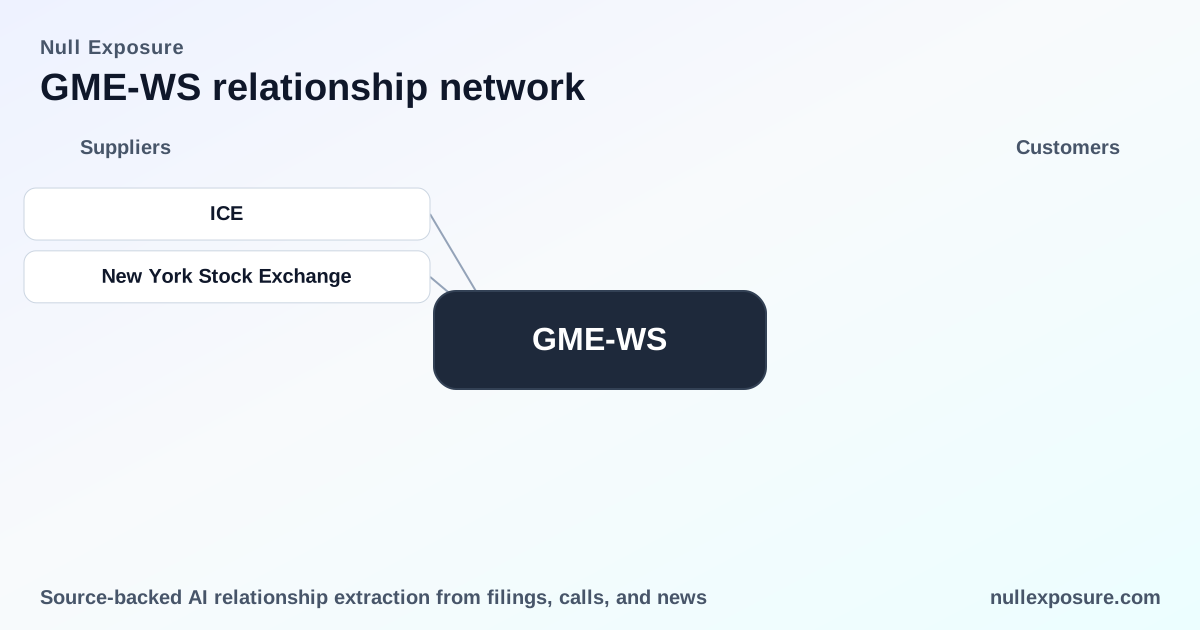
GameStop Corp. operates as a specialty retailer in the gaming sector that has shifted from a largely brick-and-mortar model to a technology-forward, community-driven commerce platform; it monetizes through retail sales (physical and digital), trade-in programs, and growing e-commerce/digital distribution channels while leveraging brand recognition and a dedicated customer base. The GME-WS instrument is a warrant tied to GameStop equity whose primary operational relevance today is liquidity and market access—how freely tradable instruments are listed and cleared, and which exchange provides that marketplace. For investors and operators evaluating supplier relationships, the most relevant supplier-class counterparty is the New York Stock Exchange as the listing venue for GME WS, which directly affects tradability, settlement mechanics, and market visibility.
If you want a consolidated view of supplier relationships and exchange exposure for equities and derivatives, visit https://nullexposure.com/ for platform access and deeper supplier intelligence.
Why the exchange relationship matters more than the ticker name
A listed warrant’s practical value to holders and market makers is a function of where it trades and how easily it clears. An exchange listing determines market structure parameters — listing rules, opening auction mechanics, tick-size and reporting, and the pool of liquidity providers that will show quotes. For GME WS, the NYSE's involvement signals a standardized, regulated venue and broader distribution to institutional trading desks, specialist firms, and retail brokers that route to NYSE liquidity. That structural relationship changes the economic and operational calculus for counterparties who provide trading, settlement, market-making, and custody services.
- Operational impact: NYSE listing simplifies routing and execution for broker-dealers that already integrate the exchange, reducing integration friction and operational onboarding.
- Commercial impact: Listing on a major exchange increases the addressable liquidity pool and reduces execution risk for large institutional flows.
If you want a supplier-centric scan of how this listing affects clearing counterparties and exchange concentration, see https://nullexposure.com/ for analysis and supplier scorecards.
Every supplier relationship the record shows (complete, concise)
New York Stock Exchange — Benzinga reported in coverage of GameStop’s FY2025/Q2 results that the warrants will be listed on the New York Stock Exchange with the ticker GME WS and will be freely tradable; this frames the exchange as the primary venue providing tradability and market access for the instrument (Benzinga, March 2026). Source: https://www.benzinga.com/markets/earnings/25/09/47583004/gamestop-q2-earnings-double-beat-special-dividend-528-million-in-bitcoin-holdings
New York Stock Exchange — Shacknews reiterated that following the distribution date the warrants are expected to be freely tradable and listed on the New York Stock Exchange under the ticker GME WS, underlining consistent press reporting that the NYSE is the designated listing venue (Shacknews, March 2026). Source: http://www.shacknews.com/article/145872/gamestop-gme-special-dividend
Both entries reference the NYSE listing for GME WS; there are no other supplier or exchange counterparties listed in the record. This makes the NYSE the singular, visible exchange counterparty for these warrants in the supplied results.
What investors and operations teams should extract from the relationship data
The practical takeaways for investors and operator teams cluster around liquidity, concentration, and operational standardization:
- Liquidity and market access are improved when a major exchange lists an instrument; institutional desks and authorized participants will route flow and provide quotes on an exchange with standardized rules.
- Concentration risk is concentrated in one exchange: with the NYSE as the public venue, a single-market stress event or regulatory action at the NYSE would influence trading availability and execution cost for GME WS.
- Operational posture is transactional and standardized: exchange relationships are governed by published listing standards and market rules rather than bespoke commercial contracts, which reduces counterparty negotiation complexity but increases reliance on public-rule governance.
- Maturity and predictability are high for execution and settlement mechanics relative to over-the-counter instruments; the trade-offs are symmetry (transparent pricing) against potential for aggressive short-term liquidity shifts driven by concentrated retail or institutional flows.
Constraints and company-level operating signals
At the company level — because there are no explicit contractual constraints listed in the record — the following operational characteristics are evident and should drive commercial diligence:
- Contracting posture: standardized market rules govern primary execution rather than bespoke supplier contracts, so counterparty obligations are largely rule-based and public.
- Concentration: exchange concentration is material — a single primary exchange listed for a warrant heightens single-point-of-market risk for trade execution and market-maker routing decisions.
- Criticality: high for market function; the exchange relationship is critical to liquidity, price discovery, and investor access, and therefore is a key supplier relationship to monitor operationally.
- Maturity: mature infrastructure — exchanges like NYSE provide established clearing, custodial linkages, and regulatory procedures, reducing implementation friction for broker-dealers and custodians.
These are company-level signals about the business model’s supplier posture and should inform counterparty risk frameworks and operational runbooks used by trading desks and custody teams.
Near-term investor implications and risk profile
- Positive: NYSE listing increases visibility to institutional liquidity providers, supporting tighter spreads and deeper order books for GME WS compared with an unlisted or OTC venue.
- Negative: single-exchange concentration produces dependency risk — an NYSE suspension or rule change would materially impair tradability and could increase realized execution costs for large positions.
- Operational: broker-dealers and custodians should validate routing rules, opening/closing auction handling for the new instrument, and whether market makers will be quotes-protected under NYSE rules.
For firms evaluating supplier counterparty exposure across exchanges and clearinghouses, our platform provides granular supplier relationship maps—start there if you want to align internal risk limits with exchange concentration: https://nullexposure.com/.
Final assessment and recommended next steps
The record is unambiguous: the New York Stock Exchange is the observable supplier/venue for GME WS, and that relationship materially affects liquidity, market access, and operational handling of the warrants. Investors should treat the exchange as a primary supplier when modelling execution cost and counterparty operational readiness. Operations teams should confirm routing configurations, settlement windows, and market-maker commitments ahead of material position builds.
For a deeper, supplier-focused due diligence package and exchange-concentration scoring for GME and related instruments, visit https://nullexposure.com/ and request the GameStop supplier dossier.