Global Net Lease (GNL): Supplier relationships that shape a REIT transition
Global Net Lease, Inc. operates and monetizes as a diversified net-lease REIT: it acquires commercial properties leased long-term to corporate tenants, collects predictable rental cash flow, and seeks portfolio value creation through active asset management and capital markets activity. Recent corporate actions have put supplier relationships — particularly external management and advisory engagements — squarely at the center of GNL’s strategy and governance story. For investors tracking counterparty risk and operational leverage, these developments materially affect cost structure, decision rights, and reputational exposure. Learn more about supplier intelligence at Null Exposure.
The business model in plain English — why suppliers matter here
Global Net Lease’s revenue engine is long-term contractual rent tied to corporate tenants across sectors and geographies, with portfolio returns amplified by leverage and property-level value gains. As a REIT, GNL’s operating economics are highly sensitive to management structure and third-party supplier arrangements because those agreements determine fees, investment decisions, and cash available for distributions.
- Contracting posture: Net leases create predictable revenue streams, but the company’s historical use of external asset and property managers transferred meaningful control and fees to outside suppliers.
- Concentration and criticality: A diversified tenant base reduces single-tenant concentration risk, but supplier contracts for management and advisory services are single points of operational leverage that influence asset performance and governance.
- Maturity: GNL is an established, publicly traded REIT with experienced management and a sizeable market capitalization, yet governance evolution — particularly moving from external to internal management — signals a material change in operating maturity and cost base.
Key financial context: market capitalization about $2.11 billion, trailing revenue near $495 million, and a dividend per share around $0.845 as of the latest filings. These cash flows make supplier terms economically consequential for yield-seeking investors.
What the public record shows about GNL’s supplier ties
AR Global, LLC — internalization language flagged in industry coverage
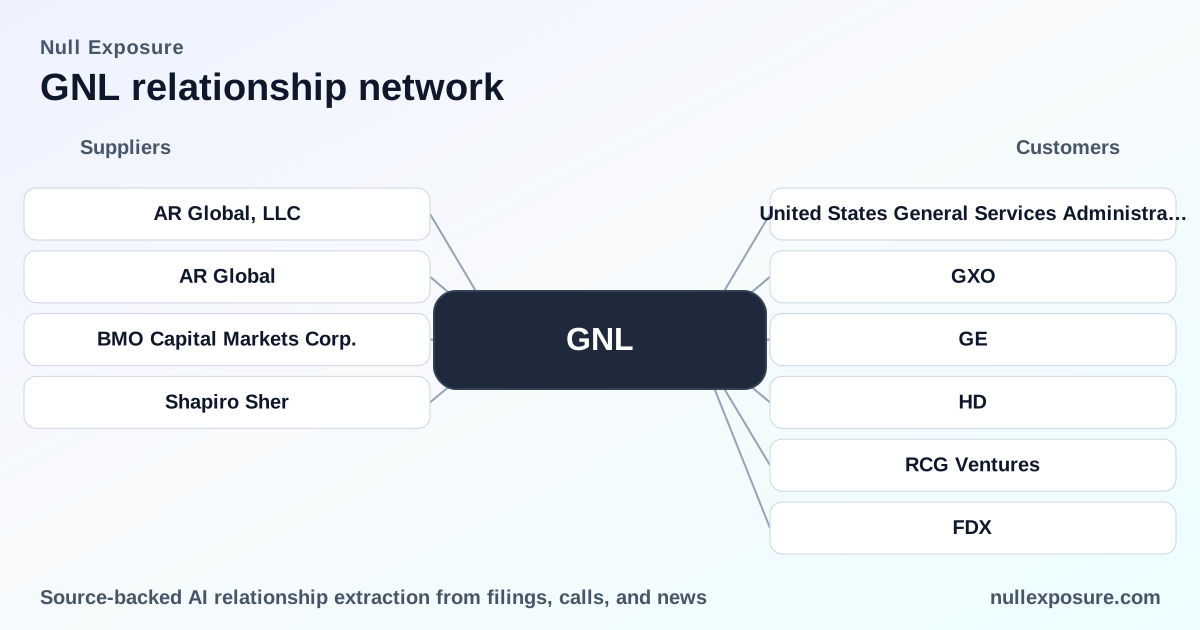
According to ConnectCRE on March 9, 2026, reporting tied to the merger between GNL and The Necessity Retail REIT, affiliates of AR Global, LLC currently perform external asset and property management functions that are slated to be internalized as part of the transactions. (ConnectCRE, March 9, 2026).
AR Global, LLC — company press release describes the internalization transaction
A PR Newswire release on March 9, 2026 stated that GNL and RTL have entered a definitive agreement to merge and to internalize the external asset and property management functions currently performed by affiliates of AR Global, LLC, explicitly framing the Internalization alongside the Merger as a combined transaction. (PR Newswire, March 9, 2026).
AR Global — activist critique of external manager incentives and governance
Blackwells Capital published a presentation and a website alleging value-destructive self-dealing by AR Global in its management of Global Net Lease and The Necessity Retail REIT, a narrative covered by The Globe and Mail on March 9, 2026 that elevates reputational and governance risk around the external manager relationship. (The Globe and Mail, March 9, 2026).
BMO Capital Markets Corp. — exclusive financial advisor to GNL’s special committee
PR Newswire indicates the GNL Special Committee retained BMO Capital Markets Corp. as its exclusive financial advisor, a conventional but consequential engagement that signals the committee sought independent valuation and transaction advice during the merger and internalization process. (PR Newswire, March 9, 2026).
Shapiro Sher — legal counsel to the special committee
The same PR Newswire release names Shapiro Sher as legal counsel to GNL’s Special Committee, underscoring that the board assembled independent legal representation to evaluate and negotiate the merger and the management internalization. (PR Newswire, March 9, 2026).
Why these supplier relationships change the investment equation
The combination of external manager scrutiny, activist pressure, and an announced internalization alters three investor-relevant dynamics:
- Cost structure and cash flow: Internalizing management functions shifts fees from third parties to corporate payroll and infrastructure, producing both one-time transition expenses and recurring savings over time; that dynamic directly affects funds available for dividends and debt coverage.
- Governance and control: The involvement of an independent special committee advised by BMO and Shapiro Sher indicates heightened governance rigor and a move to reduce conflicts of interest associated with an external manager.
- Reputational and litigation risk: Public activist filings and presentations directed at AR Global raise the possibility of disclosure disputes, litigation, or protracted shareholder activism campaigns that can disrupt execution and distract management.
These are not academic issues: for a net-lease REIT, changes in management contracting and the quality of advisors materially impact both valuation multiples and the stability of distributable cash flow. Investors should treat the internalization and advisor appointments as pivotal corporate events, not housekeeping items.
For a deeper supplier risk profile and timeline of the transaction, visit Null Exposure.
Practical implications for investors and operators
- Monitor near-term cash flow impacts: expect transition charges and a multi-quarter realization of fee savings; recalibrate dividend sustainability models against those numbers.
- Reassess governance risk premium in the cost of equity: activist pressure and external-manager allegations can compress multiples until the market validates improved alignment.
- Track vendor roll-off and replacement: internalization reduces dependence on a single external manager but raises execution risk as the company builds internal capability.
Bottom line and next steps
Global Net Lease is executing a material operational shift by moving from external management relationships into an internalized structure while relying on independent financial and legal advisors to validate that change. That shift reduces a key operational counterparty risk but introduces short-term execution and transition costs that investors must quantify. Governance improvements, if executed cleanly, justify a lower informational and governance discount; failure to execute will amplify activist-led valuation pressure.
To read more supplier intelligence and timeline analysis on GNL and peers, explore Null Exposure. For investor-grade alerts and supplier relationship monitoring, visit Null Exposure and subscribe for updates.