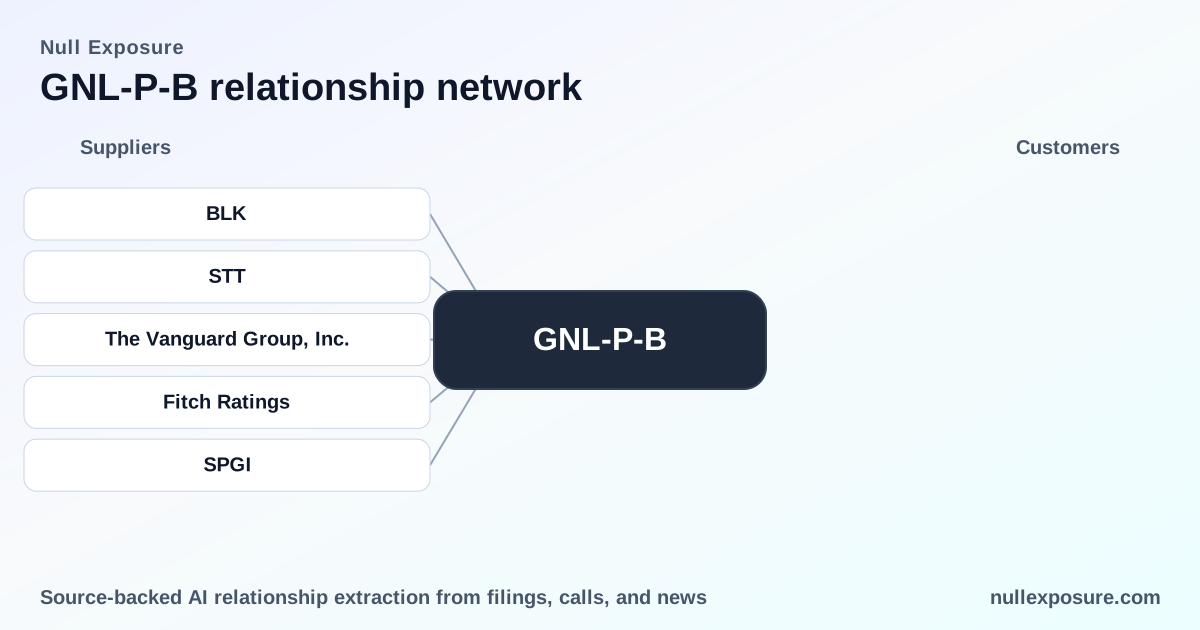
Global Net Lease (GNL-P-B): counterparty map and what it means for investors and operators
Global Net Lease (GNL-P-B) operates as a single-tenant, net-lease REIT that monetizes stable, long-duration cash flows by acquiring properties leased to creditworthy tenants across the United States and Europe and then managing those contracts to deliver predictable distributions to holders of its preferred securities and common equity. The firm's playbook is acquisition-driven portfolio growth, asset management to preserve lease economics, and capital-market activity to refinance and reprice risk into the capital structure. For an investor or operator evaluating supplier and counterparty exposures, the key is how counterparties influence access to deal flow, capital costs and credit profile. Visit https://nullexposure.com/ for a deeper counterparty study and data-driven diligence frameworks.
Strategic context: why this counterparty set matters
GNL’s recent public record ties it directly to large asset managers and rating agencies who shape both the supply of assets and the company’s cost of capital. Sellers like BlackRock, Vanguard and State Street are not casual counterparties — they are the institutional liquidity sources behind bulk REIT dispositions, and rating actions from Fitch and S&P materially change borrowing spreads and investor confidence. These relationships therefore translate into concrete operational levers: pipeline volume, pricing on acquisitions, and the credit spread on unsecured notes and preferred securities.
If you are underwriting GNL-P-B exposure, treat these counterparties as signals about (1) where GNL sources scale transactions, and (2) how external credit validation is recalibrating funding economics. If you want a full counterparty dossier, see the research hub at https://nullexposure.com/ for structured supplier intelligence.
Recent public actions that define the map
GNL completed a notable acquisition of The Necessity Retail REIT in a deal where major asset managers were sellers, and rating agencies have moved to investment-grade in the period after the transaction — both are discrete, observable events that change the company’s strategic posture and financing landscape.
Counterparties and relationships — a concise read for investors and operators
-
BlackRock, Inc.: Global Net Lease completed the acquisition of The Necessity Retail REIT from a group including BlackRock, positioning BlackRock as an institutional seller in a large portfolio disposition that helped GNL scale its portfolio. This was reported in a Simply Wall St profile of the company (reported March 9, 2026).
Source: Simply Wall St profile on Global Net Lease (Mar 9, 2026). -
State Street Corporation: State Street also participated as a seller in the The Necessity Retail REIT transaction that GNL closed, indicating State Street’s role in supplying institutional assets into the market. The seller list including State Street is noted in the same Simply Wall St report (March 9, 2026).
Source: Simply Wall St profile on Global Net Lease (Mar 9, 2026). -
The Vanguard Group, Inc.: Vanguard was identified among the sellers of The Necessity Retail REIT that GNL acquired, signaling that Vanguard’s portfolio rebalancing helped create a sizable acquisition opportunity for GNL. The transaction detail appears in the Simply Wall St company profile (reported March 9, 2026).
Source: Simply Wall St profile on Global Net Lease (Mar 9, 2026). -
Fitch Ratings: Fitch upgraded GNL’s corporate credit rating to BBB- from BB+, marking the company’s attainment of investment-grade status and directly improving credit market access and borrowing spreads, as described in a Sahm Capital summary of GNL’s 2025 accomplishments (January 8, 2026).
Source: Sahm Capital press summary of GNL strategic accomplishments (Jan 8, 2026). -
S&P Global: S&P Global raised GNL’s issuer-level rating on unsecured notes to BBB- from BB+, formally moving parts of GNL’s capital structure into investment-grade territory and reducing refinancing risk for unsecured debt, as reported in the same Sahm Capital communication (January 8, 2026).
Source: Sahm Capital press summary of GNL strategic accomplishments (Jan 8, 2026).
What these relationships imply for operating posture and business-model constraints
There are no explicit constraint excerpts provided in the supplier relationship feed, but the public relationships and rating actions give clear company-level signals that shape how GNL runs its business:
-
Contracting posture: Long-term, net lease contracts drive low turnover and predictable cash flow, which allows GNL to underwrite acquisitions aggressively when institutional sellers bring scale portfolios to market. This negotiating posture favors buy-and-hold economics rather than active leasing risk.
-
Concentration and sourcing: The presence of BlackRock, Vanguard and State Street as sellers is a signal that GNL sources large, pooled portfolios from major institutional managers, reducing the friction of sourcing but increasing sensitivity to institutional disposition cycles.
-
Criticality to operations: Rating upgrades by Fitch and S&P are critical operating factors, not peripheral signals — investment-grade status materially lowers GNL’s marginal cost of unsecured debt and affects preferred-security yields that directly impact the economics of GNL-P-B holders.
-
Maturity and transition: The move to investment-grade reflects a transition in GNL’s financial maturity and governance profile; capital markets now price GNL with a different risk lens, which affects acquisition underwriting, leverage tolerance and preferred dividend coverage expectations.
Each of these constraints is a company-level characteristic derived from observed counterparties and rating actions, and none are attributed to a specific supplier unless named above.
Visit https://nullexposure.com/ to download a workflow for translating these signals into counterparty-adjusted valuation and stress-test inputs.
Risk vectors and what operators should monitor
-
Integration risk from large portfolio acquisitions: scaling acquisition volume from institutional sellers increases execution risk — integration of leases, tax structures and cross-border operations are the first-order operational exposures.
-
Counterparty cycle risk: When asset managers rotate allocations, GNL’s pipeline can expand or contract quickly; deal flow volatility affects deployed capital and short-term leverage.
-
Interest-rate and credit-spread sensitivity: The recent upgrades reduce spread risk, but preferred security holders remain sensitive to shifts in unsecured and senior credit markets, especially if the company pursues additional unsecured issuance.
-
Market perception and liquidity for the preferred class: Preferred securities trade on investor sentiment and credit optics; rating agency actions have an outsized effect on liquidity and quoted yields.
Actionable conclusions and recommended next steps
-
For investors: Reprice preferred exposure to reflect the upgraded credit profile — rating upgrades materially compress required yields, but monitor acquisition cadence from institutional sellers because that pipeline drives growth assumptions.
-
For operators/supply-side partners: Position to be a willing buyer alongside GNL when large asset managers offer bulk portfolios; GNL is a repeat acquirer of scale transactions, and those dispositions set the terms of trade for third-party operators.
-
For diligence teams: Build triggers around institutional-seller activity and rating-agency notices; those two datasets are the highest-leverage inputs for short-term valuation and counterparty risk models.
For a structured counterparty playbook and deeper supplier intelligence on GNL-P-B, check our methodology and dossiers at https://nullexposure.com/.