GNL-P-D: Net-lease positioning, asset rotation, and what a JLL listing signals for investors
Global Net Lease (ticker GNL-P-D) operates as a net-lease REIT that acquires, manages and recycles mission-critical properties with long-term leases, collecting predictable rental cash flow and monetizing through disciplined dispositions and portfolio reweighting to preserve yield and NAV. The firm’s core monetization levers are long-duration lease income, selective asset sales, and capitalization events that convert illiquid real estate into distributable returns. For coverage of supplier relationships and counterparty mapping, explore NullExposure’s supplier intelligence at https://nullexposure.com/.
What the business model implies for supplier relationships
Global Net Lease’s operating model is built around tenant credit and lease duration — the company underwrites properties primarily on the basis of tenant financial strength and the stability of long-term contractual cash flows. That posture produces three practical supplier dynamics:
- Brokerage and capital markets relationships are execution-critical when GNL-P-D chooses to rotate assets; trusted brokers accelerate sale timelines and preserve pricing.
- Property management and legal suppliers are second-order critical because net-lease exposure reduces active management but increases the importance of lease enforcement and lease transfer capability.
- Vendor concentration is moderate because the company’s strategy is to buy widely across geographies and sectors, but individual transactions can create one-off dependence on specific advisers or brokers.
These dynamics make brokerage partners — especially market-leading firms — strategically important to GNL-P-D’s capital recycling and yield-management process. For an integrated look at supplier mappings and how relationships affect valuation, visit https://nullexposure.com/.
What the public relationship data shows (complete coverage)
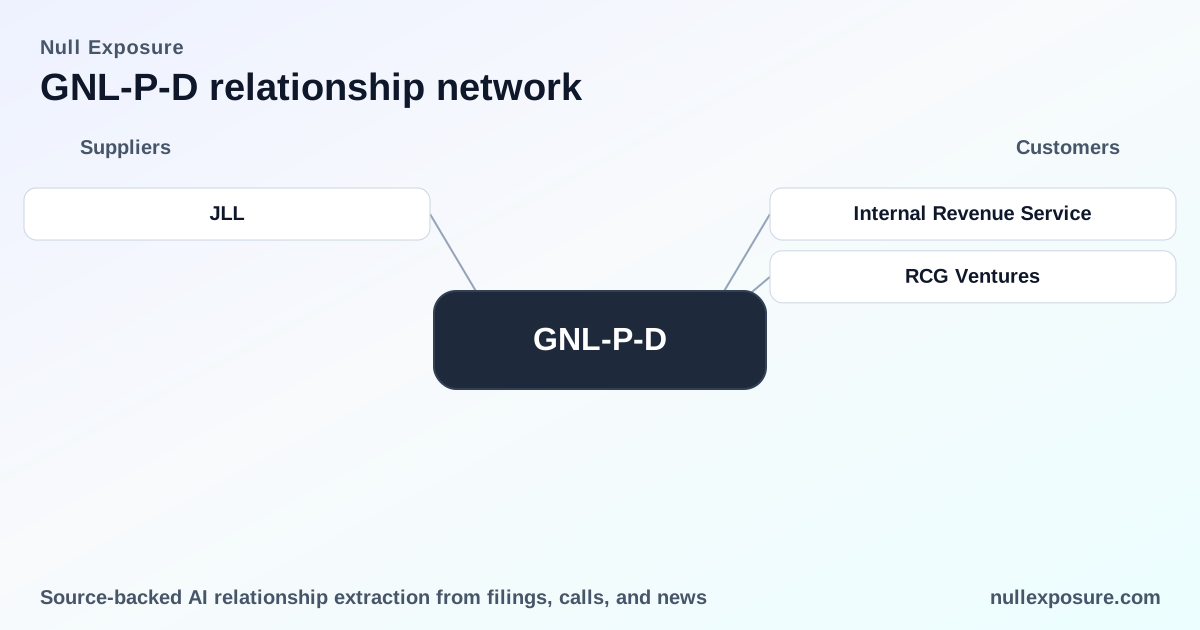
Global Net Lease’s available supplier relationship record for this review lists one brokerage interaction.
JLL — Commercial brokerage and marketing for a listed asset: Global Net Lease listed a five-story, 135,000-square-foot office building at 127 International Drive in Franklin, Tennessee — originally built for the Internal Revenue Service — and JLL is marketing the property as a plug-and-play headquarters opportunity. According to The Real Deal’s coverage of a Nashville Business Journal report (April 2025), the listing is live and positioned for occupier or investor pickup (https://therealdeal.com/national/nashville/2025/04/01/nashville-irs-building-for-sale-after-doge-kills-lease/).
Takeaway: JLL is acting as the external marketing and transaction execution partner on a high-profile disposition, giving GNL-P-D access to broad institutional and occupier buyers while reducing internal execution cost and timeline risk.
Why this JLL engagement matters strategically
The presence of JLL on a sale listing is a concrete signal about how GNL-P-D handles asset rotation:
- Execution-first disposition: Hiring a market-leading broker like JLL prioritizes speed-to-market and broad buyer canvassing, which preserves bid competition and supports stronger sale proceeds.
- Repositioning optionality: Marketing a former government-built asset as a “plug-and-play headquarters” widens the buyer set beyond single-tenant net-lease investors to corporate occupiers, which can enhance exit price.
- Capital recycling discipline: Disposing of specific assets while using external brokers allows GNL-P-D to redeploy capital into higher-yielding or more credit-stable opportunities without building permanent in-house sales capacity.
These items are operationally significant because they illustrate GNL-P-D’s active asset-management posture: the company is not a pure buy-and-hold collector but uses market execution partners to optimize its portfolio composition.
Company-level constraints and signals investors should factor in
Several operating-model constraints stand out as company-level signals rather than being tied to any specific supplier:
- Data visibility constraint: Publicly available financial metrics for this listing (EPS, revenue, debt metrics) are absent, which signals limited public disclosure or mapping issues for the ticker record; investors must rely on transaction-level reporting and filings rather than a granular public financial feed.
- Contracting posture: GNL-P-D exhibits a long-term lease contracting posture; the business prioritizes tenant-credit as an underwriting anchor and structures agreements to preserve predictable cash flows.
- Concentration management: The firm emphasizes geographic and sector diversification across net-lease assets to moderate cyclical risk, but single-asset dispositions can still materially affect short-term cash deployment.
- Maturity and market role: The company operates with mature REIT mechanics — rental yield capture and asset rotation — rather than venture-stage growth strategies, making supplier relationships oriented toward execution and cost-efficiency.
These signals should shape diligence: if disclosure is limited, third-party supplier actions (like a JLL listing) become higher-signal events for portfolio and liquidity assessments.
For a deeper mapping of supplier impacts across portfolios, see NullExposure’s supplier coverage hub at https://nullexposure.com/.
Risks and opportunities for operators and capital allocators
- Risk: Concentration around execution partners. Heavy reliance on top-tier brokers for sale execution can compress margin through fees in strong markets but can also preserve price in weak markets; investors should evaluate fee structures against realized sale proceeds.
- Opportunity: Broader buyer sets via repositioning. Marketing single-tenant assets as multi-use headquarters expands the potential buyer pool and can extract structural premiums when occupancy or lease term encumbrances are limited.
- Risk: Information asymmetry. When public financials are sparse, events like brokered listings become de facto disclosure; monitor local market coverage and broker teasers for early signals on portfolio rotation.
Practical next steps for investors and operators
- Track advertised dispositions and broker appointments as high-signal events for capital recycling and NAV movement; broker listings often lead price discovery well before filings.
- Stress-test tenant-credit outcomes for key assets and evaluate how third-party execution (brokerage) affects timing and proceeds assumptions in underwriting.
- Engage counterparties with a record of fast, high-quality executions; that reduces timing risk and supports smoother capital redeployments.
For supplier intelligence and to monitor future listings and counterparty activity, visit NullExposure at https://nullexposure.com/.
Global Net Lease is operating within a classic net-lease playbook: monetize stable lease cash flows while using top-tier brokers to optimize asset rotation. The JLL listing is a practical example of that strategy in action — a deliberate execution choice that informs both liquidity and valuation expectations. For continuous supplier mapping and actionable signals that affect portfolio valuations, return to https://nullexposure.com/.