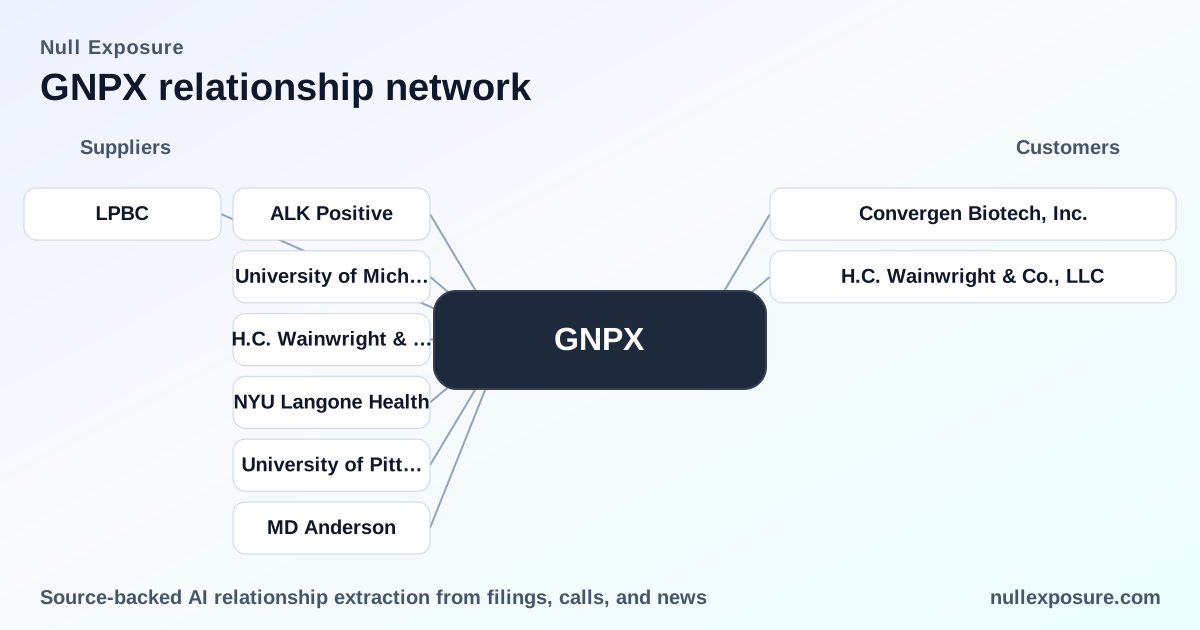
Genprex (GNPX) supplier landscape: the partner web behind REQORSA and GPX‑002
Genprex is a clinical‑stage gene therapy company that builds value by licensing academic IP, advancing product candidates through sponsored research and clinical trials, and outsourcing manufacturing and distribution to third parties; the company monetizes through eventual product commercialization, licensing milestones/royalties and capital markets activity. Genprex’s operating model is partner‑centric: academic licenses and SRAs secure novel IP, CDMOs and contract service providers convert that IP into clinical‑grade material, and financing partners bridge cash flow until commercial revenues materialize. For investors, understanding those supplier relationships is essential to modeling development timelines, capital needs and regulatory risk.
Explore more supplier intelligence at https://nullexposure.com/.
How Genprex contracts and where the operational risk sits
Genprex’s disclosures establish a clear contracting posture: the company uses a mix of long‑term development agreements and exclusive licensing deals with academic institutions, and it outsources manufacturing and distribution to third‑party CDMOs and service organizations. This creates a working model with several observable characteristics:
- Contracting posture: Genprex executes multi‑year development and license agreements that embed milestone and payment schedules, reflecting a strategic preference to acquire IP and outsource execution.
- Criticality and concentration: Manufacturing and release testing are mission‑critical functions performed by third parties; failure at these nodes would materially harm development and commercialization.
- Maturity of relationships: Multiple active licenses and SRAs indicate an established academic partnership footprint, while the use of CDMOs indicates transition from preclinical academic production to scalable clinical manufacturing.
- Spend profile: Commitments in the low‑single‑digit millions for development services suggest moderate per‑supplier spend rather than heavy internal CapEx.
These are company‑level signals drawn from Genprex’s filings and press disclosures; specific contracts and terminations are disclosed where relevant.
The partner roll call — who Genprex works with and what each relationship delivers
ALK Positive
Genprex collaborated with ALK Positive, a patient‑driven non‑profit, which co‑sponsored a preclinical study assessing REQORSA in ALK‑positive lung cancer — an example of patient‑group funding and advocacy accelerating niche translational research. According to press reporting in FY2025, ALK Positive joined sponsorship of an October 2024 preclinical collaboration (BioSpace / AIJourn coverage, FY2025).
University of Michigan Rogel Cancer Center
Genprex entered into a Sponsored Research Agreement with the University of Michigan Rogel Cancer Center in October 2024 to study TUSC2 (the tumor suppressor gene in REQORSA) in combination with ALK‑inhibitors for ALK‑EML4 positive translocated lung cancer, reflecting an exclusive research pathway to broaden REQORSA’s oncology indications (BioSpace and AIJourn coverage, FY2025).
H.C. Wainwright & Co.
H.C. Wainwright & Co. served as the exclusive placement agent for a registered direct offering announced in FY2025, functioning as a financing partner that helps Genprex access market capital for clinical programs and operations (PR Newswire release, FY2025).
NYU Langone Health
Genprex signed an exclusive patent license agreement with NYU Langone Health related to REQORSA, converting academic IP into an exclusive commercial position for that drug candidate — a direct example of Genprex’s IP‑acquisition and licensing strategy (PR Newswire announcement, FY2025).
University of Pittsburgh
Genprex executed an exclusive license agreement with the University of Pittsburgh for diabetes gene therapy technology and created a wholly‑owned subsidiary, Convergen Biotech, Inc., to develop GPX‑002, illustrating a deliberate carve‑out strategy to commercialize non‑oncology programs (Quartz earnings coverage, FY2025).
MD Anderson
Genprex completed a technology transfer from MD Anderson and moved manufacturing to commercial CDMOs, scaling clinical production for Acclaim‑1 and Acclaim‑3 trials; this shift underscores operational scaling and the company’s reliance on external manufacturers for GMP‑grade supply (Quartz / company communications, FY2025).
Lincoln Park (LPBC)
Genprex restructured its financing facility with Lincoln Park Capital, a committed funding line of up to $22 million, reinforcing how equity financing facilities are integrated into its liquidity strategy to underwrite ongoing clinical development (Parameter.io coverage, FY2025).
What the disclosed constraints mean for valuation and risk modeling
Genprex’s public disclosures and constraint signals shape three investment‑relevant conclusions:
- Manufacturing is a single‑point criticality. Multiple excerpts state the company relies on CDMOs for REQORSA and GPX‑002 and that failure to produce cGMP material would be materially harmful. Treat manufacturing risk as a high‑impact, moderate‑probability event when stress‑testing upside scenarios.
- Licensing and academic SRAs are core to the product pipeline. Exclusive licenses with institutions such as the University of Pittsburgh, NYU Langone and the University of Michigan are value drivers — they underpin the company’s IP position and justify future milestone and royalty assumptions.
- Contract length and spend suggest predictable near‑term outlays. Evidence of three‑year development services agreements and a disclosed ~$4.5M projected contract cost at inception indicate multi‑year operational commitments within a $1M–$10M spend band; model committed cash needs accordingly.
Other important company‑level signals: geography exposure includes an explicit note on global supply‑chain risk, relationships are predominantly active (with one disclosed mutual termination of a development services agreement in mid‑2024), and the firm uses third‑party service providers for clinical trial conduct and release testing — all of which increase counterparty and operational risk while keeping capital intensity low.
Investment implications and next steps
For investors and operators, the structure of Genprex’s supplier network is both a strength and an execution risk. Strengths: exclusive academic licenses provide differentiated IP and co‑sponsored research connects R&D to patient communities; financing facilities and placement agents supply runway. Risks: third‑party manufacturing and distribution are mission‑critical and create operational single‑points of failure; a terminated CDMO agreement in 2024 and the ongoing need to scale CDMO relationships are execution items to monitor closely.
If you’re evaluating Genprex as a supplier‑risk or investment case, prioritize verification of current CDMO supply agreements, review milestone schedules in the University licenses, and model the financing cadence implied by placement agent and Lincoln Park facilities. Learn more about mapping supplier exposure at https://nullexposure.com/.
For a deeper supplier‑level diligence package and continuous monitoring of Genprex’s partner ecosystem, visit https://nullexposure.com/ — the right partner intelligence accelerates decision‑making and reduces model risk.
Summary takeaway: Genprex operates a partner‑first commercial model where academic licenses and outsourced manufacturing drive value — investors should underwrite the upside to IP and clinical data while sizing material downside from third‑party manufacturing and financing execution.