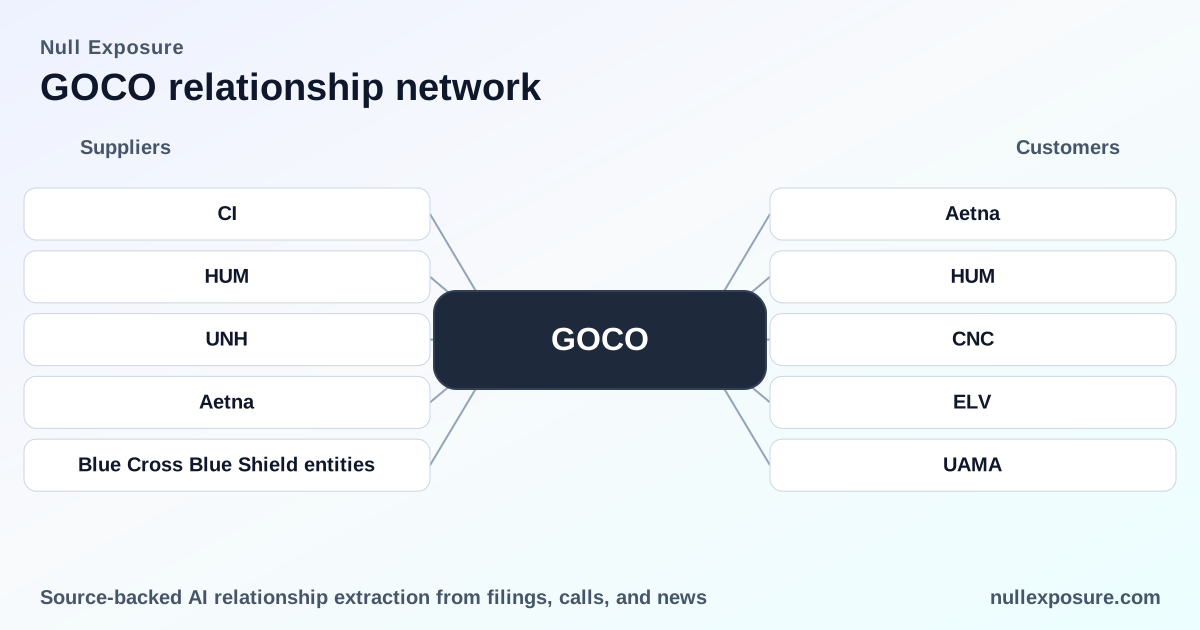
GoHealth (GOCO) supplier and partner map — what investors need to know
GoHealth operates a Medicare-focused digital marketplace that connects consumers to insurance plans and sells value-added technology and enrollment services to payers and brokers. The company monetizes through plan broker commissions, platform fees, and services sold to insurers and partners, leveraging its digital distribution and lead-generation capabilities to capture enrollment economics across Medicare and individual insurance markets. For a structured supplier and counterparty view, see the full analysis at https://nullexposure.com/.
Strategic payer partnerships that define product access
GoHealth’s commercial reach is fundamentally driven by its relationships with a set of national payers. A MarketBeat review lists the core partners that populate the company’s product shelf: UnitedHealthcare, Humana, Aetna, Cigna and Blue Cross Blue Shield entities (MarketBeat, Dec 13, 2025). Each relationship below is summarized from that coverage.
UnitedHealthcare
GoHealth maintains a strategic distribution relationship with UnitedHealthcare to offer the insurer’s Medicare plans through GoHealth’s online marketplace and enrollment channels. A MarketBeat article (Dec 13, 2025) cites UnitedHealthcare as one of the major providers on GoHealth’s platform.
Humana
Humana is listed among the national carriers whose Medicare and supplemental plans are offered via GoHealth’s consumer-facing channels, expanding plan choice and driving enrollment-based revenue. MarketBeat (Dec 13, 2025) documents Humana as a core partner for plan distribution.
Aetna
Aetna’s plan inventory is integrated into GoHealth’s marketplace to provide consumers access to Aetna Medicare options, supporting GoHealth’s monetization through commissions and referral fees. MarketBeat (Dec 13, 2025) includes Aetna in the roster of strategic insurance partners.
Cigna
Cigna is cited as one of the major insurance providers participating on GoHealth’s platform, which broadens plan selection and helps sustain the company’s enrollment volumes. MarketBeat (Dec 13, 2025) includes Cigna in its listing of GoHealth partners.
Blue Cross Blue Shield entities
Multiple Blue Cross Blue Shield entities are available on GoHealth’s marketplace, providing regional plan depth that complements the national carriers and supports localized sales funnels. MarketBeat (Dec 13, 2025) groups BCBS entities among GoHealth’s strategic partnerships.
How contractual and operating constraints shape supplier posture
GoHealth’s disclosures and filings show a supplier and operating model shaped by a handful of persistent constraints that are material to supplier risk and capital allocation.
- Long-term real estate commitments. The company has operating lease agreements with expirations between 2025 and 2032; aggregate lease payments were $5.5 million for the twelve months ended Dec 31, 2024 (company filings for the period). These leases create a mid-sized fixed-cost footprint that influences cash flow and operating leverage.
- Government exposure through CMS. GoHealth identifies a federal-government sensitivity—specifically, the potential operational impact of a federal government shutdown on CMS—making regulatory cadence and federal funding a systemic business risk rather than a single-vendor issue (company disclosure).
- Reliance on third‑party service providers. The company contracts telephony, bandwidth, cybersecurity vendors, and other technology service providers to operate its platform; GoHealth defines these partners as service providers in its regulatory filings and describes ongoing third‑party assessments to secure operations (company filing). This positions vendors as critical operational nodes whose availability and security posture are consequential for enrollment operations.
- Spend scale signal. Lease-level cash outflows in the $1M–$10M range for recent years indicate modest but non-trivial facilities spending and suggest a company with distributed vendor relationships rather than heavy capital intensity.
These constraints are company-level signals that govern contracting posture, operational maturity, and vendor criticality across GoHealth’s supplier base.
What that means for investors: concentration, criticality, maturity
GoHealth’s model balances breadth of payer relationships with concentrated operational dependencies.
- Concentration vs. diversification. Partnering with large national payers like UnitedHealthcare, Humana, Aetna and Cigna provides broad product access and scale distribution, reducing single-carrier dependence. At the same time, revenue economics are tied to enrollment flows and the willingness of those carriers to channel business through third-party marketplaces, making the payer relationship set strategically critical.
- Contractual maturity and posture. Long-term lease commitments and documented vendor reliance indicate a mature operating posture with established third-party relationships and predictable fixed costs, rather than a nascent or ad-hoc supplier base.
- Operational criticality. Telephony, bandwidth and cybersecurity vendors are directly linked to the company’s ability to process enrollments and protect consumer data; these suppliers are operationally critical and warrant targeted due diligence by counterparty managers and insurers.
- Financial context. GoHealth reported revenue TTM of $738.3 million with negative EPS and thin operating margins in the latest public figures (latest quarter 2025-09-30), which underscores why distribution economics and payer terms are central to long-term profitability (public financials).
For a unified supplier-risk view and tailored monitoring tools, visit https://nullexposure.com/ to access deeper reporting.
Practical diligence checklist for operators and investors
- Validate contractual reach and exclusivity terms with each listed payer partner (UnitedHealthcare, Humana, Aetna, Cigna, BCBS entities) and confirm how lead flows convert to revenue.
- Audit vendor continuity and incident response for telephony, bandwidth and cybersecurity providers; these are single points of failure for enrollment operations per company filings.
- Stress-test lease obligations against conservative revenue scenarios given the multi-year lease horizon and the company’s current margin profile.
- Monitor CMS funding and regulatory timelines as a top-line risk vector for Medicare-centric distribution.
Bottom line and next steps
GoHealth is a distribution-first platform that derives value from broad payer relationships and an established vendor ecosystem, but its operating model is shaped by long-term lease commitments, dependencies on third-party service providers, and exposure to federal program dynamics. Investors and operators should treat the listed insurers as strategic access points while prioritizing vendor resilience and contract-level diligence.
For a consolidated supplier-risk profile and continuous monitoring of GOCO counterparties, visit https://nullexposure.com/. For bespoke research or subscription access to supplier mapping and alerts, start at https://nullexposure.com/ and request a demo.