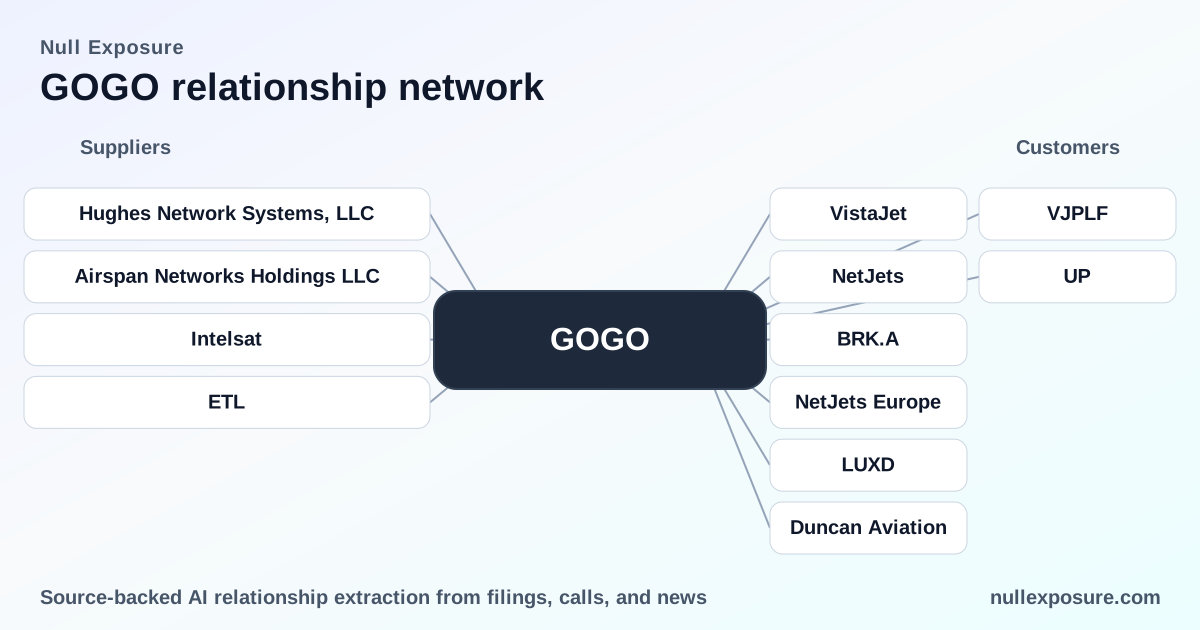
Gogo Inc.: supplier map and what it means for investors
Gogo Inc. provides inflight broadband and wireless entertainment to commercial and business aviation and monetizes through a combination of connectivity service contracts, hardware sales and long-term supplier commitments, and revenue-share arrangements with satellite partners. The company operates a hybrid model: it designs and assembles key airborne electronics in-house, outsources antenna manufacturing and satellite capacity, and extracts recurring cash flow from onboard subscriptions and airline contracts. For investors evaluating counterparty risk and supplier exposure, the balance of capital commitments and partner revenue-sharing is the primary lens to judge operational leverage and concentration.
For more supplier intelligence on Gogo, visit https://nullexposure.com/.
How Gogo makes money — the business drivers investors should track
Gogo’s revenue mix combines service subscriptions and usage fees for inflight Wi‑Fi with hardware sales and long-term purchase commitments for terminals and antennas. The company reported $910.5M in trailing twelve‑month revenue with $188.8M EBITDA, indicating a profitable core but ongoing capital intensity driven by network equipment purchases and satellite capacity. Gogo’s operating margin was ~6% and its forward valuation metrics (Forward PE ~8.6) reflect expectations of higher earnings as deployment scales. The corporate model rests on three commercial levers: recurring connectivity revenue, capital commitments to secure capacity and antennas, and partner revenue‑sharing for ATG/LEO services.
Supplier relationships that materially affect operations
Below are the supplier and partner relationships identified in recent public sources. Each relationship is summarized in plain English with a concise source citation.
Hughes Network Systems, LLC
Hughes has commenced shipments of Gogo FDX ESA terminals engineered for larger airframes and higher‑throughput connectivity, which supports Gogo’s transition toward higher‑capacity satellite terminals. According to MarketScreener coverage on March 9, 2026, Hughes is a manufacturing/terminal supplier for Gogo’s FDX equipment.
Airspan Networks Holdings LLC
Airspan enabled the commercial launch of Gogo’s next‑generation 5G Air‑To‑Ground communications platform, supporting Gogo’s ATG expansion and terrestrial connectivity capabilities. MarketScreener reported this linkage on March 9, 2026 in the context of Gogo product rollouts and filings.
Intelsat
Intelsat is a revenue‑sharing partner under Gogo’s ATG Network Sharing Agreement; Gogo explicitly excludes ATG revenue share from certain internal calculations, signaling the commercial importance and accounting separation of that arrangement. This detail was noted in Gogo’s 4Q/2025 results commentary published via Sahm Capital on February 27, 2026.
Eutelsat (ETL)
Gogo cited Galileo operating on the Eutelsat OneWeb satellite network and highlighted Eutelsat’s capital actions to support a 414‑satellite LEO order that secures long‑term capacity for Gogo’s services. This remark came from Gogo’s Q4 2025 earnings call on March 7, 2026 and frames Eutelsat as a strategic satellite capacity provider.
Company‑level constraints that define supplier risk and contracting posture
Gogo’s public disclosures and excerpts point to several operating characteristics investors should treat as structural signals:
- Long‑term procurement posture. Gogo has multi‑year purchase commitments tied to antenna programs and project milestones. The company disclosed purchase commitments over seven‑year schedules for full duplex and HDX antennas, indicating supplier relationships that extend across the capital lifecycle of aircraft installations.
- High aggregate capital commitments. Excerpts reference aggregate antenna purchase obligations in excess of $100M, placing these suppliers in a high‑spend band and creating multi‑year cash outflows tied to supplier performance and delivery schedules.
- Hybrid manufacturer/licensor/service provider roles. Gogo designs and assembles many airborne LRUs in‑house while relying on third parties for antenna manufacture, licensing and satellite resale, which creates mixed criticality: Gogo controls some IP and assembly but depends on external vendors for key antenna components and capacity.
- Lease and term commitments. Operating leases and future minimum lease payments are multi‑year in nature; the company notes operating leases with six‑year terms and disclosed future minimum lease obligations, signaling fixed‑cost commitments that reduce short‑term flexibility.
- Materiality posture on incidents. Gogo described prior cybersecurity incidents as not having produced material effects to date, which positions these vendor risks as monitored but not historically disruptive to financial condition.
These constraints describe a supplier network that is capital intensive, long‑dated, and strategically critical, with supplier performance directly tied to Gogo’s ability to deploy higher‑capacity services and preserve margins.
For more on how these supplier arrangements affect credit and operational risk models, explore our analysis hub at https://nullexposure.com/.
Investment implications: concentrated commitments, strategic optionality, and execution risk
- Capital absorption will be front‑loaded. The multi‑year antenna purchase commitments and leases lock cash flow into supplier relationships while Gogo scales recurring revenue; investors must track delivery timing and how capex profiles convert into higher ARPU (average revenue per unit).
- Supplier concentration creates execution risk. Dependence on a small set of antenna and satellite providers (Hughes, Eutelsat/OneWeb, Intelsat, Airspan) creates potential single‑point delivery risk during ramp periods; contract length and co‑design responsibility mitigate some risk but increase switching costs.
- Revenue sharing diversifies commercial exposure but complicates margins. Revenue‑share agreements, like the ATG deal with Intelsat, broaden distribution but change cash flow timing and margin calculations; investors should separate service cash flow from hardware financing when modeling profitability.
- Operational continuity tied to satellite capacity expansions. Eutelsat’s LEO orders and OneWeb integration materially support Gogo’s long‑term capacity plan; successful LEO deployments reduce reliance on legacy GEO links and improve latency/throughput.
Key takeaway: Gogo’s supplier architecture is structured for scale — long contracts and significant spend secure capacity and terminals — but that structure also concentrates execution risk and requires careful monitoring of milestone deliveries and partner financial health.
Final judgement and next steps for investors
Gogo is a connectivity company executing a capital‑intensive rollout supported by multi‑year supplier commitments and strategic satellite partners. Evaluate Gogo’s risk profile by tracking supplier delivery milestones, antenna shipment schedules (Hughes), commercial launches (Airspan), revenue‑share accounting (Intelsat), and satellite capacity confirmations (Eutelsat). For actionable supplier risk scores and ongoing monitoring, visit our portal at https://nullexposure.com/.
If you want a supplier‑level briefing or a deeper diligence package on Gogo’s counterparty exposures, our team can provide tailored tracking and scenario analysis. Contact us through the homepage linked above for the next step.