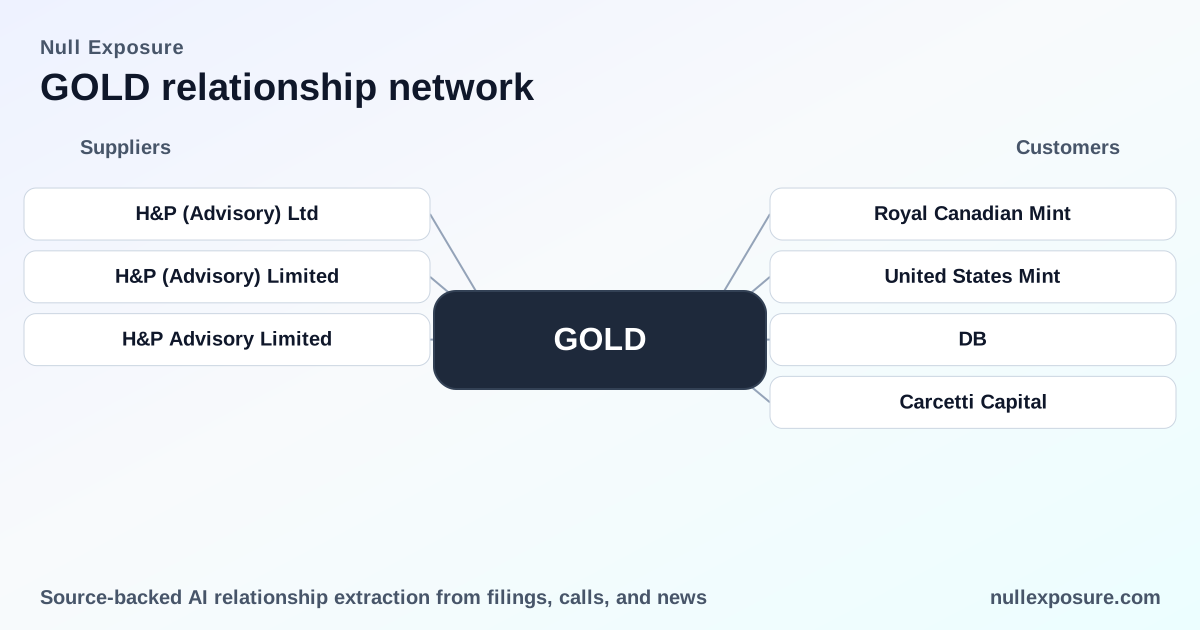
GOLD supplier relationships: what operators and investors need to know
Gold.com, Inc. (ticker: GOLD) operates as an integrated precious‑metals merchant and distributor that monetizes through high‑volume inventory turnover, financing facilities and leasing arrangements: the company purchases, borrows and resells coins, bars and refined metal; it leases metals on short terms; and it funds trading and inventory through a dedicated Trading Credit Facility and product‑financing arrangements. Revenue scale, short‑term metal leasing and concentrated financing lines drive both gross volume and counterparty risk exposure. For a quick company snapshot visit https://nullexposure.com/.
Headline thesis for investors
GOLD generates revenue by acting as both a buyer and seller of precious metals and as an authorized distributor for sovereign and private mints, extracting margin on inventory spreads while using short‑term leases and committed credit lines to support working capital. The business model is capital‑intensive and liquidity‑sensitive: large product‑financing obligations and short‑term leased metals are structural features that determine supplier criticality and counterparty posture.
What the public record shows about recent supplier disputes
H&P Advisory has three separate mentions in the monitoring set; each entry documents the same fee dispute connected to the Barrick/Randgold merger. Below are the three source references captured.
H&P (Advisory) Ltd — Norton Rose Fulbright (Mar 2026)
H&P claimed over US$18 million in advisory fees tied to an alleged oral agreement for advisory services related to the merger between Barrick Gold Corporation and Randgold Resources. According to the Norton Rose Fulbright discussion of the decision, that fee claim was the central issue in the dispute (FY2025). Source: https://www.nortonrosefulbright.com/en-gb/inside-disputes/blog/202506-discussing-the-recent-decision-in-hp-advisory-limited-v-barrick-gold
H&P (Advisory) Limited — Norton Rose Fulbright case note (Mar 2026)
The same coverage notes H&P’s claim stemmed from an alleged oral agreement between H&P’s representative and Randgold’s CFO on 24 April 2018, under which H&P was appointed financial advisor on the merger—this is the factual basis for the fee claim (FY2025). Source: https://www.nortonrosefulbright.com/en/knowledge/publications/89f5a9e4/h-p-advisory-limited-v-barrick-gold-holdings-limited
H&P Advisory Limited — Solicitors Journal court report (Mar 2026)
A Solicitors Journal summary reiterates that the dispute was focused on entitlement to fees after the Barrick/Randgold merger, documenting the litigation outcome and the factual dispute over advisory appointment and payment (FY2025). Source: https://www.solicitorsjournal.com/sjarticle/hp-advisory-limited-prevails-against-barrick?category=Court+Report
How the constraints shape supplier risk and contracting posture
The public constraint excerpts from company disclosures produce a coherent operating model profile that investors should treat as fact:
- Mixed contract tenor with short‑term dominance. The company routinely borrows precious metals under short‑term leases that are priced and settled at lease inception, and these leasing arrangements are structured so the firm can sell pooled metals advanced. At the same time, the firm maintains longer‑dated financing: the Trading Credit Facility gave the company up to $467.0 million of access with a maturity on September 30, 2026 (disclosed as of June 30, 2025). This combination makes the firm operationally dependent on rolling short‑term metal leases and a near‑term banking facility for liquidity.
- Counterparty mix includes sovereign mints and government institutions. The company is an authorized distributor/purchaser for major sovereign mints worldwide—United States Mint, Royal Canadian Mint, Royal Mint (UK), China Mint, Banco de Mexico, Australian (Perth) Mint and others—giving diversified access to supply while introducing operational complexity across jurisdictions.
- Global footprint and market‑making relationships. The firm maintains relationships with major market makers in every major precious‑metals dealing center and claims access to global precious‑metals markets for hedging—this supports execution capability but increases monitoring needs across time zones and regulatory regimes.
- Financial exposure concentrated in financing lines and leased inventory. Product financing obligations were $484.7 million as of June 30, 2025 (and $517.7 million as of June 30, 2024), while borrowed‑metal liabilities reported market values of $46.1 million at June 30, 2025 (and $32.0 million at June 30, 2024). These balances mark meaningful counterparty exposure and working‑capital spend consistent with a $15.7 billion revenue run‑rate.
- Risk management posture downplays market‑risk materiality. The company states that, because of hedging strategies, exposures to interest‑rate, market‑price and FX risk are not material, which is a corporate signal that the firm prioritizes transactional hedging over speculative market positions.
- Role flexibility: buyer, seller, and manufacturer. The company acts as a purchaser of inventory, a seller/distributor and a manufacturer (owning at least one silver mint), implying multi‑role counterparty relationships that both diversify revenue streams and concentrate operational dependencies.
These constraints are corporate‑level signals drawn from the company’s FY2025 disclosures; they inform supplier criticality, tenor mismatch risk and the scale of financing reliance.
Key investment takeaways
- Liquidity sensitivity is the primary supplier‑related risk: short‑term leased metals and a large, near‑dated Trading Credit Facility create rollover exposure.
- Sovereign mint relationships materially reduce single‑source risk because supply comes from multiple government mints, but they do not eliminate short‑term funding requirements.
- Legal disputes captured in the public record (H&P) are discrete and capped—the headline claim is roughly US$18 million—but such disputes are signal events that increase legal and advisory counterparty diligence.
- Scale of product financing (> $480M) makes supplier financing indistinguishable from operating funding; monitor covenant and maturity schedules closely.
What operators and buyers should watch next
Operational teams must prioritize three areas: covenant and facility maturity management, counterparty onboarding for sovereign and private mints, and active oversight of leased metal positions. Neglecting any single area will create leverage‑driven supplier risk, because product financing and short‑term leases are foundational to daily operations. For further analysis and supplier mapping tools, visit https://nullexposure.com/.
Bottom line and recommended next steps
GOLD runs a high‑turnover, capital‑intensive supplier model where short‑term metal leases plus concentrated credit facilities drive operational risk while sovereign‑mint relationships provide diversified supply. Investors should monitor the Trading Credit Facility maturity, product‑financing levels and any additional litigation disclosures stemming from advisory fee claims. Operators should document roll‑over plans for leased metals and stress test funding under scenarios where the Trading Credit Facility is constrained.
For detailed mapping of supplier counterparties and a tailored briefing on GOLD’s supplier exposures, start here: https://nullexposure.com/. For partnership‑level insight and ongoing monitoring, return to https://nullexposure.com/ for subscription options and briefings.