Gladstone Commercial (GOOD): The supplier map that underwrites a conservative REIT strategy
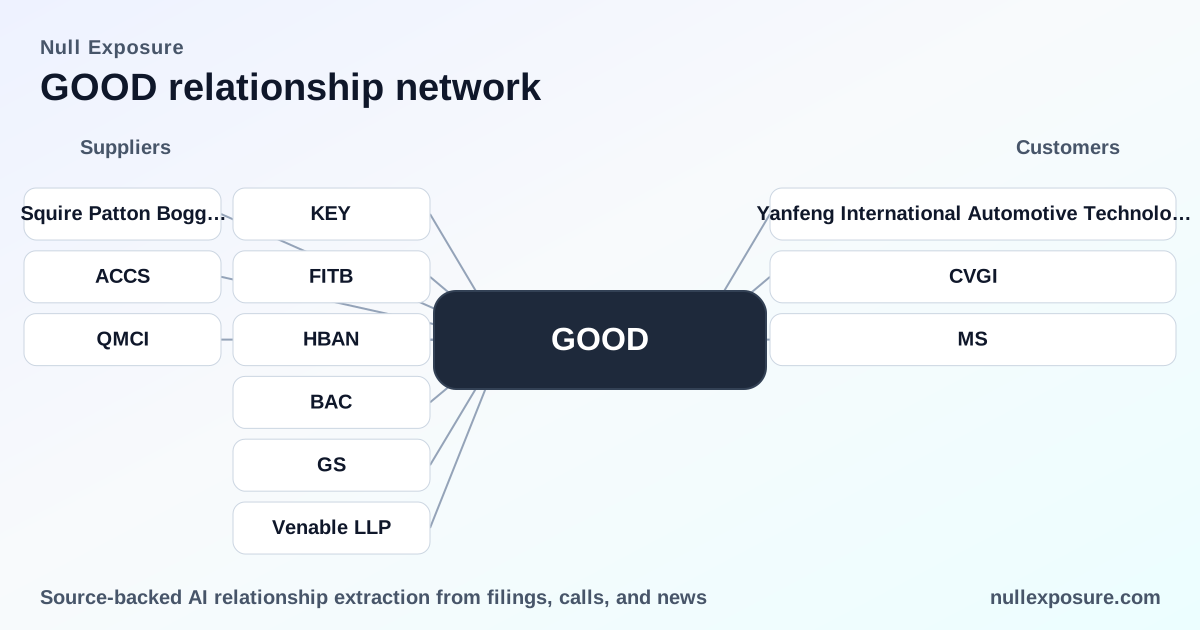
Gladstone Commercial acquires, owns and operates net-leased office and industrial properties and monetizes through property income and financing programs: rental cash flow funds dividends while a mix of credit facilities, term loans and unsecured notes provide capital for acquisitions and refinancing. The company’s supplier relationships are concentrated in banking and capital markets partners, securities placement agents and law firms that collectively enable capital access and compliance. Learn more about supplier risk and counterparty structure at https://nullexposure.com/.
Why the supplier list matters to investors
Gladstone Commercial’s business is capital-dependent: leasing generates operating cash flow, but growth and refinancing require reliable credit and placement partners. The supplier roster revealed in recent notices shows a bank-led credit facility and multiple placement agents for debt issuance, which directly influence liquidity, interest cost and covenant flexibility. For investors, these relationships translate into operational continuity or tightening under credit stress, and they deserve focused diligence. Explore supplier intelligence at https://nullexposure.com/ for deeper due diligence.
The bank group that underpins liquidity
Cash management and leverage are anchored by a syndicate led by regional and national banks. The company announced an amendment, extension and upsizing of its credit facility and publicized a private placement of unsecured notes; those actions identify the core suppliers that execute Gladstone’s funding strategies.
Relationship-by-relationship rundown
Below are concise, plain-English summaries of every supplier relationship reported in the results, with the source cited.
-
Key Bank (KEY) — Key Bank served as joint lead arranger and book manager on Gladstone Commercial’s amended and upsized credit facility. According to a MarketScreener press release dated March 9, 2026, Key Bank led the bank group that executed the transaction (https://www.marketscreener.com/news/gladstone-commercial-amends-extends-and-upsizes-credit-facility-ce7d5ad9de8df225).
-
Fifth Third Bank National Association / Fifth Third Bak National Association (FITB) — Fifth Third acted as a joint lead arranger in the same bank group for the credit facility amendment and also appears as a securities co-lead placement agent in the note issuance. The MarketScreener and Yahoo Finance corrections from March 9, 2026, and an Augusta Chronicle release describing the notes placement cite Fifth Third in both banking and securities roles (https://www.marketscreener.com/news/gladstone-commercial-amends-extends-and-upsizes-credit-facility-ce7d5ad9de8df225; https://www.augustachronicle.com/press-release/story/79157/gladstone-commercial-announces-issuance-of-85-million-of-senior-unsecured-notes/).
-
The Huntington National Bank (HBAN) — Huntington is named as a joint lead arranger on the credit facility and its brokerage arm acted as a co-lead placement agent for unsecured notes, signaling a dual banking and capital markets role (MarketScreener, March 9, 2026; Augusta Chronicle, March 9, 2026: https://www.marketscreener.com/news/gladstone-commercial-amends-extends-and-upsizes-credit-facility-ce7d5ad9de8df225; https://www.augustachronicle.com/press-release/story/79157/gladstone-commercial-announces-issuance-of-85-million-of-senior-unsecured-notes/).
-
Bank of America (BAC) / Bank of America Securities, Inc. (BAC) — Bank of America appears both as a joint lead arranger in the bank group and as a co-placement agent on the senior unsecured notes, providing national-scale financing and distribution capability (MarketScreener and Augusta Chronicle releases, March 9, 2026: https://www.marketscreener.com/news/gladstone-commercial-amends-extends-and-upsizes-credit-facility-ce7d5ad9de8df225; https://www.augustachronicle.com/press-release/story/79157/gladstone-commercial-announces-issuance-of-85-million-of-senior-unsecured-notes/).
-
Fifth Third Securities, Inc. (FITB) — Identified as a Co-Lead Placement Agent on the $85 million senior unsecured notes, Fifth Third Securities handled distribution responsibilities for the private placement (Augusta Chronicle, March 9, 2026: https://www.augustachronicle.com/press-release/story/79157/gladstone-commercial-announces-issuance-of-85-million-of-senior-unsecured-notes/).
-
Huntington Securities, Inc. (HBAN) — Acts as a Co-Lead Placement Agent alongside Fifth Third Securities for the unsecured notes, reinforcing Huntington’s capital markets role for Gladstone (Augusta Chronicle, March 9, 2026: https://www.augustachronicle.com/press-release/story/79157/gladstone-commercial-announces-issuance-of-85-million-of-senior-unsecured-notes/).
-
KeyBanc Capital Markets Inc. (KEY) — Named as a Co-Placement Agent for the unsecured notes, supporting distribution and underwriting tasks (Augusta Chronicle, March 9, 2026: https://www.augustachronicle.com/press-release/story/79157/gladstone-commercial-announces-issuance-of-85-million-of-senior-unsecured-notes/).
-
Goldman Sachs & Co. LLC (GS) — Listed as a Co-Placement Agent on the note issuance, bringing global institutional distribution reach to the transaction (Augusta Chronicle, March 9, 2026: https://www.augustachronicle.com/press-release/story/79157/gladstone-commercial-announces-issuance-of-85-million-of-senior-unsecured-notes/).
-
Venable LLP — Served as Maryland counsel to Gladstone Commercial in the notes issuance, fulfilling local corporate legal requirements (Augusta Chronicle press release, March 9, 2026: https://www.augustachronicle.com/press-release/story/79157/gladstone-commercial-announces-issuance-of-85-million-of-senior-unsecured-notes/).
-
Squire Patton Boggs (US) LLP — Acted as counsel to Gladstone Commercial and Gladstone LP for the issuance, providing primary transaction legal support (Augusta Chronicle, March 9, 2026: https://www.augustachronicle.com/press-release/story/79157/gladstone-commercial-announces-issuance-of-85-million-of-senior-unsecured-notes/).
-
ACCESS Newswire (ACCS) — Quoted as the originator of certain Gladstone press releases and earnings call notifications, functioning as a distribution channel for corporate communications (Gladstone Commercial newsroom, March 2026: https://www.gladstonecommercial.com/newsroom/press-releases/detail/546/gladstone-commercial-corporation-earnings-call-and-webcast).
-
QuoteMedia (QMCI) — Cited as the market data provider on Gladstone’s press releases, supporting investor-facing information delivery (Gladstone Commercial newsroom press releases, March 2026: https://www.gladstonecommercial.com/newsroom/press-releases/detail/546/gladstone-commercial-corporation-earnings-call-and-webcast; https://www.gladstonecommercial.com/newsroom/press-releases/detail/545/gladstone-commercial-corporation-announces-monthly-cash).
What the constraints tell us about Gladstone’s operating posture
The company’s filings and press releases codify supplier characteristics that define strategic risk.
-
Long-term contracting is structural. Gladstone discloses mortgage notes with maturities through 2037, a term loan that extends into 2028, and ground leases with a weighted average remaining term over a decade; these facts establish long-dated liabilities that lock in funding relationships and interest exposure.
-
Capital relationships are concentrated and material. As of December 31, 2024, Gladstone reported roughly $351.9 million outstanding under its credit facility and more than $250 million in mortgage note fair value—signals of high absolute spend and dependency on a relatively small set of lenders and placement agents.
-
Service-provider model with external management. The firm is managed by an external adviser (Gladstone Management) and relies on an administrator and third-party IT provider, confirming a service-provider operating model that centralizes execution with a handful of external partners.
-
Active and high-dollar engagement. The corporate disclosures list compliance with covenants and active amendments/extensions, implying current, active relationships with the bank syndicate rather than dormant counterparties.
These constraints translate into a business model that is credit-sensitive, moderately concentrated, and legally/formationally dependent on external professional services.
Investment implications and risk checklist
Gladstone’s supplier map produces a clear set of investor considerations.
- Liquidity and refinancing risk are primary: the bank group and placement agents determine access and cost of capital; any market disruption will directly affect Gladstone’s ability to refinance maturing debt.
- Concentration risk concentrates counterparty exposure among a handful of institutions—regional banks and major placement agents—so monitoring bank health and distribution channels is essential.
- Operational reliance on external managers and advisers suggests operational continuity risk is driven by contractual terms and vendor stability rather than in-house control.
For investors and operators seeking deeper supplier-level intelligence and ongoing tracking, visit https://nullexposure.com/ to request a tailored report.
Conclusion and next steps
Gladstone Commercial’s supplier relationships reveal a credit-centric capital structure supported by a consistent syndicate of banks, placement agents and law firms. These partners are the operational backbone for growth and refinancing; they define liquidity, cost of capital and covenant flexibility. For investors, the appropriate focus is counterparty stability and covenant exposure rather than property-level minutiae.
Take action: review the supplier list in your model, stress-test refinancing scenarios with the bank group, and subscribe for continuous monitoring at https://nullexposure.com/.