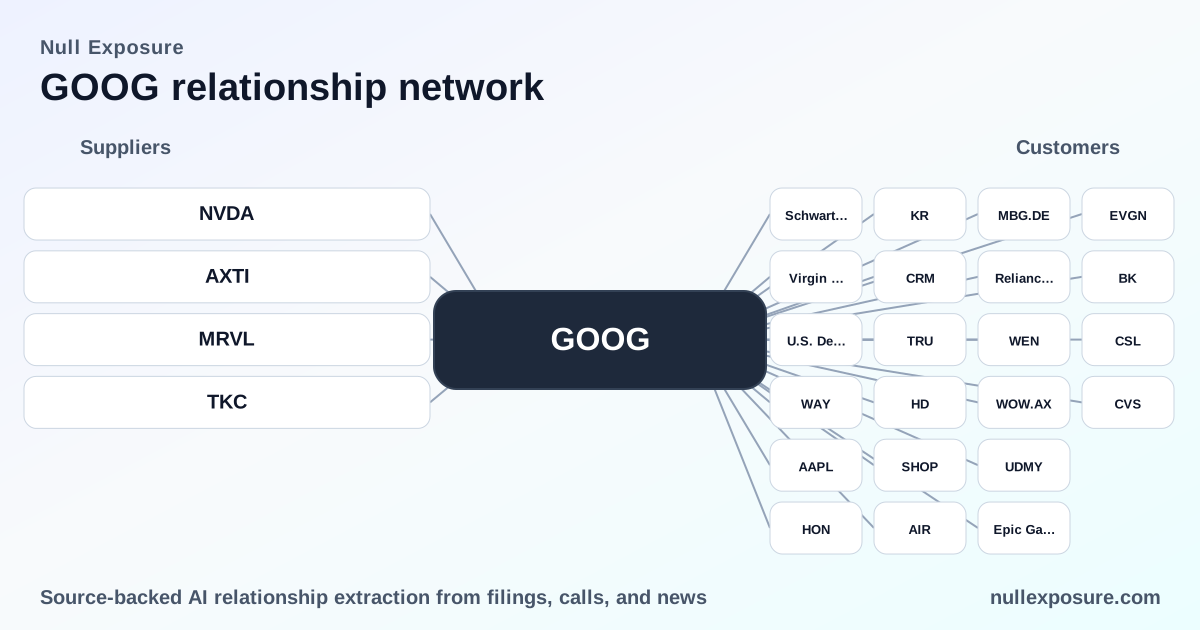
Alphabet’s supplier footprint: what investors need to know about GOOG’s vendor relationships
Alphabet operates a diversified digital monopoly across advertising, cloud, consumer devices and infrastructure; it monetizes primarily through advertising and Google Cloud subscriptions, while shouldering large capital and contractual obligations to support hyperscale compute and content distribution. This analysis focuses on supplier relationships that drive Alphabet’s AI and data-center capacity, content licensing, and device manufacturing — and what those relationships imply for operational leverage and downside risk. For a deeper vendor-risk view, visit https://nullexposure.com/.
Why suppliers move the needle for Alphabet investors
Alphabet’s growth trajectory over the next decade is tied to two capital-intensive vectors: AI compute (training and inference) and global data-center expansion, plus ongoing content licensing and device programs. That combination produces a supplier posture defined by large, long-duration contracts, concentrated strategic vendors for chips and network optical components, and significant energy and lease commitments. Those characteristics translate into leverage on costs and execution: supplier disruption, price shifts, or delivery slippage have direct margin and capacity implications.
The supplier relationships you should track now
NVIDIA — the GPU anchor for training capacity
Alphabet confirmed in its Q4 2025 earnings call that NVIDIA GPUs are a core element of its AI infrastructure, and the company will be among the first to deploy NVIDIA’s Vera Rubin GPU platform. This positions NVIDIA as a critical hardware supplier for Alphabet’s next-generation training clusters. (Q4 2025 earnings call, March 2026.)
AXT Inc. — optical wafer supplier for high-speed interconnects
Industry coverage notes that AXT’s indium phosphide wafers are integral to the laser chips used in 800G and 1.6T transceivers, components Google and other hyperscalers need to scale data-center interconnects. This places AXT squarely in the optical supply chain that underpins Alphabet’s network capacity upgrades. (Markets.FinancialContent article, March 4, 2026.)
Marvell Technology — chip design partner for AI networking and accelerators
Reporting indicates Marvell is involved in designing chips for AI workloads and is believed to be working with Google Cloud, aligning the company as a supplier for custom silicon and networking components that support large-scale AI deployments. (SiliconANGLE coverage, March 5, 2026.)
Turkcell — regional hyperscale partnership in EMEA
Turkcell’s investor materials describe a new hyperscale-region partnership with Google Cloud that supports a planned sixfold jump in its data-center and cloud revenues in U.S. dollar terms by 2032, making Turkcell a strategic regional partner for Alphabet’s international capacity expansion. (The Globe and Mail / TipRanks summary of Turkcell earnings call, March 2026.)
What Alphabet’s supplier constraints reveal about its operating model
Alphabet’s public disclosures and contract excerpts show a consistent pattern of supplier commitments that define the company’s risk and flexibility profile:
- Contracting posture: long-term and non-cancellable commitments dominate. Alphabet reports leases with long-duration terms (1–25 years) and future lease payments of $52.7 billion in long-term commitments plus $5.8 billion short-term that have not yet commenced, indicating long-horizon locking into locations and capacity (as of Dec 31, 2025).
- Spend concentration and scale: absolute commitments are very large. The company reported $149.1 billion of purchase and contractual commitments, with $113.0 billion short-term largely tied to technical infrastructure and inventory orders — a spend band well above $100 million per vendor program in aggregate.
- Criticality: supplier relationships are material to operations. Alphabet discloses material purchase commitments for energy take-or-pay contracts, licenses (including content), and infrastructure orders, underscoring that supplier performance directly affects revenue delivery and margins.
- Maturity and vendor role diversity: Alphabet both licenses content and relies on external manufacturers. The company pays third parties to license video and other content (primarily for YouTube) and uses contract manufacturers for devices and infrastructure hardware, creating dual exposure to content licensors and manufacturing supply-chains.
- Energy and renewables exposure through multiyear PPAs. Alphabet regularly signs multi-year, non-cancellable power purchase agreements to support data centers, increasing its exposure to long-term energy pricing and counterparty risk.
These characteristics are company-level signals that affect how supplier risk translates to financial performance; they are not assigned to any single vendor unless explicitly stated.
Investment implications and near-term watch items
Alphabet’s supplier footprint supports an aggressive growth strategy but also concentrates certain risks that investors should monitor:
- Execution risk is concentrated around a few strategic hardware suppliers. GPU and networking suppliers (e.g., NVIDIA and Marvell) are technology gatekeepers for scaling AI compute; any supply shortfall or pricing power shift will affect margins and capacity rollout.
- Liquidity and balance-sheet timing matter given large upfront commitments. With more than $149 billion in contractual commitments and long-term leases starting through 2031, capital allocation decisions will interact materiality with free cash flow and investment cadence.
- Content licensing and licensor roles create recurring cash flows and fixed obligations. YouTube-related content licensing ties a portion of cost of revenue to subscriber or ad-based royalties, translating content relationships into predictable but non-trivial obligations.
- Energy contract structure is a strategic lever and a risk vector. Multi-year PPAs smooth operating costs for data centers but lock Alphabet into long-term power contracts that can work for or against the company depending on energy markets.
For more granular supplier risk scoring and to monitor updates to these relationships over time, see the vendor-focused analysis available at https://nullexposure.com/.
Portfolio actions and monitoring checklist
Investors and operators should prioritize three actions:
- Monitor quarterly commentary for confirmed supply timetables from NVIDIA, Marvell, and networking vendors for product ramp dates and pricing clauses.
- Watch Alphabet’s capex and free-cash-flow reconciliation against contractual commitments, especially the schedule for long-term leases beginning 2026–2031.
- Track regional hyperscale deals and content-license renewals that can change both revenue mix and fixed-cost commitments.
Explore an ongoing supplier risk dashboard and alerts at https://nullexposure.com/ to stay ahead of vendor-driven inflection points.
Bottom line: supplier-driven growth with concentrated operational leverage
Alphabet’s supplier ecosystem is a strategic enabler of its AI and cloud ambitions, but also a source of concentrated operational leverage. The company’s large, long-term commitments — both for infrastructure equipment and energy — raise the stakes on vendor execution and pricing. Investors should treat reported supplier relationships not as peripheral line items but as levers that materially influence capacity, cost structure, and the timing of revenue realization. For a continuously updated supplier watchlist and vendor stress indicators, visit https://nullexposure.com/.