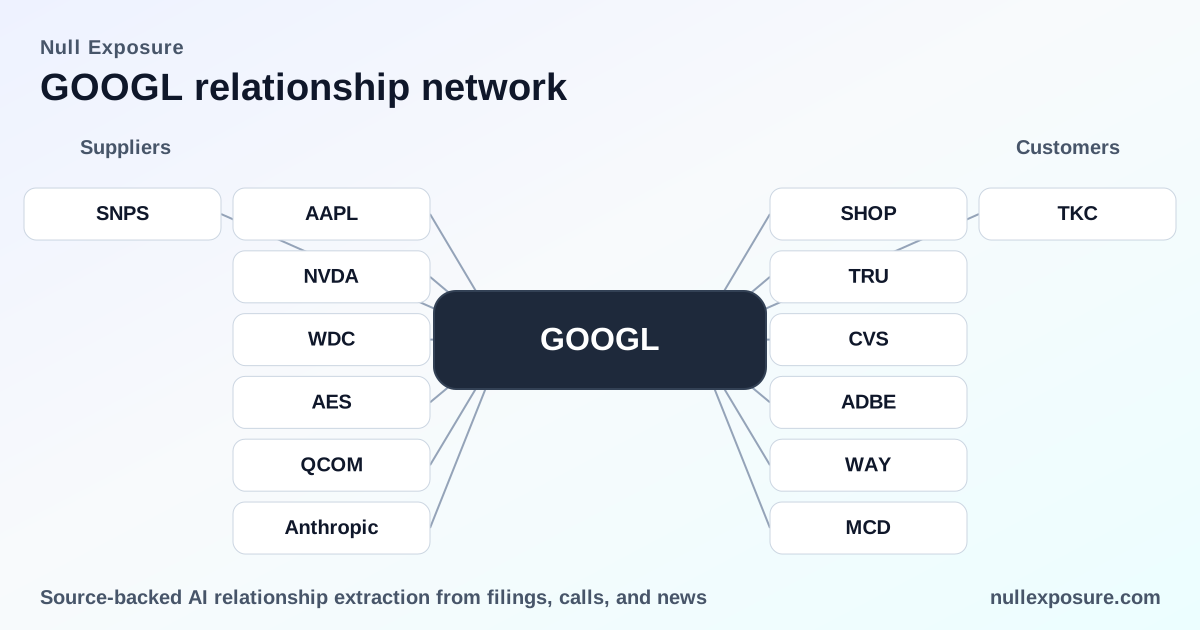
Alphabet (GOOGL) supplier relationships: where the company sources scale and competitive advantage
Alphabet monetizes primarily through advertising and cloud services while also investing heavily in AI, infrastructure, and devices. The company operates large hyperscale data centers, contracts multi-year energy and manufacturing relationships, and integrates third‑party hardware and software into its AI and consumer product roadmaps; these supplier relationships both enable revenue growth in advertising and Google Cloud and underwrite Alphabet’s push into foundational AI and bespoke silicon. For a concise view of supplier exposure and dependency, visit the Nillexposure homepage: https://nullexposure.com/.
What the recent signals show about how Alphabet structures supplier risk
Alphabet’s public comments and market reporting from early 2026 reinforce a predictable operating model: heavy dependence on specialized hardware partners and long-term infrastructure contracts, complemented by strategic cloud and energy partnerships that lock in capacity and cost profiles. The company balances in-house engineering with supplier ecosystems for GPUs, storage, energy, and device components, which creates a mix of strategic optionality and concentrated vendor risk.
- Contracting posture: Alphabet uses multi-year commercial agreements and long-duration PPAs that transfer operational certainty to suppliers while creating fixed obligations on Alphabet’s balance sheet.
- Concentration and criticality: A limited set of technology suppliers (GPUs, custom silicon design tools, enterprise storage) are strategically critical to AI and data-center performance.
- Maturity and control: Alphabet increasingly designs its own silicon and AI stacks, reducing some supplier leverage, but still relies on external manufacturing and energy partners for scale.
These company-level signals are grounded in public filings and press coverage; see Nillexposure for a supplier-focused intelligence briefing: https://nullexposure.com/.
Supplier-by-supplier view: what investors need to know
Apple — cloud and foundation models collaboration
Alphabet disclosed collaboration with Apple where Google Cloud is Apple’s preferred cloud provider and will help develop the next generation of Apple Foundation models using Google’s Gemini technology. This is a strategic cloud partnership that deepens commercial ties between two major platform players. According to Alphabet’s 2025 Q4 earnings call (reported 7 March 2026), the companies are jointly developing model workstreams based on Gemini.
NVIDIA — GPU supply for AI scale
Alphabet confirmed that it will be among the first to offer NVIDIA’s latest Vera Rubin GPU platform, signaling continued reliance on NVIDIA for cutting‑edge AI accelerator capacity. This vendor relationship is essential to Google Cloud’s AI offering and to Alphabet’s internal model training throughput. The mention came during Alphabet’s 2025 Q4 earnings call (7 March 2026).
Western Digital — high-capacity storage for hyperscale
Market coverage identifies Alphabet as a “Titan” hyperscale buyer of Western Digital’s enterprise helium drives, indicating large-volume purchases of archival and hot-tier storage hardware for data centers. FinancialContent’s March 9, 2026 piece on the storage market underscores Alphabet as a major customer driving Western Digital’s cloud and hyperscale segment demand.
The AES Corporation — co-located generation and 20-year PPAs
AES announced agreements to develop energy generation assets co-located with a new Google data center in Wilbarger County, Texas, and to enter 20-year power purchase agreements and long-term energy management contracts. This is a strategic, long-duration energy sourcing arrangement that reduces operating carbon footprint risk and locks long-term power economics. The arrangement was reported on Finviz citing AES disclosures (February 24, 2026 / reported via Finviz March 2026).
Qualcomm — Snapdragon Wear Elite adoption
Qualcomm announced that Google LLC will adopt Snapdragon Wear Elite for wearable devices, indicating supplier continuity for device-level system-on-chip components in Alphabet’s hardware ecosystem. Thelec.net reported this adoption as part of broader vendor announcements (reported March 2026).
Anthropic — continued non‑defense access to models
MarketBeat filings indicated Alphabet stated that Anthropic will remain available for non‑defense projects after Department of Defense actions, preserving Alphabet’s access to Anthropic models and enterprise AI offerings for commercial customers. MarketBeat covered related filings in early March 2026 (March 8–9, 2026), highlighting limited operational disruption to Alphabet’s enterprise AI roadmap.
(There are two MarketBeat entries reflecting similar filings; each confirms the same corporate stance that Anthropic’s availability for non‑defense use will continue, as reported by MarketBeat on March 8 and March 9, 2026.)
Synopsys — EDA tools for custom silicon development
Industry reporting notes that hyperscale companies including Google design custom AI silicon and therefore rely on Synopsys’ advanced electronic design automation tools to create those chips. This relationship is a strategic upstream supplier link enabling Alphabet’s internal silicon programs and custom accelerator projects. Finterra’s March 6, 2026 analysis referenced Synopsys as a critical vendor for in‑house chip design.
How these relationships translate to investment risk and opportunity
Alphabet’s supplier map reveals a deliberate mix of strategic vendor concentration and long-term contractual insulation. The company’s approach reduces spot-market exposure for energy and hardware but increases fixed obligations and counterparty dependency.
- Risk concentration: NVIDIA and Western Digital represent high criticality nodes for compute and storage; disruption or supply constraints would directly affect AI throughput and incremental cloud capacity.
- Contractual leverage: Long-duration PPAs and multi‑year vendor commitments provide price stability but increase Alphabet’s fixed-cost base and counterparty credit exposure.
- Vertical mitigation: Alphabet’s investments in custom silicon design capacity and in‑house model stacks reduce long-term dependence, but the company still outsources manufacturing and energy delivery at scale.
- Operational maturity: These supplier arrangements indicate a mature procurement posture: strategic partnerships for capacity, long-term energy contracting, and selective verticalization where economics justify control.
Practical investor takeaways
- Positive: Long-term PPAs and strategic GPU relationships support predictable margins for cloud/AI scale and demonstrate disciplined capital allocation into operating certainty.
- Watchlist: Monitor NVIDIA supply dynamics, AES project execution timelines, and Anthropic access conditions for potential short-term disruptions to AI product deliverables.
- Structural: Alphabet’s hybrid strategy—vertical integration where value accrues, outsourcing where scale is paramount—creates both resilience and supplier concentration risk that warrants active monitoring.
For an investor-focused supplier risk snapshot and continuous monitoring of these relationships, see the Nillexposure overview: https://nullexposure.com/.
Next steps for analysts and operators
- Prioritize tracking vendor delivery schedules for NVIDIA GPUs and Western Digital shipments as leading indicators of Google Cloud capacity expansion.
- Model the financial impact of long-term energy agreements on data-center operating margins and scenario-test counterparty failure or PPA renegotiation.
- Maintain watch on Anthropic-related policy developments that could alter enterprise AI product availability.
Access ongoing supplier intelligence and alerts at Nillexposure to convert these relationship signals into portfolio actions: https://nullexposure.com/.
Bold, contractual supplier ties and strategic internal investments together define Alphabet’s operational moat; investors should value both the predictability those contracts produce and the concentrated vendor risk they create.