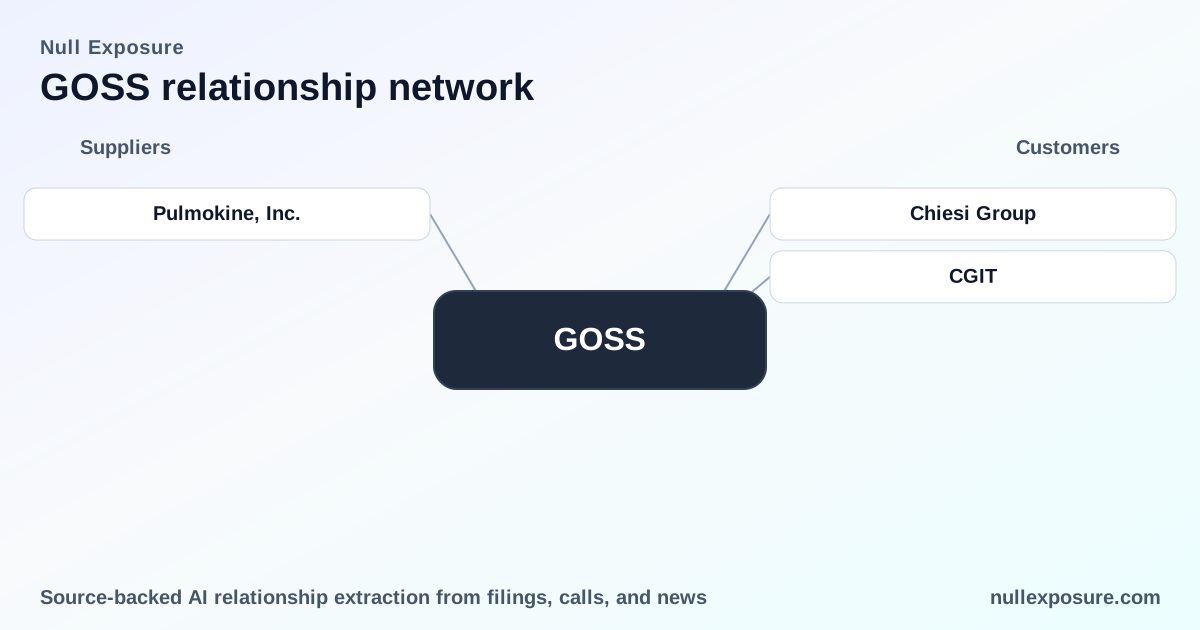
Gossamer Bio (GOSS): Supplier map and what the Pulmokine license signals for investors
Gossamer Bio operates as an asset-light, clinical-stage biopharmaceutical company that monetizes through owning or in‑licensing clinical assets and advancing them toward regulatory approval and commercialization. The firm captures value by acquiring exclusive rights to drug candidates, outsourcing development and manufacturing, and aiming to realize value through successful clinical readouts, partnering deals, or product launches. Understanding supplier and licensing relationships is therefore central to evaluating Gossamer’s operating leverage and execution risk. For a consolidated view of supplier exposures and contract types, visit https://nullexposure.com/.
Executive thesis: one in‑license drives strategic exposure
Gossamer’s most consequential supplier/partner relationship disclosed in its FY2024 filings is the in‑license of seralutinib from Pulmokine, Inc.; that arrangement is a direct input to Gossamer’s clinical pipeline and underpins near‑term program focus and capital allocation. Beyond the license, Gossamer runs an outsourced model for manufacturing and clinical execution, which concentrates operational criticality on third‑party manufacturers, contract research organizations (CROs), and medical institutions. For investors, the combination of an exclusive license for a lead asset and a fully outsourced operating model creates concentrated program risk but preserves capital flexibility. Learn more about supplier profiles at https://nullexposure.com/.
The single supplier relationship you must know
Pulmokine, Inc. — the licensor of seralutinib
Gossamer in‑licensed seralutinib from Pulmokine, Inc. via an exclusive license agreement executed on October 2, 2017; the company discloses this agreement in its FY2024 Form 10‑K as the source of its rights to develop and commercialize the asset. According to Gossamer’s FY2024 10‑K, the Pulmokine license is the contractual basis for Gossamer’s development program for seralutinib and is explicitly called out in the company’s intellectual property and license disclosures (FY2024 Form 10‑K).
What the contract details imply for operations and investor risk
Gossamer’s public disclosures and constraint signals reveal a consistent operating model: licensing core assets, relying on third‑party manufacturing, and outsourcing clinical execution. Those characteristics translate into a specific risk and opportunity profile for investors.
- Contracting posture: Gossamer is an acquirer/licensee of intellectual property rather than an originator that retains in‑house manufacturing. The FY2024 filing documents an exclusive license transaction with Pulmokine for seralutinib, which makes IP control a primary driver of value.
- Concentration: The firm’s strategic exposure is concentrated around licensed assets, with seralutinib singled out in the 10‑K. That concentration concentrates value and downside around clinical outcomes and license economics.
- Criticality: Manufacturing and clinical services are mission‑critical suppliers. Gossamer states that it “does not own or operate manufacturing facilities” and relies on third parties for clinical and commercial manufacture as well as CROs and investigators for trials; this elevates counterparty and operational continuity risk.
- Maturity: The licensing relationship dates to 2017 and is mature in contract tenure, but the asset is still in clinical development, meaning contractual terms around milestones, royalties, and sublicensing rights will determine downstream economics and partnership options.
Key takeaway: Gossamer’s value is highly dependent on licensed IP plus the performance of outsourced manufacturers and CROs; legal control of the asset is strong, but operational execution risk is transferred to third parties.
Relationship-by-relationship rundown (complete coverage)
- Pulmokine, Inc.: Gossamer acquired an exclusive license to seralutinib from Pulmokine under a contract executed October 2, 2017; the license is cited in the company’s FY2024 10‑K as the source of its development and commercialization rights for the asset (FY2024 Form 10‑K).
Practical investor implications and risk checklist
- Regulatory and clinical outcome risk is single‑asset concentrated. With seralutinib licensed from Pulmokine forming a core program, trial results will disproportionately move valuation.
- Operational continuity hinges on third‑party manufacturers and CROs. Gossamer’s decision not to build internal manufacturing creates scalability benefits but requires robust supplier management and contingency planning.
- Contract leverage is asymmetric. Exclusive license terms give Gossamer IP control, but milestone and royalty provisions embedded in license agreements will materially affect profit capture if commercialization occurs.
- Capital efficiency vs. execution risk tradeoff. Outsourcing preserves cash and reduces fixed costs, which is reflected in negative EBITDA and R&D‑heavy margins, but increases vendor concentration risk that investors must price into valuation.
For a deeper supplier map and to benchmark Gossamer’s contract posture against peers, see https://nullexposure.com/.
How to monitor this relationship going forward
Watch for these observable triggers in filings and press releases:
- Amendments to the Pulmokine license or disclosures around sublicensing rights and financial obligations in future SEC filings.
- Manufacturing partner announcements or disruptions; any change in third‑party CMO or process transfer will affect commercialization timing.
- Clinical milestones, enrolment updates, and regulatory interactions tied to seralutinib — these will be the primary value inflection points.
Conclusion: concentrated upside and vendor‑driven execution risk
Gossamer’s business model is clear and consistent: acquire or license clinical assets, outsource development and manufacturing, and pursue value via clinical progress or partnerships. The Pulmokine license for seralutinib is the central supplier/partner disclosure in the company’s FY2024 filings and defines both the upside and the most direct downside. Investors should balance the capital efficiency of the outsourced model against the elevated execution risk that comes with heavy reliance on third‑party manufacturers and CROs. For an organized view of supplier relationships and their contract types, go to https://nullexposure.com/.
If you want an analyst‑grade supplier map or tailored diligence on Gossamer’s contractual exposures, visit https://nullexposure.com/ for structured supplier intelligence and follow‑up.