GreenPower Motor Company (GP) — supplier relationships and what investors should price in
GreenPower Motor Company manufactures and distributes battery-electric commercial vehicles—primarily school buses and utility trucks—for the U.S. and Canadian markets and monetizes through vehicle sales, upfit and service work, and structured financing tied to fleet and school-district contracts. Revenue comes from unit sales and related financing arrangements; capital and bank relationships underpin working capital and growth capacity. For investor-grade supplier intelligence and counterparty exposure mapping, see https://nullexposure.com/.
How GreenPower makes money and why supplier relationships matter
GreenPower sells finished vehicles (EV Star buses, cabin & chassis, and upfitted utility trucks) to school districts and commercial fleets, capturing margins on vehicle manufacture plus recurring service and upfit revenues. On a trailing-twelve-month basis the company reported roughly $16.8M in revenue and $8.4M gross profit, but negative net income and EBITDA indicate an ongoing capital intensity that relies on external financing to scale production and fulfill contracts. That financing relationship is a central operational lever: bank lines, term loans and export financing directly affect production cadence and order conversion.
Explore counterparty and supplier risk for GP at https://nullexposure.com/.
The supplier and financing relationships you need on your radar
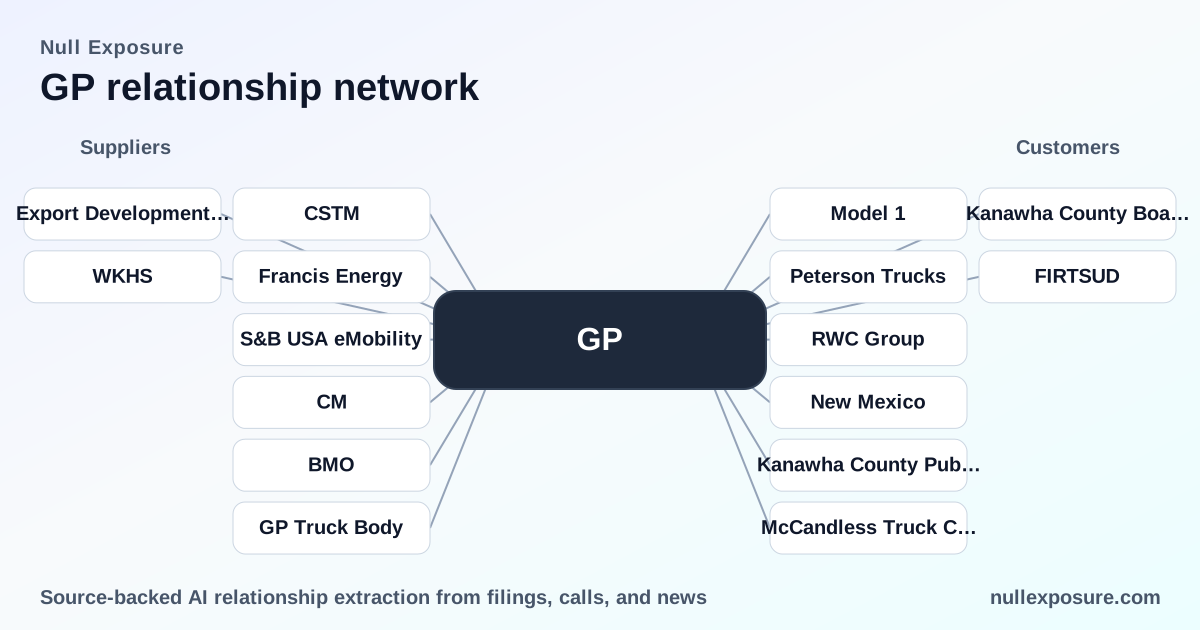
Below I cover every counterparty flagged in the public reporting and news set for GP. Each entry is a plain-English summary with the source cited.
Constellium (CSTM)
GreenPower designs a fully integrated EV body featuring a corrosion-resistant extruded aluminium structure manufactured by Constellium that is mated to a high-strength steel truss chassis, signaling a structural supplier relationship for body components. According to a PR Newswire order announcement, Constellium supplies the aluminium body sections for GreenPower’s BEAST school bus (PR Newswire, March 2026).
Francis Energy
Francis Energy is a charging-systems provider included in GreenPower’s school bus pilot projects in West Virginia, which indicates GreenPower outsources part of the charging infrastructure evaluation and deployment. GreenPower’s PR Newswire release on pilot expansion lists Francis Energy among the charging partners used in Lewis and Upshur counties (PR Newswire, FY2023).
S&B USA eMobility
S&B USA eMobility is another charging-systems partner in GreenPower’s West Virginia pilot program, participating in on-the-ground assessment of charging options for school districts. The pilot announcement identifies S&B USA eMobility as a supplier of charging systems for those pilots (PR Newswire, FY2023).
Canadian Imperial Bank of Commerce (CIBC / CM)
CIBC is a newly disclosed banking partner providing a line of credit and term loan facilities that GreenPower used to restore Nasdaq equity compliance and to fund operations, including closing two term loans totaling $5M and related working-capital moves. GreenPower’s SEC exhibit and PR Newswire releases document the new banking relationship and term loans with CIBC (SEC filing exhibit; PR Newswire, FY2026).
BMO (Bank of Montreal)
BMO provided an earlier $8M credit line to GreenPower and is referenced as a complementary financing source for school-bus orders, showing GreenPower runs multiple banking relationships for working capital flexibility. SustainableBiz covered management commentary describing the fit between BMO’s credit line and GreenPower’s customer orders (SustainableBiz, FY2024).
GP Truck Body
GP Truck Body supplies upfit solutions used on GreenPower utility trucks; GreenPower has used GP Truck Body for multiple truck body upfits, suggesting in-house or captive supplier integration for certain upfit work. TheBuzzEVNews reports this is the tenth truck body upfit manufactured by GP Truck Body for GreenPower (TheBuzzEVNews, FY2024).
Export Development Canada (EDC)
Export Development Canada provided a revolving loan facility to support EV production, giving GreenPower access to up to $5M of additional liquidity to scale manufacturing for customers. SustainableBiz reported on the EDC revolving loan as a production-focused financing tool (SustainableBiz, FY2024).
Workhorse (WKHS)
Workhorse resumed deliveries of EV Star cab & chassis to GreenPower under a 2022 delivery contract, indicating GreenPower sources chassis/cab assemblies from Workhorse as part of its vehicle platform supply chain. TheBuzzEVNews reported Workhorse resumed deliveries during GreenPower’s fiscal Q4 2024 (TheBuzzEVNews, FY2024).
Operational strengths and supplier risk — what the counterparty map implies
GreenPower’s commercial model is production- and capital-intensive, and the supplier/finance map shows a hybrid approach: sourcing critical structural components (Constellium), outsourcing charging solutions (Francis Energy, S&B), and relying on multiple financing sources (CIBC, BMO, EDC) to fund operations. Key company-level signals:
- Capital dependence and financing sophistication: multiple credit facilities, term loans, and conversions of related-party debt into convertible securities were used in FY2026 to shore up liquidity and Nasdaq compliance, indicating an active balance-sheet management posture (company filings and PR releases, FY2026).
- Supplier criticality: Constellium supplies structural aluminium for bodies—this is a high-criticality supplier because body design and crashworthiness are integrally tied to the aluminium structure.
- Early-stage scale and maturity: pilot programs (West Virginia) and resumed chassis deliveries from Workhorse point to a company still scaling production and validating charging and upfit ecosystems rather than a fully mature supply chain.
- Concentration and governance: insiders own ~34% of shares while institutional ownership is under 2%, suggesting concentrated insider control that affects strategic decisions and raises governance and liquidity considerations (company overview metrics).
- Financial profile: modest market capitalization (~$5.5M), negative EBITDA and negative EPS contrast with positive gross margin, implying operational unit economics that work at a smaller scale but require capital to expand.
These are company-level operating signals investors should fold into any credit or supplier-risk model for GreenPower; they are not claims about a single counterparty unless explicitly documented.
Explore deeper counterparty profiles at https://nullexposure.com/.
Investment implications — what to watch and where value and risk sit
- Watch banking and export facilities closely: term loans and credit lines from CIBC, BMO and EDC are the immediate levers for production ramp and Nasdaq compliance; a tightening of these relationships would directly constrain shipments and margins.
- Monitor supplier concentration for body and chassis components—loss or disruption of Constellium or Workhorse supply would impede deliveries and contract fulfillment.
- Follow pilot-to-production conversion of charging partners and school-district pilots; successful scale increases predictable revenue and reduces customer concentration risk.
- Governance and liquidity risk are elevated given high insider ownership and low institutional float, which amplifies volatility and can affect access to capital in stressed markets.
For a practical assessment of counterparty exposure and supplier concentration, visit https://nullexposure.com/ for structured supplier intelligence.
Bottom line
GreenPower operates at the intersection of EV vehicle manufacturing and fleet-focused finance; its supplier map reveals critical structural and charging partners plus diverse financing counterparties that collectively determine execution risk. Investors and operators should prioritize monitoring bank lines, structural suppliers (Constellium), and the conversion of pilots into recurring school-district and fleet sales—these items drive both near-term liquidity and the company’s ability to scale profitably. For ongoing updates and supplier risk scoring, see https://nullexposure.com/.