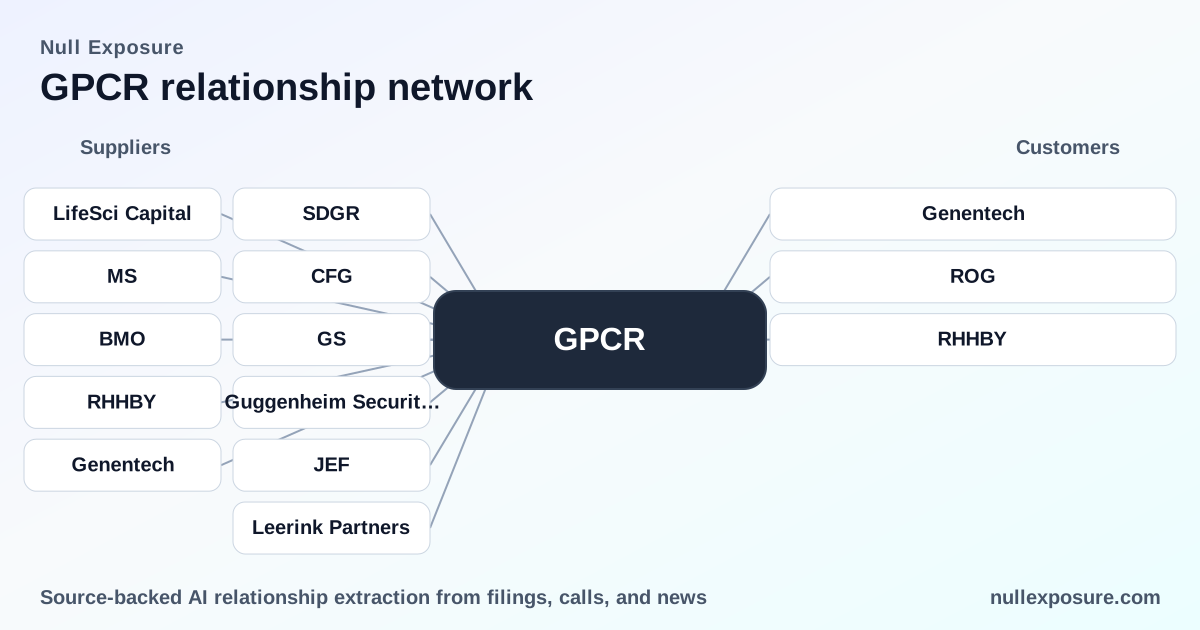
GPCR supplier map: who matters to investors and how the relationships drive risk and value
GPCR operates as a research-stage biopharma that outsources discovery, development and manufacturing while monetizing through licensing, partnerships and capital markets activity. The company captures value by advancing proprietary assets through external collaborators and financing rounds rather than owning integrated manufacturing, which concentrates operational leverage in a small set of third‑party providers and finance partners. Learn more about counterparty exposure and monitoring at https://nullexposure.com/.
Quick read for portfolio managers: what to know first
GPCR’s business model is built on three pillars: externalized R&D and computational support, outsourced manufacturing and distribution, and capital markets-driven funding events. That structure reduces fixed capital needs but creates concentrated supplier risk, regulatory exposure and underwriting dependency when tapping equity markets. Below I map every external relationship detected in public reporting, followed by the company-level constraints that shape contracting posture and operational criticality.
Who the company is working with (short, source-backed takeaways)
The following covers every relationship listed in the available results; each line is a concise investor-oriented takeaway with the cited source.
-
Schrödinger — GPCR has an established collaboration for computational chemistry support to augment discovery capabilities. According to a TradingView summary of the company’s FY2026 filings, Schrödinger provides computational chemistry services to GPCR (TradingView, March 2026: https://www.tradingview.com/news/tradingview%3A201d17d879146%3A0-structure-therapeutics-inc-sec-10-k-report/).
-
Roche — GPCR holds licensing arrangements related to GLP‑1 receptor agonist patents with Roche as a counterparty in intellectual property deals. TradingView’s FY2026 coverage notes GPCR’s licensing relationships with Roche (TradingView, March 2026: https://www.tradingview.com/news/tradingview%3A201d17d879146%3A0-structure-therapeutics-inc-sec-10-k-report/).
-
Genentech — GPCR is party to patent licensing concerning GLP‑1 receptor agonists with Genentech, positioning the company within established pharma IP networks. The FY2026 SEC summary referenced by TradingView lists Genentech as a licensing partner (TradingView, March 2026: https://www.tradingview.com/news/tradingview%3A201d17d879146%3A0-structure-therapeutics-inc-sec-10-k-report/).
-
Citizens Capital Markets — Citizens acted as a co‑manager on GPCR’s proposed financing, supporting capital raising distribution and placement. A Yahoo Finance announcement of the proposed offering in FY2025 lists Citizens Capital Markets as a co‑manager (Yahoo Finance, March 9, 2026: https://finance.yahoo.com/news/structure-therapeutics-announces-proposed-500-210100526.html).
-
LifeSci Capital — LifeSci served as a co‑manager on the same offering, bringing sector-specific investor access to GPCR’s equity process. The FY2025 offering notice on Yahoo Finance identifies LifeSci Capital as a co‑manager (Yahoo Finance, March 9, 2026: https://finance.yahoo.com/news/structure-therapeutics-announces-proposed-500-210100526.html).
-
Goldman Sachs & Co. LLC — Goldman is listed among the joint book‑running managers for GPCR’s equity offering, indicating a top‑tier underwriter relationship during the financing event. The March 2026 offering release on Yahoo Finance lists Goldman Sachs as a joint book‑running manager (Yahoo Finance, March 9, 2026: https://finance.yahoo.com/news/structure-therapeutics-announces-proposed-500-210100526.html).
-
Guggenheim Securities — Guggenheim participated as a joint book‑running manager on GPCR’s proposed offering, supplementing distribution capacity for the financing. The Yahoo Finance notice records Guggenheim as a joint book‑running manager (Yahoo Finance, March 9, 2026: https://finance.yahoo.com/news/structure-therapeutics-announces-proposed-500-210100526.html).
-
Jefferies — Jefferies acted as a joint book‑running manager on the proposed deal, reflecting a critical role in pricing and allocation of new equity. The offering announcement on Yahoo Finance includes Jefferies among joint managers (Yahoo Finance, March 9, 2026: https://finance.yahoo.com/news/structure-therapeutics-announces-proposed-500-210100526.html).
-
Leerink Partners — Leerink is named as a joint book‑running manager for the offering, contributing biopharma investor coverage and syndicate support. The Yahoo Finance disclosure lists Leerink Partners among the joint managers (Yahoo Finance, March 9, 2026: https://finance.yahoo.com/news/structure-therapeutics-announces-proposed-500-210100526.html).
-
Morgan Stanley — Morgan Stanley is reported as a joint book‑running manager on the FY2025 financing, supplying institutional distribution and research channel reach. The Yahoo Finance release includes Morgan Stanley in the manager roster (Yahoo Finance, March 9, 2026: https://finance.yahoo.com/news/structure-therapeutics-announces-proposed-500-210100526.html).
-
BMO Capital Markets — BMO Capital Markets participated as a joint book‑running manager for GPCR’s proposed offering, broadening geographic and institutional placement capability. The offering notice on Yahoo Finance lists BMO as a joint manager (Yahoo Finance, March 9, 2026: https://finance.yahoo.com/news/structure-therapeutics-announces-proposed-500-210100526.html).
What the public constraints tell investors about operational posture
The company-level signals extracted from disclosures paint a consistent operating model: outsourced, concentrated, and geographically diversified execution with active third‑party dependencies. Key characteristics:
-
Contracting posture: GPCR does not own manufacturing capacity and outsources clinical and commercial manufacturing, storage, distribution and testing to third parties, signaling fixed‑cost light operations and reliance on vendor performance.
-
Concentration and criticality: The firm identifies reliance on a single supplier, WuXi STA (a WuXi AppTec subsidiary), for active pharmaceutical ingredients and drug product; that relationship is described as material and elevates single‑point operational risk if supply is disrupted.
-
Geographic footprint: Management has an established U.S. manufacturing plan and is actively contracting with suppliers in the United States and "other regions outside of China" to diversify production; the company also maintains subsidiaries in Mainland China, Hong Kong, Australia, the Cayman Islands and the U.S., and reports many suppliers and trial relationships outside the U.S.
-
Relationship maturity and role mix: Supplier relationships are active and operational, spanning manufacturing, distribution and services (application providers, hosting, cybersecurity firms and CROs). The firm relies on third parties for discovery research, preclinical and clinical execution and cybersecurity risk management.
These constraints collectively indicate high operational leverage to vendor execution, meaningful concentration risk and an active need for supply‑chain diversification.
Investment implications and downside scenarios
-
Supply disruption is the primary operational risk. Reliance on WuXi STA and outsourced manufacturing elevates the probability that production shortfalls or regulatory noncompliance would delay development or commercialization timelines.
-
Financing relationships matter to liquidity. The roster of co‑managers and book‑running managers (Jefferies, Goldman, Morgan Stanley, Guggenheim, BMO, Citizens and LifeSci) signals access to tier‑one distribution networks for capital raises, but successful follow‑on financing will remain sensitive to clinical progress and supply stability.
-
IP licensing with Roche and Genentech is strategic value capture. Licensing of GLP‑1 related patents positions GPCR within attractive therapeutic franchises and creates monetization pathways beyond internal commercialization.
Investors should model scenarios where supplier disruption forces additional financing rounds, increasing dilution risk, and should value the Roche/Genentech licensing optionality as a partial hedge to manufacturing concentration.
For a deeper counterparty exposure analysis and ongoing monitoring, visit https://nullexposure.com/ to review tracking options and alerting strategies.
Tactical recommendations for operators and investors
-
Prioritize contractual redundancy in manufacturing agreements and enforceables for capacity, quality and regulatory compliance to mitigate single‑supplier concentration.
-
Ensure covenant and disclosure coverage in financing documents when engaging underwriters to preserve access to top‑tier syndicates that GPCR has used historically.
-
Monitor timelines for any license milestone payments or upfronts from Roche/Genentech as near-term catalysts that de‑risk funding needs.
Learn how our platform operationalizes these checks and automates monitoring at https://nullexposure.com/.
Conclusion: concise verdict
GPCR’s model delivers capital efficiency through outsourcing and value creation through licensing and asset advancement, but this structure concentrates execution risk in a small set of manufacturers and service providers and ties near-term liquidity to capital markets partners. Active monitoring of manufacturing counterparties, contractual protections and financing lead managers is essential for any investor or operator allocating to GPCR.