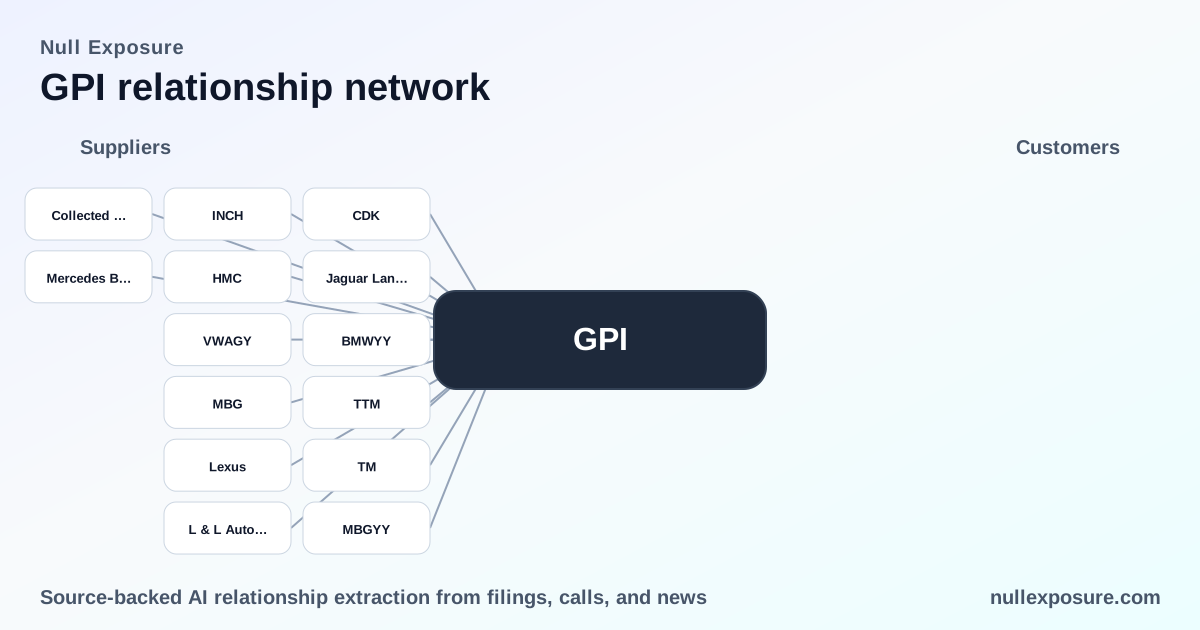
Group 1 Automotive (GPI): Supplier relationships that shape a national dealer roll-up
Group 1 Automotive runs a capital-intensive dealership platform that earns margins from vehicle sales, service operations and finance & insurance, and expands primarily through acquisitions of franchised dealerships. The company monetizes by optimizing inventory floorplan financing, capturing used-vehicle margins, and leveraging scale with manufacturers and local luxury franchises; its supplier relationships — OEMs, finance partners and third‑party service vendors — are directly tied to acquisition success and operational continuity. For deeper diligence on supplier exposure and competitive positioning, visit https://nullexposure.com/.
The quick take: why supplier links matter for GPI investors
Group 1’s business model is built on three interdependent supplier classes: manufacturers (OEMs) that grant franchise rights and provide floorplan financing, financial institutions that fund inventory, and service providers that supply critical software and marketing. These links determine inventory access, cost of capital and the customer experience — all of which flow through to margins and free cash flow.
- Contracting posture: The company uses a mix of short-term floorplan facilities (vehicle loans repaid on sale) and framework franchise agreements with major manufacturers that govern long‑term dealer rights and obligations.
- Concentration and criticality: Relationships with OEMs are critical to acquisition strategy and sales mix; dependence on manufacturer-aligned lenders concentrates funding risk.
- Maturity and stage: Supplier ties are active and operational, with ongoing communication about recalls, marketing and sourcing.
These operating signals translate to an investment view that emphasizes balance‑sheet strength and manufacturer relationships as primary risk/return drivers. Learn how supplier intelligence informs valuation at https://nullexposure.com/.
What the constraints tell investors about operating risk
The company-level evidence includes explicit language on floorplan repayment timing, franchise framework agreements, and the strategic dependence on OEMs. Taken together, these constraints paint a clear picture:
- Short‑term working capital posture: Floorplan borrowings are structured to be repaid on sale and are not to remain outstanding beyond one year — this forces recurring refinancing and operational discipline.
- Framework agreements for scale: Group 1 maintains framework franchise arrangements with most major manufacturers in the U.S., supporting standardized integration and acquisition playbooks.
- Critical dependency on OEMs: Management states acquisition success depends on OEM relationships, making manufacturer alignment both a strategic asset and a single point of failure.
- Active relationships: The company reports routine, operational communications with OEMs and compliance with debt covenants, indicating mature, ongoing partnerships.
These are company-level signals; they are not attributed to any single supplier unless explicitly named in the company text.
Detailed roster — every supplier relationship surfaced (short, source‑backed notes)
Below are the supplier and partner mentions pulled from recent company filings and media coverage, with concise, source-linked takeaways.
-
CDK Global LLC — Group 1 disclosed employment compensation costs tied to a cybersecurity incident at CDK Global that occurred in June 2024, reflecting operational exposure to third‑party dealer software providers. Source: Group 1 press release, FY2026 results (Jan 29, 2026). https://www.group1corp.com/2026-01-29-Group-1-Automotive-Reports-Fourth-Quarter-and-Full-Year-2025-Financial-Results
-
Jaguar Land Rover (JLR) — Analysts pressed management on soft luxury sales and the company discussed exiting its UK Jaguar Land Rover dealerships and strategic alternatives for the brand in the UK. Source: Finviz coverage of investor Q&A, FY2025 earnings call (reported Mar 2026). https://finviz.com/news/241661/group-1-automotive-gpi-sees-bullish-sentiment-from-analysts
-
BMW — Management noted BMW inventory is healthy with new product introductions, a signal about brand-level inventory quality and sales cadence at BMW franchises. Source: Q4 2025 earnings call transcript (InsiderMonkey, Mar 2026). https://www.insidermonkey.com/blog/group-1-automotive-inc-nysegpi-q4-2025-earnings-call-transcript-1685220/
-
JLR (duplicate mention) — The company stated it is working with interested parties on an exit of the JLR brand, confirming active disposition or restructuring efforts for those UK assets. Source: Q4 2025 earnings call transcript (InsiderMonkey, Mar 2026). https://www.insidermonkey.com/blog/group-1-automotive-inc-nysegpi-q4-2025-earnings-call-transcript-1685220/
-
Lexus — Group 1 completed acquisitions including Lexus and Acura stores in Fort Myers, emphasizing targeted expansion in high-income U.S. markets. Source: Q4 2025 earnings remarks (InsiderMonkey, Mar 2026). https://www.insidermonkey.com/blog/group-1-automotive-inc-nysegpi-q4-2025-earnings-call-transcript-1685220/
-
Mercedes‑Benz — The firm cited acquisitions of Mercedes‑Benz dealerships in Austin and Atlanta, part of a luxury portfolio build that improves exposure to resilient, higher-margin segments. Source: Q4 2025 earnings remarks (InsiderMonkey, Mar 2026). https://www.insidermonkey.com/blog/group-1-automotive-inc-nysegpi-q4-2025-earnings-call-transcript-1685220/
-
Toyota — Group 1 reported UK activity that included three Toyota and one Lexus dealership acquisitions, indicating continued brand diversification across geographies. Source: Q4 2025 earnings remarks (InsiderMonkey, Mar 2026). https://www.insidermonkey.com/blog/group-1-automotive-inc-nysegpi-q4-2025-earnings-call-transcript-1685220/
-
Inchcape plc — Group 1 completed the acquisition of Inchcape U.K. dealerships, a strategic cross-border purchase that expanded its U.K. footprint. Source: SimplyWall.st company update (FY2026 acquisition notice). https://simplywall.st/stocks/us/retail/nyse-gpi/group-1-automotive
-
Acura — Included among recent U.S. acquisitions, Acura dealerships are part of the company’s targeted growth in affluent markets. Source: Q4 2025 earnings remarks (InsiderMonkey, Mar 2026). https://www.insidermonkey.com/blog/group-1-automotive-inc-nysegpi-q4-2025-earnings-call-transcript-1685220/
-
Audi — Management referenced brand-specific impairments within Audi, signaling localized volume or valuation pressures at certain Audi franchises. Source: Q4 2025 earnings remarks (InsiderMonkey, Mar 2026). https://www.insidermonkey.com/blog/group-1-automotive-inc-nysegpi-q4-2025-earnings-call-transcript-1685220/
-
Mercedes‑Benz (SWOT coverage) — Analysts noted diversified luxury portfolio benefits from recent Mercedes‑Benz and Lexus acquisitions that strengthen high-income market positioning. Source: SWOT analysis coverage (AlphaStreet, FY2026 commentary). https://news.alphastreet.com/swot-analysis-group-1-automotive-inc-gpi/
-
Lexus (SWOT coverage) — External coverage reiterated that recent Lexus acquisitions reinforce resilience in luxury markets, tying to the company’s strategic premium push. Source: SWOT analysis coverage (AlphaStreet, FY2026 commentary). https://news.alphastreet.com/swot-analysis-group-1-automotive-inc-gpi/
-
L & L Automotive Group Limited — Group 1 acquired four Mercedes‑Benz dealerships north of London from L & L Automotive, a targeted inorganic expansion into the U.K. luxury market. Source: SimplyWall.st acquisition report (Jul 02, FY2026). https://simplywall.st/stocks/us/retail/nyse-gpi/group-1-automotive
-
Collected Strategies — Listed as media contacts in the company press release, indicating Collected Strategies is a retained communications firm handling investor/media relations. Source: Group 1 press release, FY2026 results (Jan 29, 2026). https://www.group1corp.com/2026-01-29-Group-1-Automotive-Reports-Fourth-Quarter-and-Full-Year-2025-Financial-Results
-
Mercedes Benz Of Buckhead, Inc. — Group 1 acquired Mercedes Benz Of Buckhead, a tactical purchase that adds to its U.S. luxury retail footprint. Source: SimplyWall.st acquisition update (Aug 05, FY2026). https://simplywall.st/stocks/us/retail/nyse-gpi/group-1-automotive
Collectively these entries demonstrate active M&A with global OEMs and dealer groups, plus operational exposure to third‑party vendors and PR firms.
Strategic implications for investors
- Risk concentration on OEM relationships is real and acknowledged: management explicitly ties acquisition success and inventory access to OEM partners, so covenant compliance and OEM goodwill are top-line risk factors.
- Working capital rhythm is predictable but sensitive: short‑term floorplans force recurring capital flows tied to vehicle turns; interest rates and resale margins therefore have outsized P&L leverage.
- Operational vendor exposure is non-trivial: the CDK Global cybersecurity mention underscores dependency on dealership software and the downstream cost of third‑party incidents.
If you are evaluating GPI for allocation or vendor risk, prioritize diligence on manufacturer framework terms, floorplan cost trends and third‑party vendor SLAs. For a deeper operational supplier map and scenario modeling, see our coverage at https://nullexposure.com/.
Bottom line and next steps
Group 1’s supplier relationships are a mix of strategic, long‑running manufacturer franchises and short‑term financing arrangements, with active M&A execution that increases operational complexity but also revenue diversification into luxury markets. The balance sheet and covenant compliance will determine how effectively the company leverages these relationships to drive shareholder returns.
For layered supplier-risk analysis and tailored exposure reports, visit https://nullexposure.com/ and request the full supplier intelligence brief.