Graphic Packaging (GPK): Supplier posture, recent M&A, and what it means for investors
Graphic Packaging Holding Company operates and monetizes by manufacturing and converting paperboard into packaging solutions for food, beverage and consumer products companies, selling finished packaging through commercial contracts and customer agreements. The company generates most revenues from these manufacturing and converting activities and offsets raw-material exposure through a mix of owned capacity and long-term external purchase arrangements, producing $8.617 billion in trailing revenue and $1.379 billion of EBITDA on a trailing basis. For a focused supplier-risk view and ongoing monitoring, visit https://nullexposure.com/.
How GPK sources paperboard and why supplier posture matters
Graphic Packaging’s business is built on two linked activities: manufacturing paperboard and converting that material into packaging sold to customers. This dual role gives GPK both supplier-like and customer-like dynamics: it must secure feedstock (recycled and virgin fiber paperboard) while also protecting margin on finished packaging.
- Contracting posture: The company reported that the majority of external paperboard purchases are executed through long-term arrangements with major industry suppliers, which creates predictable input pricing and supply continuity. That contracting posture reduces short-term volatility for revenue conversion and supports coverage of installed converting capacity.
- Geographic sourcing split: GPK manufactures most of the paperboard it consumes in the Americas but primarily purchases paperboard from third parties for its European operations, exposing the EMEA business to regional supplier markets and potential concentration risk.
- Operational role: GPK is a manufacturer and converter rather than a pure reseller; owning manufacturing assets increases control over supply and cost structure but requires capital intensity and integration discipline.
These factors are not abstract—they drive negotiation leverage, working-capital needs, and capital allocation choices for the company and should be modeled alongside unit economics and regional demand trends.
What the public record shows about key supplier relationships
Below I cover the supplier and related-party disclosures in the public filing set so investors can weigh counterparty risk and integration returns.
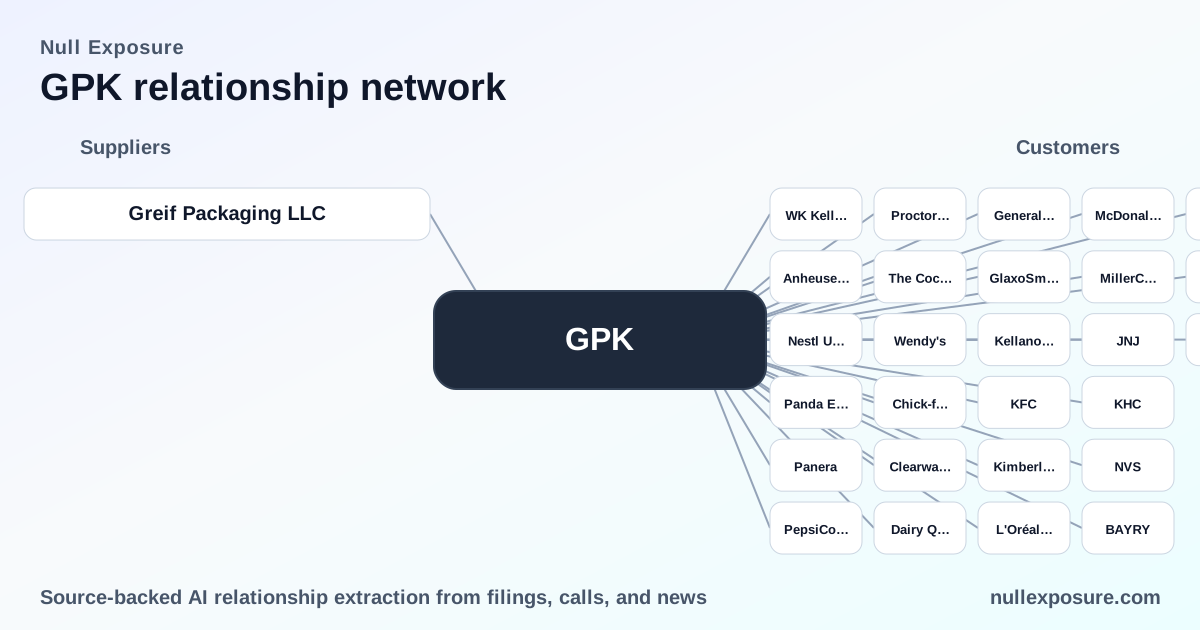
- In January 2023, Graphic Packaging completed the acquisition of Tama Paperboard, LLC, a recycled paperboard manufacturing facility, from Greif Packaging LLC for approximately $100 million. According to the company’s FY2024 10-K, the deal added manufacturing capacity and recycled paperboard feedstock to GPK’s asset base. (Source: GPK FY2024 10-K disclosure.)
Why the Tama acquisition matters for supplier strategy
The Tama Paperboard purchase is a clear example of vertical integration to reduce buy-side exposure. By acquiring a supplier asset, GPK converted a portion of future external purchases into internally supplied capacity, improving control over recycled paperboard availability and quality. The acquisition price—about $100 million as reported in the FY2024 filing—should be evaluated against the incremental EBITDA contribution of the asset, expected synergies in logistics and procurement, and the ongoing capital intensity of recycled fiber operations.
This move aligns with the company-level signals on contracting and geography: GPK builds owned capacity in the Americas while continuing to rely on third-party purchases to serve EMEA needs. Investors should therefore separate Americas supply risk (now more internally secured) from EMEA supply exposure (still dependent on external suppliers).
For more background on supplier strategies and M&A outcomes in packaging, see coverage and monitoring resources at https://nullexposure.com/.
Other supplier constraints and company-level signals to model
The filing-based constraints reported by the company provide additional, actionable signals for investors:
- Long-term contracting bias (company-level signal): The explicit prevalence of long-term arrangements for external paperboard purchases indicates predictable procurement but also potential lock-in at specified pricing schedules. For modeling, assume lower short-term volatility in input costs versus a spot-purchased profile, but include scenario stress tests for supplier disruptions.
- EMEA third-party sourcing (company-level signal): GPK manufactures locally in the Americas but buys most EMEA paperboard from third parties, implying regional supplier concentration and FX/transport exposure for Europe. Treat EMEA margins as more sensitive to supplier market tightness and regional energy or logistics shocks.
- Manufacturer-converter business model (company-level signal): GPK’s core operating model is capital-intensive manufacturing plus converting operations; this imposes capex and working-capital demands distinct from lighter-weight packaging players and influences how suppliers and customers negotiate terms.
These constraints are strategic inputs—use them to build more granular scenarios for gross margin resilience, working capital swings, and capital allocation trade-offs.
Investment implications and checklist for supplier diligence
Graphic Packaging’s financial ratios highlight a company with low multiple valuation metrics and meaningful payout characteristics that investors should balance against supplier and operational exposures:
- Market capitalization roughly $2.93 billion with trailing revenue of $8.617 billion and EBITDA of $1.379 billion.
- Valuation metrics include a trailing P/E of 6.69, EV/EBITDA of 6.17, and Price-to-Sales of 0.34.
- Dividend yield is 4.52% with a recent dividend per share of $0.44.
Key diligence items tied to supplier exposure:
- Confirm the contract tenor and renewal mechanics on long-term paperboard purchase arrangements—these determine pass-through or margin compression in inflationary cycles.
- Stress-test EMEA operations for supplier price shocks and transport disruptions given the heavy reliance on third-party paperboard in that region.
- Evaluate capital allocation and integration success on acquisitions like Tama to determine whether M&A is a repeatable method to de-risk supplier dependence.
If you require a tailored supplier-risk scorecard or ongoing signal monitoring, start here: https://nullexposure.com/.
Final read: balance of risk and opportunity
Graphic Packaging’s operating model—manufacturing plus converting with an explicit long-term purchase posture and selective vertical integration—creates a defensible supply base in the Americas and an area of exposure in EMEA that investors must price. The Tama Paperboard acquisition is a concrete execution of vertical integration; its impact will be measurable in regional gross margins and reduced purchase volatility.
For systematic access to supplier disclosures, counterparties and constraint signals that matter to portfolio construction, visit https://nullexposure.com/ and incorporate these company-level supplier insights into your next investment memo.