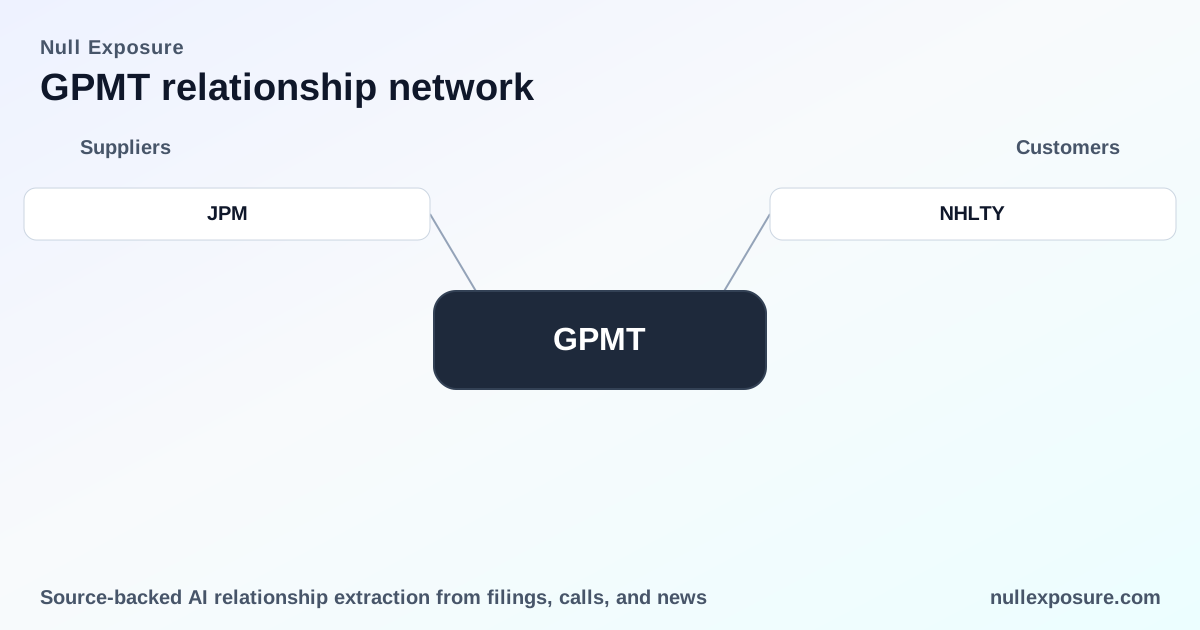
Granite Point Mortgage Trust (GPMT): Supplier Relationships and Operational Signals investors need to know
Granite Point Mortgage Trust originates, invests in and manages floating-rate senior commercial mortgage loans and related commercial real estate debt instruments, monetizing through interest income, spread capture on originated or purchased loans, fee income from asset management activities, and dividends to shareholders. The company funds and leverages these assets via secured facilities and structured finance vehicles, making its counterparty mix — lenders, servicers and custodial banks — determinative for liquidity, cash collections and portfolio performance. For a focused view of GPMT’s supplier posture and material counterparties, review the analysis below. If you want a quick supplier-risk briefing for your due diligence workflow, visit https://nullexposure.com/ for consolidated supplier intelligence.
What the supplier footprint tells you about GPMT’s operating model
Granite Point’s business model is operationally dependent on external service providers and secured funding counterparties. Three company-level signals in the record shape that conclusion:
- Third-party servicer reliance: Company disclosures state explicitly that Granite Point uses a third-party servicer to collect principal and interest and to perform asset management functions for the commercial real estate loans it owns and the loans underlying its CRE CLOs. This is a structural operating choice: cashflow collection and asset-level workout capabilities sit off-balance-sheet from the sponsor and therefore are critical to day-to-day liquidity management.
- Geographic concentration of operations: Corporate filings place headquarters in sub-leased space at 3 Bryant Park in New York with an additional leased office in St. Louis Park, Minnesota — a footprint consistent with a lean corporate operator that outsources operational scale to vendors rather than building it in-house.
- Large vendor spending signal: The supplier constraints include a spend-band flag classed as “100m_plus” alongside a tabulation of totals — “$597,874 $638,640 $1,236,514 $822,080” — which the intelligence engine maps into a high aggregate supplier spend category for the period sampled.
Taken together, these signals imply a supplier posture that is concentrated, operationally critical and materially sized: GPMT contracts out core servicing, relies on secured funding from counterparties, and runs significant annualized vendor cashflows. For a tailored supplier-risk package on GPMT and its counterparties, go to https://nullexposure.com/.
The single material supplier relationship found in the record
JPMorgan Chase Bank, N.A. — repurchase facility counterparty
Granite Point amended its Master Repurchase and Securities Agreement with JPMorgan Chase Bank, N.A., extending the Additional Advance Termination Date to April 12, 2026, a contractual change that directly affects the company’s secured funding runway. This amendment is documented in an industry news summary of Granite Point’s quarter and was reported on March 9, 2026 by Ad-Hoc-News. (Ad-Hoc-News, March 9, 2026).
Implication: JPMorgan is a core secured funding counterparty and the facility extension is liquidity-positive for the contractual period cited; counterparties and investors should price the concentration and bilateral counterparty risk into any financing or valuation view.
Why the JPMorgan amendment matters for investors and operators
A repurchase or securities financing facility is a primary liquidity lever for a mortgage REIT that holds floating-rate loans. The extension to April 12, 2026 accomplishes two things: it preserves near-term access to pledged-asset financing and it postpones immediate refinancing risk tied to the maturity of that facility. For asset operators and portfolio managers, this reduces the urgency to deleverage in the short term and buys time to stabilize cashflow from loan collections and workouts.
Counterparty considerations are straightforward: JPMorgan’s credit and operational counterparty ability matter because the facility is secured and operational events (margining, collateral eligibility, valuation disputes) are handled bilaterally. Any investor model should therefore include a scenario for facility renewal or replacement beyond April 12, 2026, and stress-test collateral valuation and margin triggers under adverse CRE market scenarios.
Company-level constraints that shape supplier risk and contracting posture
Granite Point’s supplier profile is further illuminated by the constraint excerpts captured in its filings and disclosures.
- Geography: The company reports a primary office in New York with leased space in Minnesota, a footprint that signals a concentrated U.S. operating base rather than a broadly distributed vendor network. The relevant disclosure reads, “Our corporate headquarters is located in sub-leased office space at 3 Bryant Park… We also lease office facilities in St. Louis Park, Minnesota.”
- Relationship role: Multiple passages in company disclosures confirm reliance on third-party servicers: “We rely on a third-party servicer to service the commercial real estate loans that we invest in… to collect principal and interest payments… and perform certain asset management services.” This elevates servicer relationships to mission-critical supplier contracts whose performance directly affects cash collection and loss mitigation.
- Spend band: The supplier intelligence flagged a “100m_plus” spend band and shows totals listed as “Total $597,874 $638,640 $1,236,514 $822,080,” indicating material annual supplier cashflows that justify focused vendor governance and concentration monitoring.
From a contracting posture perspective: GPMT operates with outsourced operational dependencies and meaningful vendor spend, so supplier contracts should be assessed for termination provisions, transition assistance, performance SLAs, and substitution options. From a maturity perspective, the company’s model is typical of middle-market mortgage REITs that prefer capital and counterparty structures over large in-house operations.
Practical takeaways for investors and operators
- Liquidity hinge: The JPMorgan repurchase facility extension is a positive short-run liquidity development; the market should anticipate renegotiation or refinance work in 2026. (Ad-Hoc-News, March 9, 2026)
- Operational dependency: Third-party servicers are core to Granite Point’s cashflow mechanics; their performance and contractual protections are key drivers of operational risk.
- Vendor concentration and spend: The spend-band signal and office footprint indicate meaningful outsourced operations, which increases the importance of supplier governance and contingency planning.
For investors conducting counterparty risk or procurement diligence, focus on contractual expiration calendars, collateral eligibility schedules for secured facilities, servicer termination and transition language, and the company's contingency liquidity plans.
If you want a supplier-risk dossier or a counterparties heat-map for Granite Point Mortgage Trust, visit https://nullexposure.com/ to request an in-depth briefing.
Bottom line
Granite Point runs a model where external servicers and secured funding counterparties are central to value realization. The extension of the JPMorgan repurchase facility formalizes access to pledged-asset financing through April 12, 2026, reducing immediate refinancing pressure while leaving longer-term renewal risk in play. Investors should treat servicer performance and counterparty concentration as primary operational risks and require clear remediation and contingency provisions in underwriting or monitoring. For a deeper supplier-risk analysis and ongoing monitoring coverage, go to https://nullexposure.com/ and subscribe for continuous updates.