Global Payments Inc (GPN): Supplier Relationships and Operational Signals investors need
Global Payments monetizes by operating as a global payments technology platform that captures fees from transaction processing, software subscriptions, and value-added services to merchants and financial institutions worldwide. The company leverages scale and integrations from acquisitions to generate revenue synergies, while margins are driven by processing volume and software mix. For investors and operators evaluating counterparty risk, the supplier posture and vendor criticality inside Global Payments are as material as its merchant-facing product stack. Learn how these supplier relationships and governance signals affect exposure and decision-making at https://nullexposure.com/.
What Global Payments' model means for suppliers and partners
Global Payments runs a hybrid model: transaction-processing scale combined with a growing portfolio of vertical software and integrated payments assets. This creates two supplier dynamics worth noting:
- A contracting posture that is operationally integrated — integrations with processing platforms and acquirers translate directly into revenue uplift and operational dependence.
- Concentration risk on a small number of large integrations: successful integrations deliver outsized synergies but also concentrate technical and contractual risk around those partners.
From a commercial and risk-management perspective, Global Payments treats some vendors as critical service providers and subjects them to formal risk assessments, which raises the bar for supplier security, resiliency, and contractual SLAs.
All supplier relationships flagged in the source material
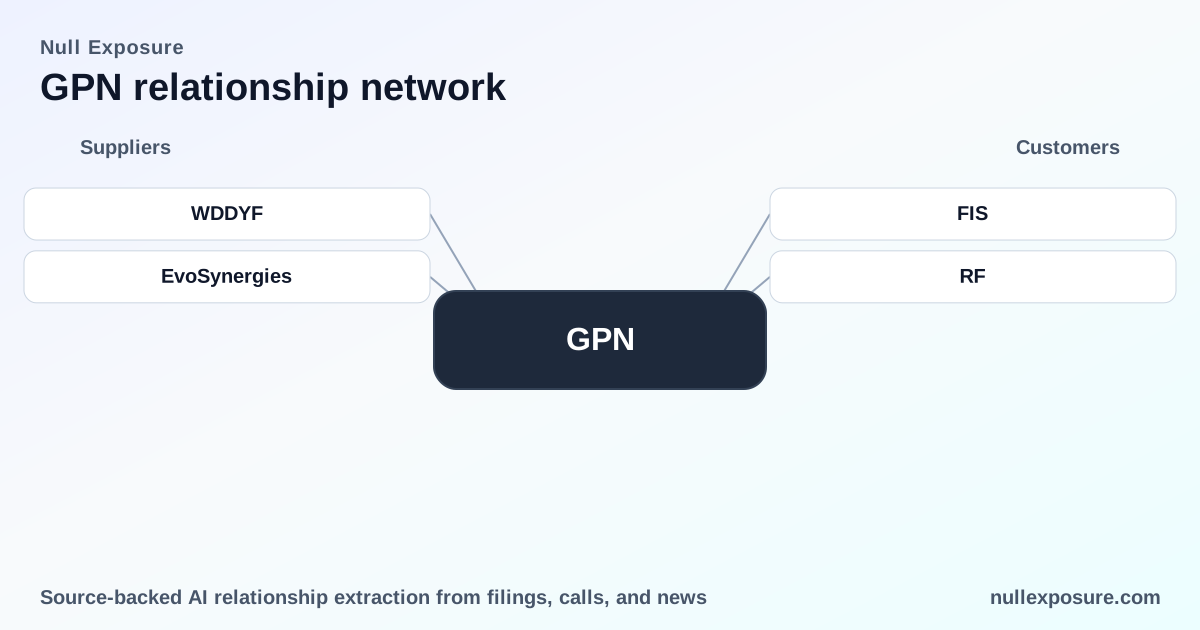
Worldpay (inferred symbol: WDDYF)
Global Payments expects meaningful revenue synergies from integrations such as Worldpay, signaling that Worldpay is a commercial and technical integration point that contributes directly to bottom-line improvement following merger activity. According to an InsiderMonkey piece covering FY2026 commentary, these integrations are highlighted as drivers of improved financial performance (InsiderMonkey, March 9, 2026). Source: InsiderMonkey blog (March 9, 2026).
EvoSynergies
EvoSynergies is listed alongside Worldpay as an integration expected to drive revenue synergies, indicating EvoSynergies functions as an integrated partner or acquired asset that broadens Global Payments’ product or market coverage. The same InsiderMonkey report cites EvoSynergies in the context of FY2026 synergy realization and profitability improvement (InsiderMonkey, March 9, 2026). Source: InsiderMonkey blog (March 9, 2026).
What the supplier relationships collectively imply for investors
Both noted relationships are discussed specifically in the context of integration-driven revenue synergies for FY2026. That makes supplier/partner integration a primary operational lever for Global Payments: acquisitions and platform consolidations are not merely strategic—they are core to near-term earnings uplift. Investors should treat supplier integration success as a key value driver, and operators should treat these third parties as embedded elements of the product-delivery chain.
Explore deeper supplier analytics and how they affect portfolio exposure at https://nullexposure.com/.
Company-level constraints and what they signal about governance
The information available includes two governance and risk-management constraints that are company-level signals rather than relationship-specific findings:
- Critical vendor designation and periodic comprehensive risk assessments. Global Payments’ vendor management office, working with Information Security and Business Resiliency Governance, conducts periodic comprehensive risk assessments on critical vendors with a focus on cybersecurity practices. This indicates a mature vendor-governance process and the company’s willingness to allocate resources to monitor high-impact suppliers.
- Third-party service provider posture. The company explicitly designs its risk-identification and management processes to account for cybersecurity risks associated with third-party service providers, reflecting formalized contracting and oversight for suppliers that deliver operational services.
Collectively these constraints indicate high maturity in control posture: Global Payments treats a subset of suppliers as critical, requires cybersecurity assessments, and embeds vendor risk into enterprise risk management. For investors, this reduces operational tail risk but does not eliminate integration execution risk.
Operational characteristics that investors and operators should factor into valuation and risk
- Contracting posture: Contracts with key processing and integration partners are likely to include stringent SLAs, security requirements, and audit rights. That contracting posture increases switching costs for Global Payments but raises expectations for supplier compliance and monitoring.
- Concentration: The emphasis on a few named integrations (Worldpay, EvoSynergies) implies concentration of operational dependencies; successful integration drives outsized revenue upside, while integration failure would compress realized synergies.
- Criticality: Given the explicit critical-vendor treatment in governance excerpts, certain suppliers are operationally critical—their availability and security affect merchant processing continuity and regulatory compliance.
- Maturity: A documented vendor management office and periodic comprehensive assessments denote a mature third-party risk program, reducing likelihood of unmanaged cyber or resiliency exposures but increasing costs and vendor management overhead.
Risk and upside for investors and operators
- Upside: Integration-driven revenue synergies are a direct lever to raise margins and EBITDA if realized on schedule; the company’s FY2026 outlook references such synergies explicitly. This supports the investment thesis that consolidation and cross-selling remain primary drivers of growth.
- Risk: Execution risk on complex integrations, counterparty security lapses, or contractual disputes with large processing partners represent the principal operational exposure. Despite mature governance, concentration and integration complexity are non-trivial.
If you evaluate counterparties or need a consolidated view of supplier criticality that matters to portfolio companies, start with a targeted supplier-risk assessment at https://nullexposure.com/.
Bottom line: what investors should do next
Global Payments is executing a playbook that relies on strategic integrations and operational control of suppliers to convert scale into margin. Treat acquisition integrations and named processing partners as primary drivers of near-term earnings, and monitor the company’s vendor assessment disclosures and integration milestones for early signals of synergy realization or execution slippage. For operators, insist on contractual clarity around SLAs, audit rights, and cybersecurity attestation from any critical service provider tied into Global Payments’ processing stack.
For more supplier-focused risk intelligence and comparative analysis across payment platforms, visit https://nullexposure.com/.