Gulfport Energy Operating Corp (GPOR): supplier posture, obligations, and the one public transaction investors should note
Gulfport Energy Operating Corp is an upstream E&P operator that explores, develops and produces natural gas, crude oil and NGLs in the United States and monetizes through commodity sales and disciplined capital allocation, including occasional share repurchases. The company carries material long‑term midstream commitments that function as fixed capacity reservations and a significant balance‑sheet lever, while capital actions such as share buys are tactical moves that influence free‑cash deployment. For deal and counterparty diligence, focus on the midstream contract structure, counterparty credit, and the firm’s $1.1 billion of long‑term contractual obligations.
Discover more supplier relationship signals at https://nullexposure.com/.
How Gulfport makes money and why suppliers matter
Gulfport sells produced hydrocarbons into commodity markets, capturing margin between field production costs and realized prices while managing midstream logistics through contracted gathering, processing and transportation. Revenue is generated at the wellhead but realized only after midstream capacity converts production into marketable barrels and MMBtu—making midstream suppliers operationally critical. Financially, Gulfport reported trailing revenue of about $1.30 billion and EBITDA of $907 million as of the latest reported quarter ended 2025‑12‑31, with a market capitalization near $3.86 billion—numbers that position the company to absorb operational cycles but also make contractual commitments meaningful to cash flow. (Company filings and financial statements through 2025‑12‑31.)
What the filing evidence tells you about Gulfport’s supplier relationships
Gulfport’s public disclosures describe a supplier posture with three measurable characteristics:
-
Long‑term contracting posture: Gulfport states it “has entered into long‑term gathering, processing and transportation contracts … that reserve capacity for fixed, determinable quantities of production over specified periods of time.” This is a deliberate strategy to secure takeaway and processing capacity and to stabilize realized volumes against infrastructure constraints. (Company filings, Dec 31, 2024.)
-
Service provider reliance and fee structure: The company acknowledges paying midstream service providers fees based on minimum volume commitments regardless of actual throughput, which creates a fixed‑cost layer under production variability and increases operational leverage. Gulfport also engages third‑party cybersecurity providers for 24/7 monitoring, indicating reliance on external service partners for critical operational security functions. (Company filings.)
-
Material committed spend: Gulfport discloses aggregate long‑term contractual obligations of approximately $1.1 billion as of Dec 31, 2024, which signals a high level of committed spend that is relevant to liquidity planning, counterparty concentration analysis and restructuring scenarios. (Company filings, Dec 31, 2024.)
These are company‑level signals that shape counterparty risk and operational resilience rather than attributes of any single supplier. Treat the long‑term midstream commitments as structural fixed costs that magnify the impact of commodity cyclicality on free cash flow.
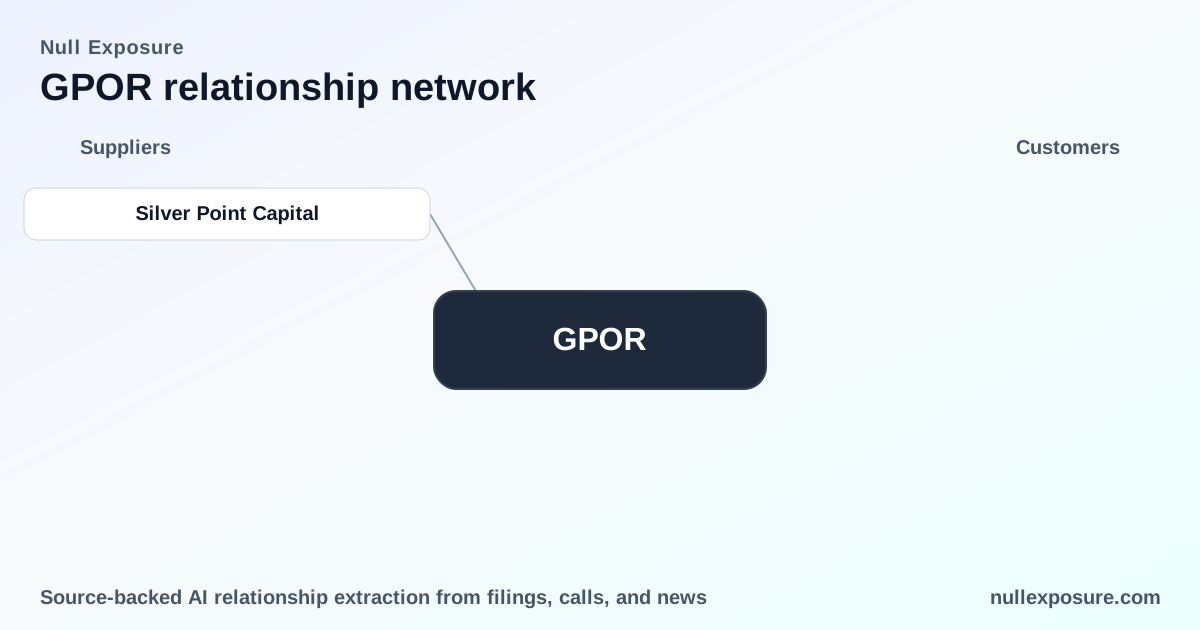
Publicly visible relationship: Silver Point Capital
Gulfport executed a share transaction involving Silver Point Capital in early 2026. According to a March 9, 2026 TradingView news item, Gulfport agreed to buy 45,546 shares from Silver Point Capital, a disclosed equity transfer tied to the company’s stock repurchase activity. (TradingView news, March 9, 2026.)
This transaction is an equity repurchase from an investor rather than a procurement of goods or services; it affects capital allocation and free‑cash deployment rather than supplier performance. Treat this as a corporate‑finance event—relevant to balance‑sheet composition and shareholder returns, not as a material supplier relationship.
Why the constraints matter for operators and buyers
The constraint evidence in Gulfport’s disclosures gives a clear playbook for supplier diligence:
-
Contracting posture: Long‑term reservations mean Gulfport prioritizes throughput certainty over spot flexibility. For counterparties, this implies predictable volume and revenue streams but also contractual stickiness.
-
Concentration and materiality: With >$1.1 billion in long‑term obligations, suppliers and lenders should assume economically significant bilateral exposure; counterparty credit and contract assignment provisions become critical in stress scenarios.
-
Criticality: Minimum‑volume fees create operational criticality—midstream outages or underperformance do not simply reduce variable cost; they can leave Gulfport paying for unused capacity, compressing margins.
-
Maturity of relationships: The language points to established, multi‑year contracts rather than nascent or ad‑hoc arrangements, which supports midstream counterparties’ ability to underwrite long‑dated cash flows but requires attention to price and take‑or‑pay mechanics.
These characteristics should be integrated into stress tests, covenant design and negotiation of service levels when engaging with Gulfport as a supplier or counterparty.
Explore deeper supplier signals and counterparty profiles at https://nullexposure.com/ to support your diligence.
Investment implications and a risk checklist for investors
-
Capital allocation signal: The Silver Point share repurchase demonstrates Gulfport uses buybacks to manage share count and return excess cash; this alters net leverage and liquidity available for supplier commitments.
-
Operational leverage: Minimum‑volume midstream fees create fixed cash outflows that amplify commodity price exposure; in downside scenarios, these commitments reduce operating flexibility.
-
Counterparty exposure: The scale of long‑term obligations requires monitoring of the credit quality and concentration of Gulfport’s midstream partners and any pass‑through or assignment rights.
-
Cybersecurity dependency: Reliance on third‑party security operations monitoring is a positive control but also introduces outsourcer risk—contracts should include SLAs and incident response commitments.
-
Balance‑sheet context: With trailing EBITDA of $907 million and profit margin near 33%, Gulfport has operational cash generation today, but committed midstream spend consumes a notable portion of future cash flow under stressed commodity prices. (Financials through 2025‑12‑31.)
Bottom line and next steps for relationship managers and investors
Gulfport’s supplier framework is defined by long‑term, high‑commitment midstream contracts that are operationally critical and balance‑sheet relevant. The publicly visible interaction with Silver Point Capital is a corporate finance event and not a supplier engagement; suppliers and investors should focus their diligence on contract terms, minimum‑volume exposure, counterparty credit, and service continuity provisions.
For transaction teams, risk managers, and investors requiring a structured view of Gulfport’s supplier exposures and contractual footprints, consult the NullExposure portal for consolidated supplier intelligence and continuous monitoring: https://nullexposure.com/. If you need a tailored counterparty risk memo or an alert stream for GPOR supplier events, start here: https://nullexposure.com/.
Key takeaway: long‑term midstream commitments are a structural part of Gulfport’s operating model and drive both operational risk and valuation leverage; equity transactions such as the Silver Point repurchase are peripheral to supplier risk but important for capital allocation analysis. Explore supplier relationship signals on the NullExposure home page: https://nullexposure.com/.