GoPro (GPRO) — Supplier relationships, secured financing, and operational constraints investors should price in
GoPro operates and monetizes as a hardware-first consumer electronics company: it designs and sells mountable and portable cameras, drones, and accessories, while outsourcing the bulk of manufacturing and fulfillment. Recent financing activity shows the company is supplementing operating cash flows with secured lending rather than equity, and it monetizes primarily through product sales and accessories with recurring logistics and aftermarket service costs embedded in its go-to-market model. Investors should treat supplier concentration and secured-creditor claims as first-order risks to cash flow recovery and strategic optionality. For an integrated view of counterparty and supplier risk, see https://nullexposure.com/.
The headline transaction: $50 million second-lien term loan and the bank amendment
On March 9, 2026 GoPro announced a $50 million secured second-lien term loan provided by Farallon Capital Management and affiliates to strengthen the balance sheet. According to the SGB Online report, the financing is a second-lien credit agreement that sits behind existing secured lenders in the capital structure and injects near-term liquidity into operations. A copy of the coverage is available at SGB Online: https://sgbonline.com/gopro-inc-raises-50m-via-second-term-loan-to-bolster-balance-sheet/.
Shortly alongside that financing, GoPro amended its existing credit agreement with Wells Fargo Bank, National Association to permit the second-lien facility and to grant the administrative agent and the lenders a first-priority security interest in the company’s IP registrations and applications under an Amended and Restated Guaranty and Security Agreement. That amendment reallocates real collateral priorities and crystallizes an important structural claim on intangible assets. (Source: SGB Online coverage of the March 9, 2026 transaction.)
For deeper counterparty mapping, visit https://nullexposure.com/ to see how these secured arrangements change recovery prospects across lender classes.
Counterparty summaries — the relationships you need on the radar
-
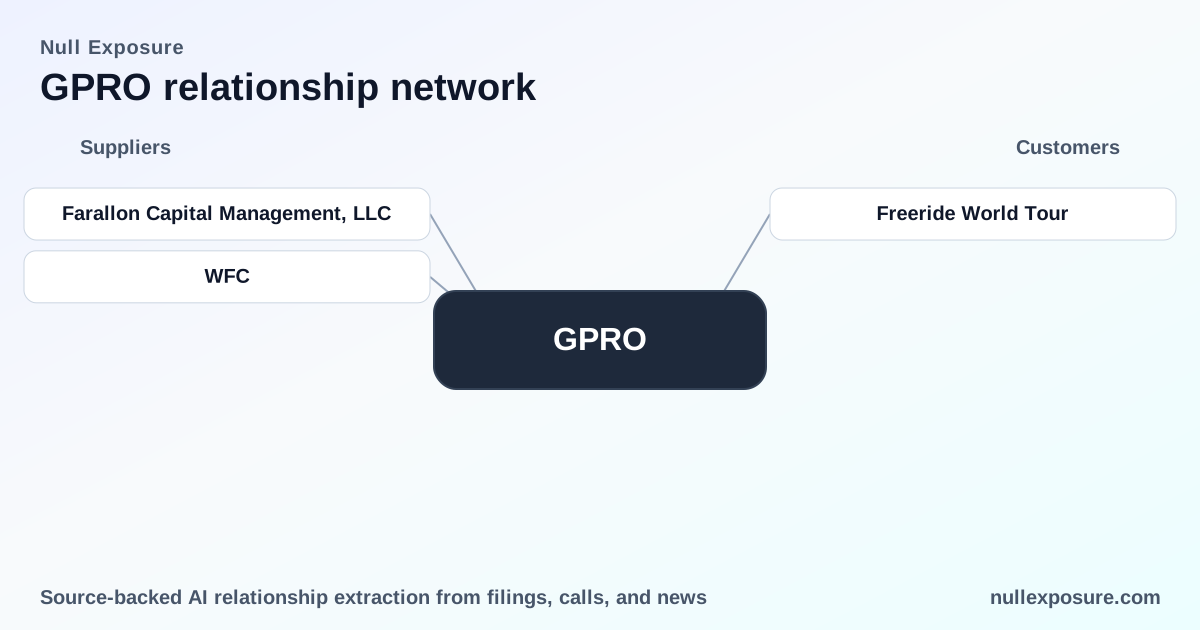
Farallon Capital Management, LLC — Farallon provided a $50 million second-lien secured term loan to GoPro in FY2025 to bolster liquidity; this loan takes a subordinated position behind existing secured lenders and increases the burden of fixed financing costs. (Source: SGB Online, March 9, 2026.)
-
Wells Fargo Bank, National Association — Wells Fargo, serving as administrative agent under GoPro’s existing credit facility, agreed to an amendment to permit the second-lien loan and accepted a restructuring of collateral priorities that grants the administrative agent and the lenders a first-priority security interest in GoPro’s intellectual property registrations and applications. This change elevates the existing credit group's collateral position ahead of the new second-lien lender. (Source: SGB Online, March 9, 2026.)
What the relationships and disclosures imply about GoPro’s operating model
GoPro’s supplier and financing posture is shaped by several clear, company-level signals drawn from its public disclosures:
-
Long-term contracting posture. The company states it routinely enters multi-year agreements — from sponsorships to software licenses and operating leases — that lock in operating commitments over multiple years. This lengthens fixed expense visibility and reduces short-term flexibility in vendor negotiations.
-
APAC manufacturing concentration and outsourcing. GoPro relocated production to concentrate manufacturing in China and Thailand and outsources the majority of production to contract manufacturers in China, Thailand, and Vietnam. This geographic concentration increases supply-chain vulnerability to regional disruption and supplier bargaining power.
-
Global fulfillment footprint. Finished goods are forwarded to outsourced fulfillment centers in the United States, Hong Kong, Japan, and the Netherlands, indicating a distributed logistics network that supports global demand but also adds layers of service-provider dependency.
-
Critical single-source exposure. The company reports that several key strategic parts are purchased by GoPro and consigned to manufacturers, while many components are procured directly by contract manufacturers; some suppliers are sole-source. These practices create single points of failure for high-value components and limit rapid substitution.
-
Manufacturing and service-provider relationships are central. The firm relies on third-party contract manufacturers and outsourced fulfillment providers for core operations, making supplier performance and contractual protections operationally critical.
These signals combine into an operating model where product margin recovery depends on uninterrupted manufacturing, robust logistics, and the protection of intangible assets (IP), which lenders now treat as pledged collateral.
Credit and operational risk — what investors should price
The financing and the underlying supplier profile create a set of clear risk-adjusted implications:
-
Collateral re-allocation elevates secured debt recovery but compresses unsecured recovery. Granting a first-priority security interest in IP to the existing credit group reduces the asset pool available to subordinated creditors and equity. Investors should price lower recovery for unsecured claims and equity while valuing IP less as an unencumbered optionality lever.
-
Second-lien financing increases fixed obligations with subordinated status. The Farallon $50 million infusion strengthens liquidity but adds a contracted repayment burden that ranks behind Wells Fargo’s secured claim, increasing refinancing and covenant risk under stress.
-
Concentration risk in APAC manufacturing is a material operational lever. Production consolidation into China and Thailand and reliance on sole-source components create negotiating leverage for suppliers and exposure to geopolitical, labor, or transport shocks that would directly depress revenue and inflate margins through expedited logistics or supplier premium pricing.
-
Long-term contracts create committed cost floors. Multi-year sponsorships, software licenses, and leases reduce short-term flexibility to cut costs if revenue softens.
Use the company’s public disclosures on manufacturing and contracting when stress-testing scenarios; these are company-level characteristics that determine operational resilience.
Practical takeaways for supplier managers and investors
- Treat IP as encumbered collateral until filings and security agreements are released showing otherwise; this affects valuation and licensing options.
- Stress-test supply interruption scenarios focused on China/Thailand manufacturing nodes because a single shock will have outsized effects on product availability.
- Re-evaluate counterparty credit thresholds for suppliers whose payments or deliveries are contractually consigned — those suppliers represent high operational criticality.
- Monitor covenant language and amortization schedules in the amended Wells Fargo facility and the Farallon second-lien documents to detect refinancing windows or acceleration triggers that will pressure cash flow.
If you manage procurement or credit exposure, prioritize contingency plans for alternate suppliers and inventory strategies that mitigate sole-source failures. For a mapped view of these suppliers and secured creditors, visit https://nullexposure.com/ to see connectivity across counterparties.
Final assessment and call to action
GoPro’s move to secure a subordinated $50 million credit infusion while conceding first-priority claims in IP to its administrative agent shifts the capital structure toward secured creditors and raises operational dependency on a concentrated manufacturing base. Investors and operators should prioritize collateral analysis and supplier continuity planning when valuing or contracting with GoPro.
For a consolidated supplier-risk profile and counterparty scoring to inform investment and operations decisions, explore the platform at https://nullexposure.com/.