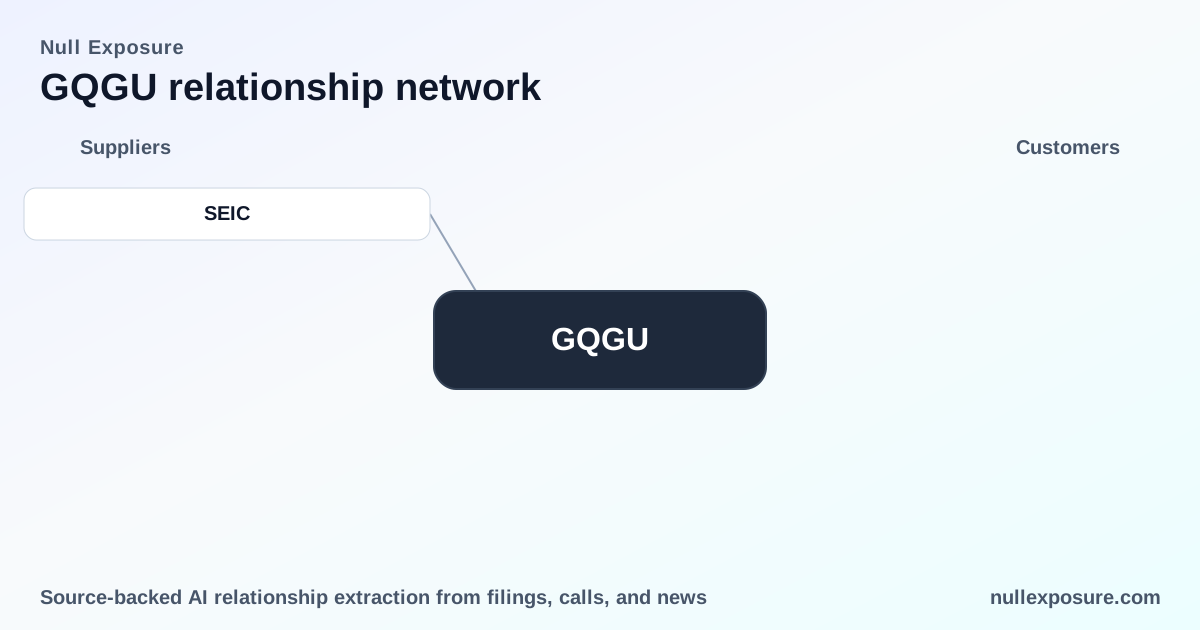
GQGU supplier profile — what operators and allocators need to know
GQG US Equity ETF (ticker: GQGU) is an exchange-traded fund launched by GQG Partners to package its US equity strategy for public investors. The firm monetizes this vehicle through management fees tied to assets under management, distribution arrangements, and the scale benefits of ETF economics; operationally the product sits on a platform of third‑party fund services that enable custody, transfer agency, and exchange listing functions. For investors and operations teams evaluating supplier relationships, the critical question is how GQG is structuring those service relationships and where concentration or operational dependency creates execution or continuity risk.
If you are mapping supplier exposure for portfolio operations or counterparty diligence, start here: visit https://nullexposure.com/ for supplier intelligence and ongoing monitoring.
Quick take: business model and where supplier risk concentrates
GQG leverages its investment track record to attract AUM into an ETF wrapper, which converts active management into a retail-liquid, institutional-accessible product. Revenue scales with AUM and distribution reach, while operational complexity is outsourced to established fund service providers. That outsourcing model reduces in-house operational burden but concentrates execution risk into a small set of external vendors for fund administration, custody, and exchange listing.
- Contracting posture: Outsourced trustee, transfer-agent, and servicing arrangements are the default; vendor relationships will determine settlement and NAV accuracy risk.
- Concentration: A newly launched ETF can be heavily dependent on a few core suppliers for launch, ongoing administration, and exchange connectivity.
- Criticality: Technology and fund-service vendors are critical to operations; failures or onboarding delays materially affect share issuance/redemption and market liquidity.
- Maturity: The product is newly listed, which increases operational fragility during early scaling and liquidity formation.
The single supplier relationship identified in the public record
GQGU’s public supplier footprint in available results shows a primary operational partner.
SEI Investments — the execution and operations partner
GQG Partners launched GQG US Equity ETF through a longstanding strategic partnership with SEI Investments (NASDAQ: SEIC), which provides the fund-service and platform functionality needed to list and operate an ETF (report published March 9, 2026). According to the regional press coverage, SEI served as the platform and operational partner for the ETF’s rollout, underscoring SEI’s role as a backbone supplier for launch and post‑launch servicing (MyChesco, March 2026: https://www.mychesco.com/a/news/regional/gqg-partners-launches-first-etf-with-seis-advisors-inner-circle-trust/).
What that relationship means for investors and operators
The SEI tie is material for several practical reasons:
- Operational dependency: SEI’s platform capability—custody, fund accounting, transfer agency, or similar services—will be central to GQGU’s trade settlement and shareholder servicing. Any service degradation at SEI directly affects investor experience and NAV accuracy.
- Speed-to-market and distribution: Partnering with an established provider like SEI accelerates regulatory and operational readiness for listing; this reduces go‑to‑market friction but creates vendor concentration.
- Counterparty credit and continuity: SEI’s financial and operational stability becomes a second‑order risk for GQGU holders; monitoring SEI’s performance is part of monitoring the ETF’s operational health.
These are not theoretical risks—they are the predictable consequences of a lean asset manager model that outsources critical execution plumbing to a small number of providers.
For a deeper supplier risk view and continuous tracking of relationship changes, consider using the resources at https://nullexposure.com/.
Operational implications for diligence and ongoing monitoring
Teams evaluating GQGU as a product or evaluating GQG Partners as a counterparty should incorporate the following into their operational playbook:
- Validate the scope of services SEI provides (custody, transfer agency, fund accounting, order routing) and confirm contractual SLAs for NAV publication and creation/redemption windows.
- Monitor service-level signals from SEI and market liquidity metrics for the ETF; early issuance patterns and spreads will reflect bootstrapping success or friction.
- Include SEI in continuity and stress tests: define replacement timelines and the practical lead time to migrate fund operations if a vendor change is required.
- Track regulatory filings and press coverage for any changes in the supplier roster—providers change through strategic pivots or consolidation, and that directly impacts operational risk.
Constraints and company-level signals
There are no explicit contractual constraints disclosed in the available supplier results. That absence is itself a signal: no published constraint excerpts were identified, so operational characteristics should be inferred at the company level rather than as relationship-level restrictions. From a company-level perspective, the following operational traits are evident:
- Outsourced core operations — GQG relies on external fund-service infrastructure to operate the ETF.
- Concentration risk — a single named platform partner is visible in public reporting, implying limited diversification of critical suppliers at launch.
- Early-stage execution sensitivity — a newly launched ETF has elevated operational and market formation risks compared with seasoned products.
Final verdict for allocators and operations leaders
GQGU is a classic asset-manager-launched ETF: strategy-first, operations-second, with core servicing delegated to a recognized platform provider, SEI Investments. That structure delivers rapid market access and lower fixed costs for the manager but creates concentrated operational dependency that should be actively managed by counterparties and allocators via contractual, monitoring, and contingency measures.
If you need continuous visibility into supplier linkages and automated alerts when relationships change, start tracking GQGU supplier exposure at https://nullexposure.com/.
Key takeaway: evaluate SEI’s operational footprint and contractual commitments as an integral part of any investment or operational acceptance of GQGU.