Graf Global (GRAF): supplier relationships and what they mean for investors
Graf Global Corp operates as an early-stage provider of graphene and carbon-capture related technologies while carrying the legal and financial profile of a blank‑check/shell-era issuer. The company monetizes through strategic financings and commercial partnerships as it builds engineering and go‑to‑market capacity; near term value realization depends on successful capital markets activity (underwriting and IPO mechanics) and execution of commercial agreements with service providers. For investors, the key lever is the company’s ability to translate SPAC/IPO proceeds and sponsor support into operational scale without material counterparty concentration or uncontrolled contingent liabilities.
Discover more supplier insights and counterparty signals at https://nullexposure.com/.
A quick read on Graf’s financial posture and go‑to‑market setup
Graf is listed on NYSE MKT with a reported market capitalization of roughly $307 million and 23 million shares outstanding. Public filings show zero reported revenue TTM and an EPS figure that reflects non‑operating items rather than stable product sales; trailing P/E is stated at 34.45, while book value is negative. The corporate address and industry labels in filings are consistent with a company transitioning out of a shell/blank‑check phase into commercialization.
The corporate footprint is therefore dual‑track: capital markets activity (underwriting, offering mechanics) is central to near‑term funding, while a small set of ongoing service contracts support the management team and day‑to‑day office functions. Investors should treat Graf as a financing‑led story with early operational exposure to vendor and sponsor relationships.
Explore supplier intelligence and counterparty risk at https://nullexposure.com/.
Who Graf is working with today — the relationships that show up in public reporting
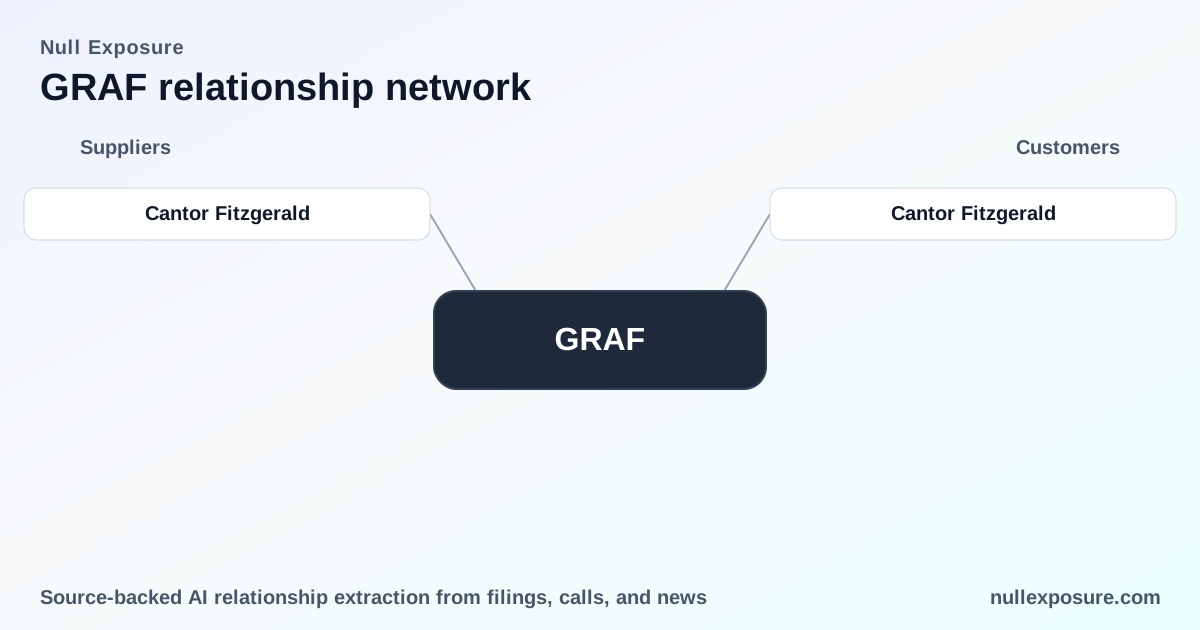
Cantor Fitzgerald — underwriter / bookrunner on the offering
Cantor Fitzgerald is identified as the sole bookrunner on Graf Global’s public filing related to a proposed offering described as a $200 million IPO. This positions Cantor as the primary capital markets partner responsible for deal syndication and underwriting negotiation.
Source: SPAC Conference report on Graf Global filing, June 3, 2024 (news.spacconference.com).
What the contract and constraint signals tell investors about Graf’s operating model
Graf’s public disclosures and extracted constraint signals reveal a compact, finance-first operating model with several operational characteristics investors must price into any valuation.
-
Short-term contracting posture and sponsor dependence. Graf has an agreement to pay an affiliate of its Sponsor up to $20,000 per month for office space and administrative support, described as lasting through the earlier of completion of an initial business combination or liquidation. That arrangement is evidence of a short‑term, renewable service contract structure rather than long‑dated vendor commitments; it is operationally convenient but creates dependency on sponsor‑affiliated services.
-
Concentrated and material service spend. The company incurred and paid $124,000 in administrative support fees for 2024, fitting into a $100k–$1M annual spend band for administrative support. Filings also disclose underwriting fee mechanics that include a deferred fee structure amounting to $0.40–$0.60 per unit and an aggregate deferred exposure up to $9.8 million—a liability profile that sits in the $1M–$10M contingent spend band for capital markets costs.
-
Service provider role and active relationships. Multiple disclosures describe third parties providing day‑to‑day administrative and secretarial services; these are active, operational supplier relationships rather than dormant or purely advisory contracts.
-
Cybersecurity is a material risk to the business. Filings explicitly state the company is early stage and has not made significant investments in data security, relying on third‑party systems and personnel to manage cybersecurity — a corporate‑level vulnerability that could translate into financial loss if exploited.
Taken together, these constraints depict a company that is capital‑markets driven, uses short‑term sponsor arrangements to operate, and carries both concentrated counterparty exposure and meaningful contingent underwriting costs. These are structural features of Graf’s business model, not incidental disclosures.
Investment implications — a concise checklist for analysts and operators
- Capital events drive value: Underwriting terms and the success of the planned offering are core to near‑term funding and valuation; Cantor Fitzgerald’s role as sole bookrunner centralizes execution risk.
- Sponsor concentration risk: Monthly administrative payments to a sponsor affiliate create operational dependency and potential governance questions; confirm contract termination mechanics post‑transaction.
- Contingent underwriting liabilities: Deferred underwriting fees create multi‑million dollar contingent expense that will affect net proceeds and post‑deal runways.
- Cyber risk is non‑trivial: Early‑stage security posture and reliance on third parties for IT controls is a clear operational risk to monitor and remediate.
- No operating revenue to validate product demand yet: Financial metrics show zero revenue TTM; any valuation premised on technology commercialization must be backed by clear milestones and supplier/offtake commitments.
Practical next steps for investors and operators
- Obtain the full underwriting agreement and detail the deferred fee waterfall to understand gross vs. net proceeds from the offering and the potential $9.8 million aggregate obligation.
- Review the sponsor service agreement termination triggers and transition plan for office and administrative services to ensure no operational gap post‑business‑combination.
- Request evidence of vendor cyber controls and incident readiness for third‑party platforms to quantify exposure and remediation costs.
- Monitor execution milestones from the graphene/carbon capture commercialization plan before shifting valuation weight from financing to operations.
For deeper counterparty and supplier intelligence on Graf and similar issuers, visit https://nullexposure.com/.
Final read: positioning Graf for a risk‑adjusted view
Graf Global is best analyzed as a financing‑led enterprise in which underwriting mechanics, sponsor relationships, and short‑term service contracts materially affect capital allocation and risk. Cantor Fitzgerald is the primary capital‑markets partner on the company’s offering, and ongoing sponsor‑affiliated administrative expenses plus deferred underwriting fees are the most immediate items that will determine runway and operational flexibility. Cybersecurity gaps and zero reported revenue TTM make a conservative, milestone‑based valuation approach appropriate for investors and operators engaging with Graf.
If you want a concise supplier risk memo or a counterparty due‑diligence checklist tailored to Graf, request more detail at https://nullexposure.com/.