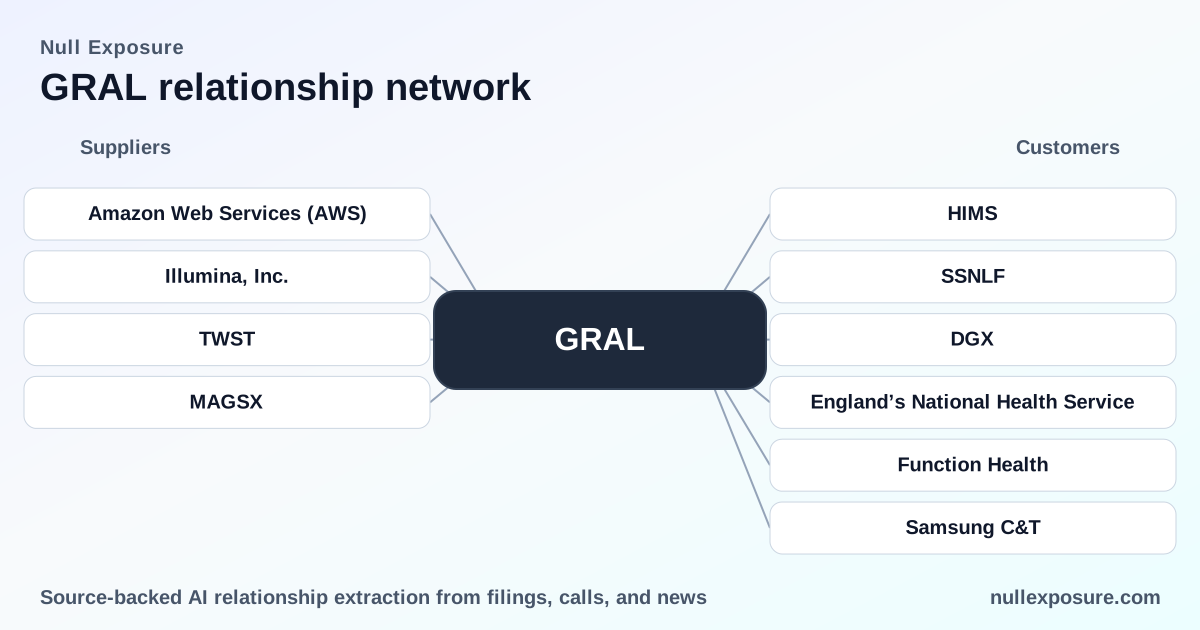
GRAIL’s supplier map: four vendors that make or break its lab and product economics
GRAIL operates a capital- and data-intensive cancer-detection business that monetizes by selling multi-cancer early-detection blood tests and related services, while carrying licensing and supplier commitments that flow through to its margin profile. Revenue generation is concentrated in lab throughput and platform commercialization; continuity of laboratory operations and data analysis is therefore the primary value driver for investors and operators assessing supplier risk.
Explore a consolidated supplier view and commercial signals at https://nullexposure.com/ for deeper diligence and sourcing intelligence.
Four relationships that determine laboratory continuity (and why they matter)
GRAIL discloses four supplier relationships that are central to ongoing operations. Each relationship is summarized below with the source cited directly to GRAIL’s FY2024 reporting.
Illumina, Inc.
Illumina is the sole supplier of next‑generation sequencers and certain laboratory reagents, and GRAIL has a long‑running Supply and Commercialization Agreement that includes a high single‑digit royalty in perpetuity on oncology‑related net sales, plus minimum royalty payments. According to GRAIL’s 2024 Form 10‑K, any disruption in Illumina’s operations or a dispute with Illumina would materially impact GRAIL’s laboratory operations and commercialization timeline. (Source: GRAIL 2024 Form 10‑K, FY2024)
Twist Bioscience Corporation (TWST)
Twist is identified as the sole supplier of GRAIL’s DNA probes and panels, making it a manufacturing-critical partner for the laboratory workflow. GRAIL’s 2024 filing specifically names Twist as a single-source supplier for DNA panels used in test processing. (Source: GRAIL 2024 Form 10‑K, FY2024)
Madison (owner of Streck, Inc.; MAGSX)
Madison, following its 2023 acquisition of Streck, is the sole supplier of blood collection tubes used for sample collection, a logistics-critical consumable that affects sample integrity and throughput. GRAIL’s filing states Madison (via Streck) supplies the tubes GRAIL relies on for patient sample collection. (Source: GRAIL 2024 Form 10‑K, FY2024)
Amazon Web Services (AWS)
GRAIL hosts its entire data estate and conducts a significant portion of data analysis on AWS, making cloud availability, costs, and security posture direct operational risks. GRAIL’s 2024 disclosure confirms AWS as the hosting and analytics backbone for laboratory and research data. (Source: GRAIL 2024 Form 10‑K, FY2024)
Visit https://nullexposure.com/ for supplier impact scenarios and contract-level tracking to support procurement decisions.
What the supplier constraints reveal about GRAIL’s operating model
GRAIL’s public disclosures and constraint excerpts paint a clear picture of the company’s commercial posture and operational concentration:
-
Contracting posture and licensing: GRAIL has entered into a multi‑amendment supply and commercialization agreement with Illumina that includes a perpetual, high single‑digit royalty on oncology product sales, plus associated minimum royalties. That structure shifts a portion of commercialization economics into a long‑term royalty stream owed to a supplier. (Company‑level signal drawn from the Illumina licensing excerpt in the 2024 10‑K.)
-
Supplier concentration and criticality: Multiple excerpts explicitly identify sole-supplier status for Illumina (sequencers/reagents), Twist (DNA probes), and Madison/Streck (collection tubes). Sole‑source arrangements create operational single points of failure with direct implications for lab uptime and go‑to‑market cadence.
-
Financial commitments and maturity: As of December 31, 2024, GRAIL reported $60.3 million of non‑cancelable purchase obligations (with $21.1 million due within 12 months) and $86.0 million of undiscounted operating lease obligations (with $15.2 million due within 12 months); minimum royalties of $6.8 million are recorded, with $1.0 million payable within 12 months. These obligations reflect mid‑to‑high single‑digit spend bands and multi‑year commitments that anchor capital and cash‑flow planning. (Company‑level signal from GRAIL’s FY2024 disclosures.)
-
Relationship roles and service dependencies: Illumina is both supplier and commercial partner, providing maintenance/repair services for sequencers and acting as a counterparty in revenue‑linked licensing; Twist and Madison function as manufacturing providers; AWS is a critical service provider for hosting and analytics. These roles imply GRAIL’s operations are dependent on third‑party technical expertise and service levels as much as on physical inputs.
-
Operational risk posture: GRAIL explicitly warns that disruptions in these suppliers would delay laboratory operations and commercialization. Given the company’s negative operating margins and reliance on lab throughput to scale revenue, supplier interruptions translate quickly into financial stress.
What investors and operators should prioritize now
For investors and procurement teams, focus on three operational levers that materially affect downside risk and upside scalability:
- Assess contract terms and exit/contingency rights with Illumina and Twist, and quantify the financial impact of royalties and minimum payments on unit economics and sensitivity to volume growth.
- Validate supply redundancy and dual‑source pathways for probes and collection tubes; where sole‑supplier status remains, tighten inventory and SLAs to protect throughput.
- Stress test cloud dependency with AWS — ensure contractual SLAs, data egress cost modeling, and incident notification commitments are in place, since analytics availability is a gating factor for test delivery.
Key takeaways and immediate actions
- Supplier concentration is structural. GRAIL runs with sole suppliers for sequencers, probes, and collection tubes, and relies on AWS for data hosting — all are high‑impact dependencies.
- Illumina’s licensing reshapes economics. The perpetual royalty and minimum payments create an ongoing cost layer that reduces operating leverage as revenue scales.
- Contractual obligations are material to near‑term liquidity planning. Purchase and lease obligations exceed tens of millions and have near‑term cash footprints.
- Operational resilience equals investor protection. Securing alternative supply channels, robust inventory policies, and tightened service clauses with cloud and equipment vendors are practical mitigation steps.
For a deeper supplier risk scorecard, portfolio impact analysis, and contract‑level intelligence, visit https://nullexposure.com/ and request focused supplier diligence.
Take action: review GRAIL’s FY2024 Form 10‑K alongside supplier contract summaries to quantify royalty sensitivity and single‑point failure exposure; for outsourced diligence and contract monitoring services go to https://nullexposure.com/ to commission targeted supplier reporting.