GRALV supplier relationships: what investors should price in
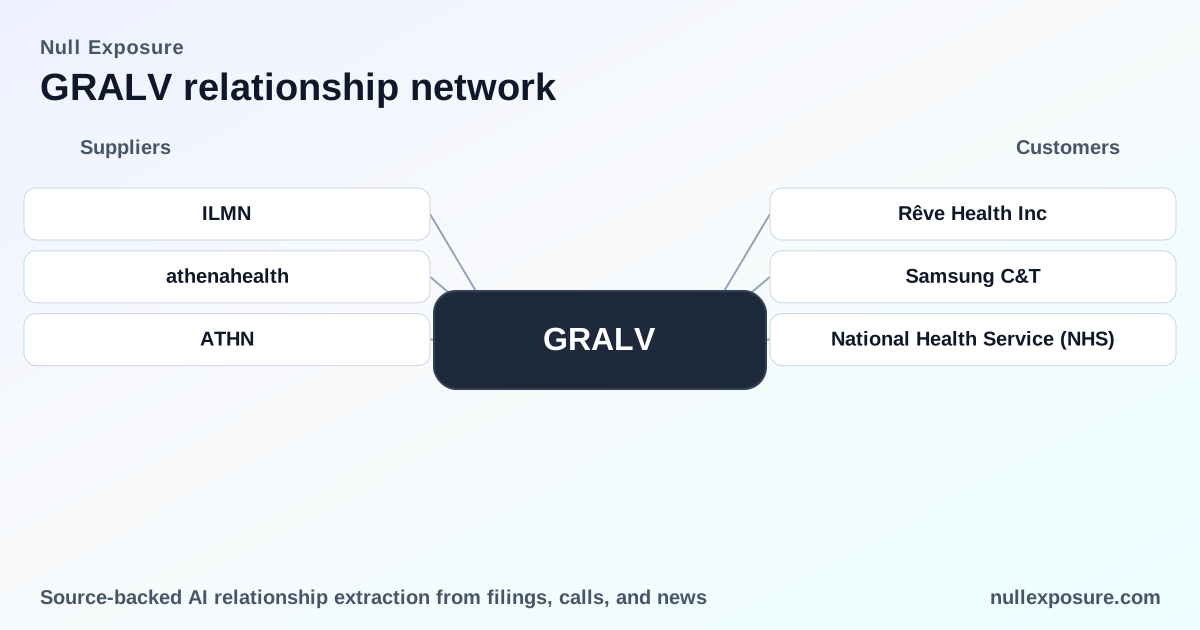
GRAIL monetizes by selling its Galleri multi‑cancer early detection test and scaling distribution through clinical and digital partners; the company depends on upstream sequencing technology for test development and on channel partners to convert clinical awareness into ordered tests. Investor returns will track commercialization execution, the stability of key supplier arrangements, and regulatory friction tied to those upstream relationships. For a concise view of counterparties and their implications, review the relationship map below and the operational takeaways that follow.
Explore deeper supplier analytics at https://nullexposure.com/.
Why supplier ties matter for GRAIL’s commercial path
GRAIL’s product is not a standalone widget: it is a combination of wet‑lab sequencing inputs, analysis pipelines, and provider workflow integration. That creates two structural dependencies — critical upstream inputs (sequencers and reagents) and downstream distribution channels (EHRs, provider networks). Those dependencies determine negotiating leverage, execution risk and the cadence of revenue growth.
The Illumina relationship — a series of regulatory and strategic touchpoints
- Illumina historically provided foundational next‑generation sequencing (NGS) technology underlying GRAIL’s test development, and EU and U.S. authorities scrutinized Illumina’s attempt to acquire GRAIL on vertical foreclosure grounds (European Commission / Autorité and other reviews). (See analysis from the Autorité de la concurrence: https://www.autoritedelaconcurrence.fr/en/communiques-de-presse/european-commission-opens-review-illuminas-acquisition-grail-under-procedure)
- The Illumina acquisition effort was characterized as vertical — Illumina operates upstream of GRAIL — which underpinned competition authorities’ interventions. (Coverage on the Commission’s blocking rationale: https://www.clearyantitrustwatch.com/2022/09/the-saga-contiues-commission-block-illumina-grail-in-landmark-decision/)
- U.S. enforcement action emphasized the risk that Illumina could favor GRAIL for NGS inputs, an incentive that drove the FTC to order divestiture during the acquisition dispute. (Reporting from CNBC on the FTC order, April 2023: https://www.cnbc.com/2023/04/03/ftc-orders-illumina-to-divest-grail-acquisition.html)
- Earlier coverage of the proposed acquisition documented that GRAIL spun out in 2016 and relied on Illumina’s NGS platform to develop the data science and machine learning models behind early detection tests. (Background on the 2016 spin‑out and acquisition announcement: https://www.massdevice.com/illumina-to-acquire-grail-for-8b-expands-cancer-early-detection/)
- The EU opened a formal investigation into Illumina’s decision to complete the roughly $8 billion acquisition of GRAIL, signaling sustained antitrust attention in key markets and reinforcing the regulatory overlay to the relationship. (MassDevice report on EU investigation: https://www.massdevice.com/eu-to-investigate-illuminas-decision-to-close-8b-grail-acquisition/)
Takeaway: Illumina is a strategically material upstream supplier and the source of regulatory risk; the history of acquisition attempts and enforcement action places Illumina at the center of any supply‑chain or contractual leverage analysis.
The athenahealth relationship — channel scale for clinical adoption
- GRAIL announced a partnership to integrate Galleri ordering into athenahealth’s platform, enabling streamlined ordering for a broad set of providers and embedding the test into clinical workflows. (Partnership announcement via PR Newswire: https://www.prnewswire.com/news-releases/grail-and-athenahealth-team-up-to-offer-healthcare-providers-streamlined-ordering-of-grails-galleri-multi-cancer-early-detection-mced-test-302452612.html)
- GRAIL’s Q1 2025 results reiterated the value of the athenahealth integration to reach more than 160,000 U.S. providers through AthenaCoordinator Core, underlining the partnership’s role in increasing patient access and test ordering. (GRAIL Q1 2025 financial release: https://www.prnewswire.com/news-releases/grail-reports-first-quarter-2025-financial-results-302454271.html)
Takeaway: athenahealth functions as a high‑reach distribution partner that converts clinical availability into provider orders; this relationship is a commercialization accelerant rather than a technical supplier.
How these relationships translate into operational constraints
GRAIL’s supplier posture can be summarized as follows:
- Contracting posture: GRAIL is a downstream buyer of sequencing technology and a downstream seller of clinical tests. Contracts with upstream providers like Illumina carry strategic complexity because upstream control over inputs can shape cost and access; regulatory scrutiny has historically constrained vertical integration. This is a company‑level signal derived from public enforcement history and transaction filings.
- Concentration: The upstream market concentration is high because leading NGS platforms command large share; that concentration elevates supplier bargaining power and supply continuity risk. Investors should price potential price pressure or preferential access issues into scenarios.
- Criticality: Sequencing inputs are mission‑critical for product integrity while channel integrations (athenahealth) are critical for demand realization. Disruption on either axis would materially affect throughput and sales conversion.
- Maturity: GRAIL is in a commercial scaling phase post‑product development, where relationships with established suppliers and large channel partners determine growth velocity and margin trajectory.
These are company‑level signals useful for modeling cash‑flow scenarios and downside protection.
Investment implications: risk, optionality and monitoring checklist
- Regulatory overhang creates binary outcomes. The Illumina history shows regulators can reshape supplier landscapes quickly, which translates into asymmetric downside if GRAIL loses favorable supplier terms or is forced to alter upstream arrangements.
- Commercial execution levered to partnerships. The athenahealth integration is a tangible path to orders; conversion rates from ordering access to completed tests will determine revenue growth in the near term.
- Negotiate around concentration. As GRAIL scales, management’s ability to diversify sequencing suppliers or secure long‑term supply agreements will reduce cost and operational risk.
Track these triggers: enforcement filings and competition rulings related to NGS suppliers, progress metrics on athenahealth adoption and ordering volumes, and any announced supply‑agreement renewals or diversifications.
For a strategic supplier risk assessment and competitive mapping, visit https://nullexposure.com/ to see structured supplier intelligence and monitoring.
Actionable next steps for investors and operators
- Stress‑test models with scenarios that include elevated upstream costs or restricted supplier access due to enforcement outcomes. Price regulatory risk into downside cash flows.
- Monitor athenahealth ordering metrics as a leading indicator of commercial adoption; operational teams should prioritize EHR integrations to accelerate conversion.
- Engage the corporate filings and competition filings cited above to confirm any changes to contractual posture or enforcement status.
For tailored supplier risk briefings and continued tracking of GRALV counterparties, go to https://nullexposure.com/.