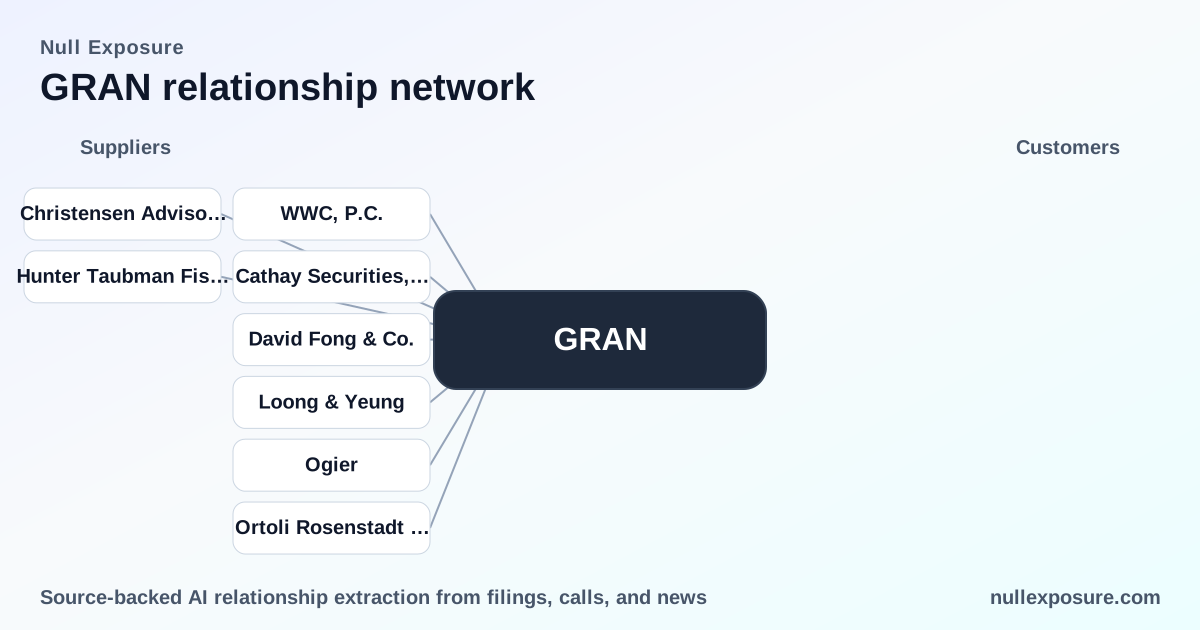
GRAN: Who supplies Grande Group and what that means for investors
Grande Group Limited operates as a boutique corporate finance advisor across Hong Kong, mainland China and Singapore, monetizing advisory fees from capital markets transactions, IPO underwriting relationships and corporate advisory mandates. The company’s revenue base is fee-driven and event-dependent, concentrated around discrete capital markets activities; its supplier ecosystem for the IPO and listing process exposes the business to standard professional-service counterparty relationships rather than operational supply-chain dependency.
For deeper counterparty mapping and supplier analysis visit https://nullexposure.com/.
A concise operating thesis for investors
Grande generates advisory revenue when transactions close; the company’s public listing was financed and supported by a set of external professional services firms (underwriters, legal counsels, auditors and investor relations advisors). That structure implies variable top-line capture tied to deal flow, a small public float with high insider ownership, and vendor relationships that are transactional and replaceable but legally and reputationally critical during capital markets events.
Explore supplier intelligence and relationship timelines at https://nullexposure.com/.
Who acted for Grande on the IPO and what each relationship means
Below are the counterparties named in public releases about Grande’s initial public offering and corporate communications. Each entry is a plain-English, investor-oriented summary with source attribution.
-
WWC, P.C. — WWC served as Grande Group’s independent registered public accounting firm for the reporting period cited in IPO close related releases, providing the audit and financial reporting sign-off necessary for SEC/Nasdaq processes (Quiver Quant News; Yahoo Finance, FY2025 press materials).
-
Cathay Securities, Inc. — Cathay Securities acted as the underwriter for the offering, executing the capital raise and placement responsibilities that generated the cash proceeds used to fund the listed entity (Yahoo Finance and FinancialContent press releases on the IPO closing, FY2025).
-
David Fong & Co. — David Fong & Co. acted as one of Grande’s Hong Kong legal counsels, handling jurisdictional corporate law and regulatory matters tied to Hong Kong corporate presence and transactions (Yahoo Finance and FinancialContent IPO announcements, FY2025).
-
Loong & Yeung — Loong & Yeung was engaged alongside David Fong & Co. as Hong Kong legal counsel, responsible for local legal opinions and filings that support cross‑border listing mechanics (Yahoo Finance and FinancialContent notices, FY2025).
-
Ogier — Ogier acted as the British Virgin Islands legal counsel to Grande, providing offshore corporate law counsel for the group’s entity structure and related transactional documentation (Yahoo Finance and FinancialContent IPO disclosures, FY2025).
-
Ortoli Rosenstadt LLP — Ortoli Rosenstadt served as Grande’s U.S. securities counsel, delivering the U.S.-jurisdiction securities advice and offering documentation required for a Nasdaq listing and related regulatory compliance (Yahoo Finance and FinancialContent IPO materials, FY2025).
-
Hunter Taubman Fischer & Li LLC — Hunter Taubman Fischer & Li acted as U.S. securities counsel to the underwriter in connection with the offering, supporting the underwriter’s legal needs on U.S. securities matters (FinancialContent press release, FY2025).
-
Christensen Advisory — Christensen Advisory was named as Grande Group’s investor relations contact and communications advisor, handling the market-facing messaging and investor communications that accompany an IPO and post-listing announcements (FinancialContent and Quiver Quant news items, FY2025).
Each of these relationships is transactional and standard for a cross-border IPO: external auditors and legal counsels are critical to listing execution and post-issuance compliance, while the underwriter and IR advisor controlled distribution and market messaging for the equity placement (sources as noted above).
Operating model signals and supplier posture
Public metrics and the vendor roster combine to reveal Grande’s business model characteristics for counterparties and investors:
-
Contracting posture: Vendor relationships are short-term, engagement-based and event-driven — typical for capital markets boutiques. Legal, audit and underwriting mandates are replaceable but legally critical while active.
-
Concentration and criticality: Insider ownership is extremely high (over 76% insiders), and institutional ownership is negligible (~0.29%), producing low free float and limited passive investor oversight; supplier counterparty failure during an offering would be highly disruptive for discrete transactions but not for ongoing operations.
-
Maturity and scale: Market cap (~$42.7M) and small float sizes indicate an early-stage public company with limited institutional sponsorship and operational scale; professional services support the company through episodic capital markets activity rather than continuous supply relationships.
-
Financial posture: Revenue is small (Revenue TTM ~ $2.88M) with negative operating margins and shrinking quarterly growth metrics, while valuation multiples (Price/Sales ~ 14.8x) imply the market is pricing future deal flow rather than current profitability — a structural risk for suppliers and investors that rely on recurring mandates.
No vendor-level constraints were listed in the reporting set; the above are company-level signals derived from public financials and IPO disclosures.
What investors and operators should prioritize
-
Counterparty reliability during capital events is non-negotiable. Underwriters, auditors and securities counsel executed the IPO; comparable future transactions will require equivalent professional capability and reputation (see Cathay Securities; WWC; Ortoli Rosenstadt; Ogier).
-
Concentration risk is real. With a tiny institutional base and a high insider stake, governance and market liquidity are limited; investors should factor potential volatility and illiquidity into position sizing.
-
Valuation vs. fundamentals divergence. Grande’s current revenue and margin profile do not support its elevated price-to-sales multiple absent sustained deal flow and material margin improvement.
Key takeaways:
- IPO execution relied on a standard professional services stack (underwriter, multiple legal counsels, auditor, IR advisor).
- Supplier relationships are transactional but critical for regulatory and market access.
- Balance sheet and ownership structure create execution and liquidity risk for future capital raises.
For a detailed supplier risk model and timeline of relationship disclosures, visit https://nullexposure.com/.
Conclusion — what this means for your investment or partnership decision
Grande is a deal-driven advisory firm whose public-stage supplier relationships are typical for cross-border listings: legally critical, short-term, and easily auditable. Investors should treat future revenue as contingent on deal flow and view legal/audit counterparty strength as a gating factor for execution risk. Operators considering vendor exposure should price these relationships for episodic demand and prioritize counterparties with proven cross-border experience.
If you are evaluating counterparty risk or building exposure models for small-cap, event-driven financial firms, start your supplier mapping and alerts at https://nullexposure.com/.