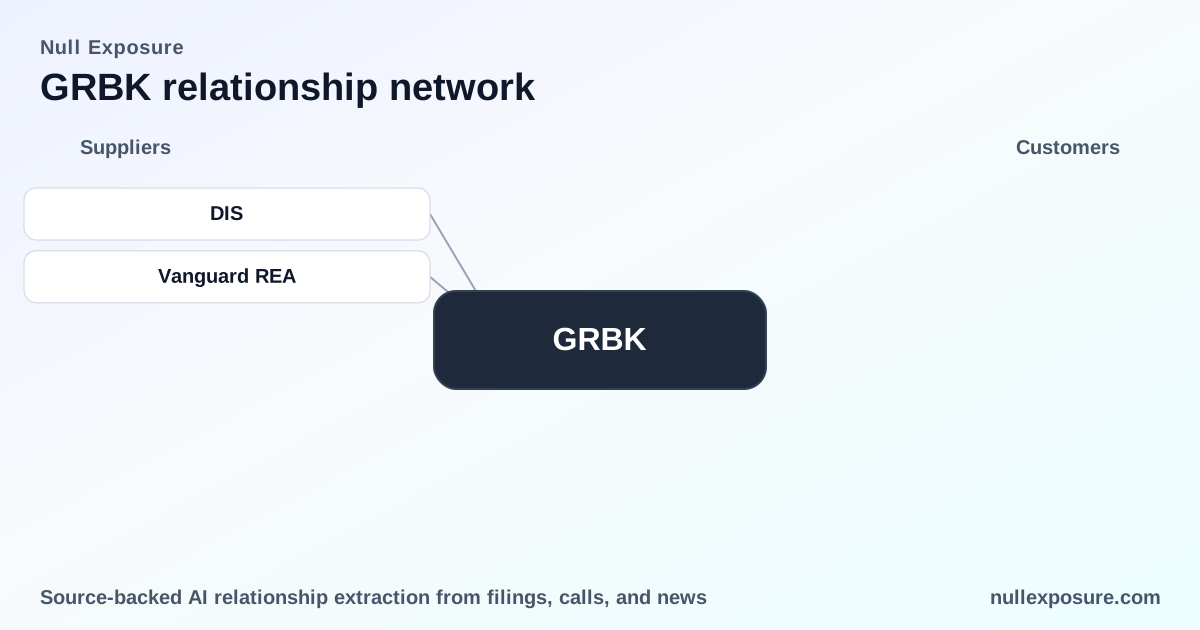
Green Brick Partners (GRBK) — supplier relationships, sourcing posture, and investor implications
Green Brick Partners builds and sells single-family homes and develops land, monetizing through land development margins, home construction profits, and recurring lot option agreements that convert deposits into revenue as communities sell. The company operates primarily as a buyer of land and a general contractor that outsources construction work to third‑party subcontractors, capturing value in land appreciation and homebuilding margins rather than vertical manufacturing. For an integrated view of supplier relationships and procurement posture, see https://nullexposure.com/.
Quick operating snapshot investors need
Green Brick is a U.S.-centric residential construction and land development firm headquartered in Plano, Texas. Financially, the company posts roughly $2.1B revenue (TTM) with EBITDA of approximately $415M, a trailing P/E near 9.2, and strong institutional ownership (~80%), indicating market investor concentration and active analyst attention. Green Brick sells lots and homes and uses lot-option contracts and strategic land acquisitions to lock future inventory and manage build schedules.
How Green Brick monetizes supplier relationships
Green Brick’s commercial model centers on three monetization levers: (1) land acquisition and option contracts that lock future supply at predetermined prices, (2) homebuilding margin capture while acting as general contractor, and (3) third‑party services—from brokers to subcontractors—that execute sales and construction. The company’s contracting posture is long-term on land (option contracts that often exceed one year), while construction delivery is outsourced to independent subcontractors who execute day-to-day builds. This structure gives Green Brick leverage on capital allocation and community planning while leaving operational execution and labor risk with third parties.
For more on supplier relationships and provenance, visit https://nullexposure.com/.
Supplier relationships identified in public records
The following relationships were identified in news and company disclosures. Each entry is summarized in plain English with the source noted.
Disney Vero Beach Resort (transaction via GHO Homes / land sale)
Green Brick (through its GHO Homes unit) acquired about 26 acres that had been earmarked for the Disney Vero Beach Resort, planning single‑family homes and attached villas on the parcel near County Road 510 and State Road A1A. This transaction reflects Green Brick’s active land acquisition strategy and illustrates the company’s willingness to convert formerly institutional or branded resorts/developments into residential inventory. According to a TCPalm news report from October 2019, the acreage was sold to GHO Homes and will be developed into residential units.
Vanguard REA (capital markets / brokerage representation)
Dallas-based Vanguard REA represented Green Brick in an acquisition and new community announcement in Princeton, Texas, with RES Real Estate Services representing the seller. This engagement reflects Green Brick’s routine use of specialized advisory and brokerage services to source and close community-level land deals and structure capital-market-facing transactions. A GlobeNewswire press release from April 2022 describes Vanguard REA’s role representing Green Brick in that transaction.
What these relationships reveal about sourcing risk and strategic posture
- Land-first strategy: The Disney Vero Beach example underscores Green Brick’s strategy of acquiring strategic parcels and converting them into for-sale inventory; this drives long-run margin capture and community control.
- Use of specialist advisors: Engagements such as Vanguard REA show Green Brick consistently taps external real-estate advisory firms to source deals and manage dispositions, which lowers internal overhead but increases dependency on external deal flow specialists.
- Operational outsourcing: The company acts as general contractor while subcontractors deliver construction—this reduces fixed labor costs but creates reliance on third‑party execution quality and local labor availability.
These characteristics collectively point to a firm that controls supply through long-term land contracts and relies on external partners for execution and market access, concentrating risk on land financing, option execution, and subcontractor performance.
Company-level sourcing constraints and what they imply
Green Brick’s public disclosures provide explicit constraints that define its supplier posture:
- Long-term contracts for land — The company states that lot option contracts are generally tied to takedown schedules and “can be in excess of one year.” This signals planning-driven procurement and implies capital commitment to future inventory rather than transactional spot buying.
- U.S.-focused sourcing for materials — Management notes that “all the raw materials and most of the components used in our business are readily available in the United States,” indicating geographic concentration that reduces international supply‑chain exposure but retains regional labor and materials risk.
- Buyer role with selective third‑party lot purchases — Green Brick will purchase finished lots from third‑party developers “to a much lesser extent,” confirming primary reliance on owned or optioned lots rather than heavy dependence on external lot suppliers.
- Service-provider orientation in construction and sales — The company “acts solely as a general contractor” and schedules third‑party subcontractors while working with independent realtors in addition to its in‑house sales force; this highlights operational leverage through outsourcing and potential variability in cost and quality.
These constraints are company-level signals shaping sourcing stability, capital exposure, and execution risk. They are not attributed to any single external partner unless explicitly named by Green Brick.
Risk factors and concentration to watch
- Land option execution risk: Long-term lot option contracts lock capital and depend on future takedown schedules aligning with market demand; mismatches can compress margins.
- Subcontractor dependency: Outsourcing construction concentrates operational risk off-balance-sheet; local labor shortages or contractor defaults can delay communities and raise costs.
- Regional concentration: U.S.-centric procurement limits exposure to global shocks but creates sensitivity to regional labor, materials inflation, and housing cycle shifts.
- Deal-sourcing reliance on advisors: Frequent use of external brokers and capital markets advisors supports scale but increases vendor concentration for deal origination.
Bottom line: what investors and operators should conclude
Green Brick’s supplier relationships and documented constraints show a land-first, outsourced-execution model that scales by capturing land appreciation and homebuilding margins while pushing operational execution to third parties. Key strengths are capitalized land positions and repeatable use of advisors and subcontractors; key risks are execution dependency on third parties and cyclical demand timing relative to long-term option schedules. For a direct view of how these relationships map to strategic risk and to monitor new disclosures, visit https://nullexposure.com/.
If you evaluate supplier counterparties or need a situational brief for investment committees, Green Brick’s public transactions and filings provide clear signals for due diligence: focus on option contract terms, subcontractor networks, and regional materials/labor constraints. For continuous coverage and relationship mapping, see https://nullexposure.com/.