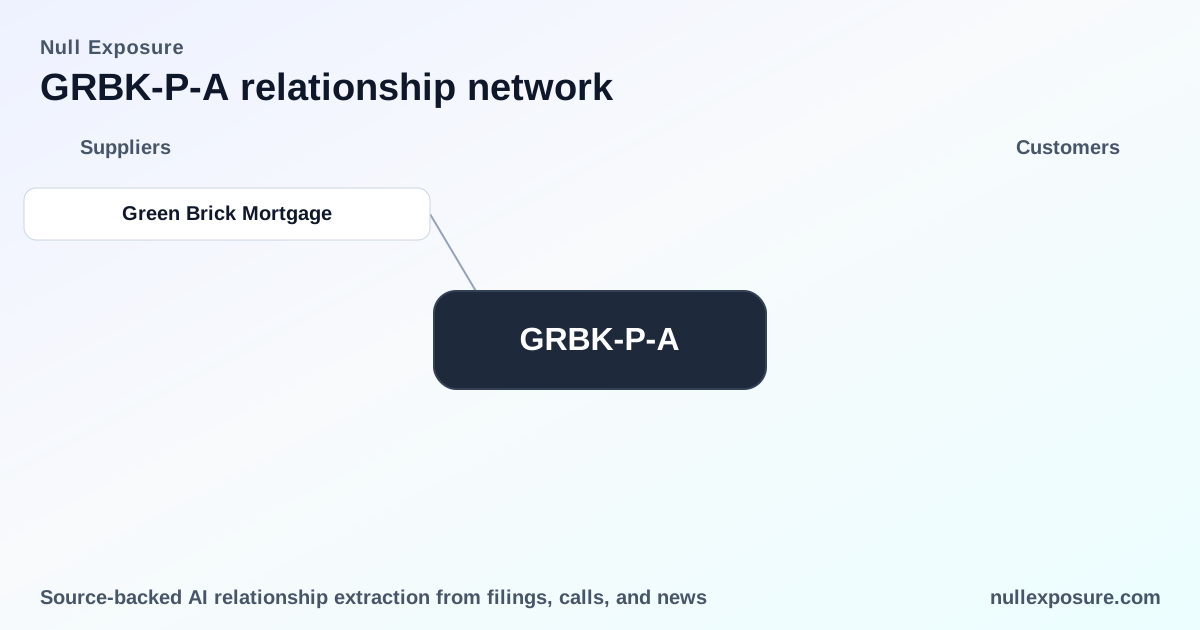
Green Brick Partners (GRBK-P-A): Supplier Relationships and What They Mean for Investors
Green Brick Partners operates and monetizes as a vertically integrated homebuilder and land developer with a growing in‑house mortgage operation that reduces financing friction and captures additional margin across the home sale lifecycle. The company converts land holdings and development capabilities into finished home revenue while retaining capture of mortgage origination economics through Green Brick Mortgage, which supports both sales throughput and ancillary finance income. For deeper supplier and partner intelligence, visit https://nullexposure.com/ for structured relationship profiles and source links.
How Green Brick’s business model drives supplier exposures
Green Brick runs a capital‑intensive, horizontally integrated residential platform: land acquisition, development, construction, sales and mortgage origination. That structure produces three commercial realities for counterparties and investors:
- Contracting posture: The firm is oriented toward owning and controlling critical inputs (land, construction management, mortgage origination) rather than relying on a fragmented subcontractor base when possible, which concentrates counterparty risk toward construction suppliers and its internal mortgage arm.
- Concentration: A vertically integrated mortgage business reduces the number of external lenders and broker partners required for a transaction, increasing internal capture but also raising the strategic importance of Green Brick Mortgage to closing velocity and buyer financing.
- Criticality: Mortgages are critical to home closings; internal mortgage capacity directly impacts sales conversion timing and developer cashflow.
- Maturity: The launch and geographic expansion of Green Brick Mortgage indicate a scaling internal capability in origination and servicing; maturity will be observable through loan volumes, geographic footprint, and underwriting stability.
These characteristics create reliable internal capture of finance economics but also place operational complexity and execution risk squarely on the company. For a quick view of Green Brick’s supplier relationships and source material, see https://nullexposure.com/.
Supplier relationships in the public record: Green Brick Mortgage
Below I cover every relationship found in the supplier search results. Each entry is a concise, plain‑English summary with the original source.
Green Brick Mortgage — FY2026 loan volume reported
Green Brick disclosed that Green Brick Mortgage, its wholly owned mortgage company, closed and funded over 380 loans in the fourth quarter of FY2026, underscoring the mortgage arm’s active role in converting inventory into closed sales and producing fee and interest income for the parent. This detail was reported in an FY2026 earnings call transcript published by The Globe and Mail (transcript link: https://www.theglobeandmail.com/investing/markets/markets-news/motley/448973/green-brick-grbk-earnings-call-transcript/).
Green Brick Mortgage — geographic expansion to Austin
Management stated that Green Brick Mortgage began serving Austin communities in Q1 of FY2026, indicating deliberate geographic expansion of origination reach that supports local sales channels and reduces dependence on third‑party lenders in new developments. This was noted in an FY2026 earnings call transcript reported on InsiderMonkey (transcript link: https://www.insidermonkey.com/blog/green-brick-partners-inc-nysegrbk-q4-2025-earnings-call-transcript-1705226/).
What those relationships signal for investors and operators
The two public references to Green Brick Mortgage combine to deliver a clear operational message: the mortgage unit is not a passive captive; it is an active, expanding participant in the firm’s go‑to‑market model. The Q4 funded loan count demonstrates throughput capability, while the Austin launch shows geographic scaling.
- Revenue capture: Internal origination converts what would otherwise be external financing fees into retained income streams for Green Brick, improving overall margin per home when origination economics are favorable.
- Sales velocity lever: A functioning mortgage arm increases control over close timing and buyer qualification, which is strategically valuable in uneven demand cycles.
- Execution risk: Rapid expansion and origination volumes create credit and operational exposure; underwriting rigor and servicing discipline are key to converting origination growth into lasting value.
If you want a curated, source‑linked view of Green Brick’s supplier and partner footprint, explore https://nullexposure.com/ for the full relationship map.
Constraints and company‑level signals
There are no supplier contract constraints explicitly disclosed in the available relationship records. Presently, that absence is itself a signal: no public supplier‑level restrictions or exclusivity clauses are reported, which leaves flexibility in Green Brick’s ability to shift supply chains or financing partners. Company‑level characteristics derived from public communications include:
- Internalization bias: The firm prefers to internalize critical functions (mortgage origination) where it can capture downstream economics and control transaction flow.
- Scaling posture: Expansion into new markets (e.g., Austin) signals a scaling stage for the mortgage function rather than a pilot.
- Counterparty substitution capacity: With no supplier constraints disclosed, Green Brick retains contractual flexibility to alter external supplier relationships if market conditions or margins change.
These are company signals intended to inform counterparties about negotiation leverage, concentration risk, and operational priorities.
Risk profile and strategic implications for suppliers and investors
For suppliers, subcontractors and financial partners, Green Brick’s integrated model presents both opportunity and discipline:
- Opportunity: Preferred supplier status with an integrated homebuilder delivers steady work across projects and potential financing support via internal mortgage placements that improve buyer conversion.
- Discipline: Suppliers face payment timing and contract terms that reflect an integrated balance sheet approach to project economics; the firm’s emphasis on internalization increases negotiating leverage.
- Investor lens: Equity or preferred holders should treat mortgage origination as a value driver that improves per‑unit economics, but also as a source of credit and operational risk whose fortunes are correlated with regional housing cycles and underwriting outcomes.
Investment takeaways and next steps
Green Brick’s integration of mortgage origination into its platform is a strategically significant move that enhances margin capture and sales control; investors evaluating GRBK‑P‑A exposure should weigh origination growth against credit risk and operational execution. Monitor quarterly disclosures for loan volumes, geographic coverage, default metrics, and any supplier contract updates.
For more relationship detail and to stay current with supplier disclosures, visit https://nullexposure.com/. If you want tailored supplier intelligence or a consolidated relationship dossier for Green Brick and its peers, check https://nullexposure.com/ for subscription options and analyst briefings.
Bold, sourced takeaways:
- Green Brick Mortgage funded 380+ loans in Q4 FY2026 (The Globe and Mail transcript).
- Green Brick Mortgage expanded into Austin in Q1 FY2026, signaling geographic scaling (InsiderMonkey transcript).
- No supplier constraints are publicly disclosed, indicating contractual flexibility at the company level.
Conclude your diligence by tracking future earnings call transcripts and regulatory filings for loan performance disclosures and supplier contract language that could materially affect execution risk.