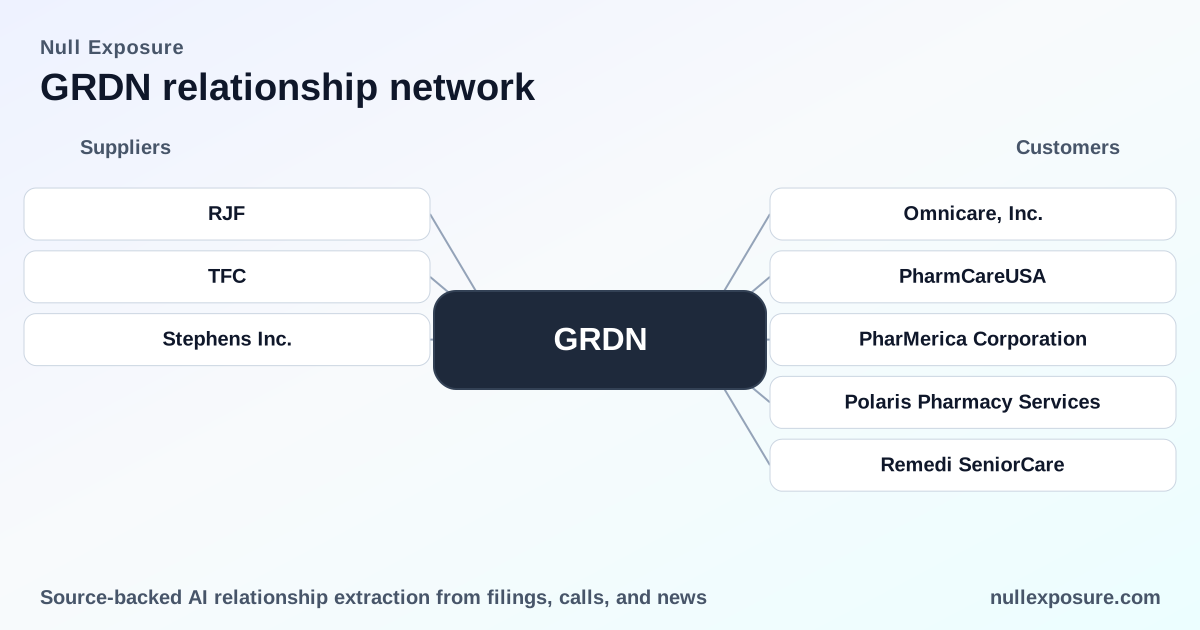
Guardian Pharmacy Services (GRDN): supplier relationships, underwriting partners, and operational constraints investors should price
Guardian Pharmacy Services operates specialized pharmacy services for the long-term care market and monetizes by dispensing pharmaceuticals and providing medication-management services to assisted living and skilled nursing facilities. Revenue comes from pharmacy dispensing, prime-vendor purchasing economics, and fee-based clinical services, supported by warehousing and third‑party logistics arrangements; the company’s fiscal profile shows approximately $1.45 billion in trailing revenue and EBITDA of about $102.6 million. For investors and operators evaluating supplier and capital-market counterparties, the critical facts are simple: Guardian runs a supply‑chain‑centric business with long-term property and financing commitments, a mixed procurement posture (wholesale distributors plus direct manufacturer buys), and recent underwriting relationships tied to its public offering. Read deeper or track counterparties through our research hub at https://nullexposure.com/.
Executive snapshot: how the model drives margin and risk
Guardian sells a mix of product and services into a concentrated end market—long‑term care facilities—where predictable volume and compliance drive recurring revenue, but margin is sensitive to drug cost, vendor terms, and reimbursement dynamics. Financially, the business trades at a premium multiple to peers (trailing P/E ~42x; forward P/E ~27x) and shows modest operating margin (~8.9%) and low net margin (~3.4%), indicating services and cost pass-through dynamics compressing profitability. Key business drivers are: vendor contract economics (prime vendor agreements), warehousing and logistics efficiency, and capital structure stability. If you evaluate operating or supplier exposure to GRDN, focus on contract tenors, counterparty concentration, and the company’s role as buyer, distributor and occasional manufacturer purchaser.
Explore related supplier intelligence and counterparty mapping at https://nullexposure.com/ for a structured view of counterparties and contractual levers.
Underwriters and advisors who supported the IPO
- Raymond James acted as a joint bookrunner on Guardian’s IPO, formally listed among the underwriting syndicate in Renaissance Capital’s IPO coverage dated March 9, 2026. According to the Renaissance Capital article, Raymond James served as a lead underwriting partner on the upsized deal (Renaissance Capital, IPO Center, Mar 9, 2026 — https://www.renaissancecapital.com/IPO-Center/News/106898/Pharmacy-services-provider-Guardian-Pharmacy-prices-upsized-IPO-at-$14-low-).
- Truist Securities was a joint bookrunner on the same transaction, recorded in Renaissance Capital’s March 9, 2026 coverage as part of the syndicate. Truist participated in IPO execution and distribution, positioning itself as a capital-markets counterparty for the company (Renaissance Capital, IPO Center, Mar 9, 2026 — https://www.renaissancecapital.com/IPO-Center/News/106898/Pharmacy-services-provider-Guardian-Pharmacy-prices-upsized-IPO-at-$14-low-).
- Stephens Inc. is listed alongside Raymond James and Truist in Renaissance Capital’s IPO reporting as a joint bookrunner, appearing in both the March 2026 news posting and the firm’s Guardian IPO profile. Stephens provided underwriting support within the syndicate and participated in the bookrun, according to the IPO profile and news item (Renaissance Capital, Profile & IPO Center, FY2023–FY2024 — https://www.renaissancecapital.com/Profile/GRDN/Guardian-Pharmacy/IPO and https://www.renaissancecapital.com/IPO-Center/News/106898/Pharmacy-services-provider-Guardian-Pharmacy-prices-upsized-IPO-at-$14-low-).
These underwriting relationships are relevant because they establish the bank counterparties that underwrote public capital and who will likely provide research coverage and distribution to institutional holders.
Contracting posture and operating constraints that drive counterparty risk
Guardian’s public disclosures reveal company-level signals about contract structure and operational constraints that affect suppliers and partners:
- Long-term commitments: The corporate headquarters lease runs through October 31, 2030, and the company extended its credit facility maturity to April 23, 2027 via a 2024 amendment. These items indicate multi-year fixed obligations that create predictable occupancy and financing costs and raise the importance of steady cash flow generation.
- Mixed procurement posture: The company purchases most brand and generic pharmaceuticals through wholesale distributors under prime vendor agreements negotiated directly, while also buying some generics directly from manufacturers. This hybrid procurement approach reduces unit cost risk via negotiated discounts but creates operational dependence on a small set of prime vendors.
- Integrated logistics role: Guardian warehouses pharmaceuticals and contracts third‑party logistics providers for distribution, positioning the company as both a buyer and distributor in its supply chain while outsourcing executional logistics.
- Third‑party services for risk management: Guardian engages external cybersecurity consultants and other service providers to manage evolving risk, indicating outsourced specialist functions rather than in‑house development for certain high‑complexity capabilities.
Taken together, these constraints point to a company with mature, locked‑in property and financing obligations, negotiated vendor pricing benefits, and critical operational reliance on a small set of distribution partners.
What the relationships and constraints mean for investors and operators
- Counterparty concentration is the key operational risk. Prime vendor agreements and warehousing/distribution partnerships concentrate execution risk; a major distributor disruption would immediately pressure fill rates and working capital.
- Long-term leases and credit maturities increase refinancing and operational leverage exposure. The credit facility extension to 2027 and a headquarters lease to 2030 make liquidity and access to capital critical variables for stability.
- Underwriter relationships matter for market access but less so for day-to-day supply. Raymond James, Truist Securities, and Stephens Inc. enabled the public equity event and will shape investor perception and liquidity, but supply-chain counterparties determine operational resilience.
Tactical takeaways for supplier negotiation and investment diligence
- Prioritize reviewing prime vendor agreements and distribution SLAs to understand termination rights, discount floors, and pass-through mechanics.
- Model working capital sensitivity around a supply interruption scenario, given the company’s role as a buyer/distributor and its warehousing obligations.
- Monitor refinancing windows and covenant thresholds tied to the extended credit facility and the company’s leverage metrics; underwriter coverage and institutional ownership can influence refinancing flexibility.
If you evaluate counterparties or want structured exposure maps for Guardian and similar suppliers, get the full report and relationship matrix at https://nullexposure.com/.
Closing: actionable next steps
Guardian is a revenue‑scale, supply‑chain‑centric pharmacy operator with clear exposure to vendor concentration and medium-term financing timelines. For investors, the trade is about balancing predictable recurring revenue against tight margin dynamics and counterparty execution risk. For operators and suppliers, contract terms and logistics SLAs determine the real operational leverage. To access a consolidated view of counterparties, underwriting syndicates, and documented constraints, visit https://nullexposure.com/ and download the relationship brief.