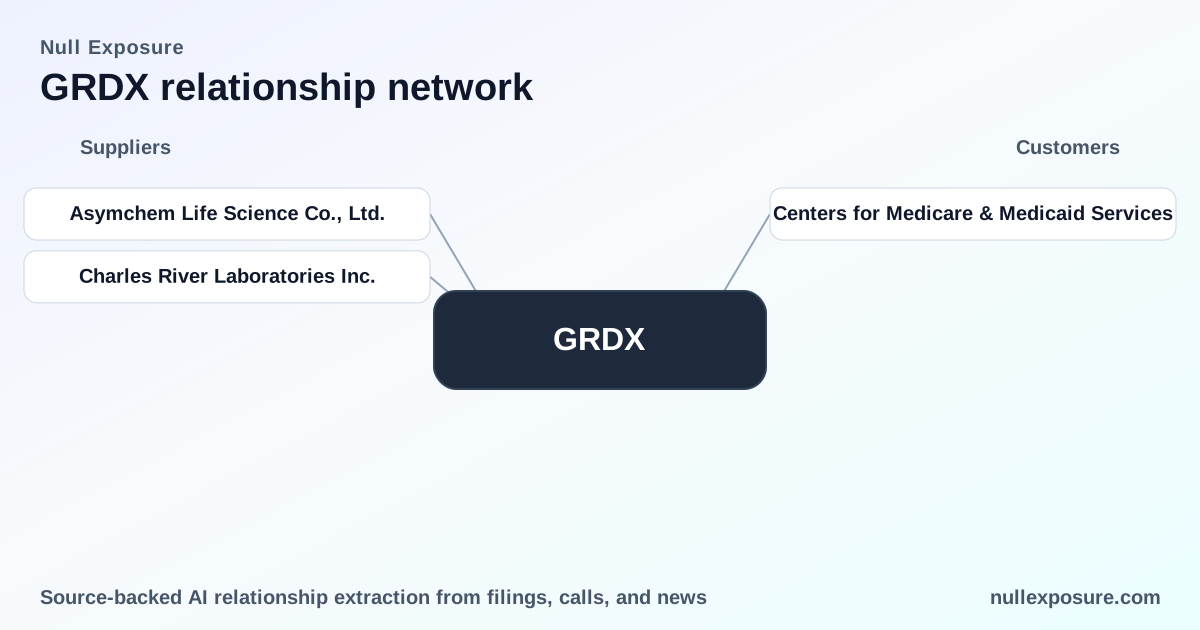
GRDX supplier map and what investors need to know
Entero Therapeutics (ticker GRDX) operates as a small-cap biotechnology developer that monetizes by acquiring and licensing therapeutic assets, progressing clinical-stage programs, and pursuing value realization through partnering or selective divestitures. The company runs a virtual manufacturing and development model: it outsources practically all R&D, manufacturing and trial execution to third parties, holds no product revenue and funds operations through capital markets and strategic transactions. For investors, the key financing and operational levers are licensing income, milestone/partner economics, and the timing of asset sales or commercialization events—none of which are currently reflected in recurring revenue. See more supplier intelligence at https://nullexposure.com/.
Quick take: what the supplier list actually signals
GRDX’s public filings describe a classic outsourced biotech operating posture. The company depends on external contract development and manufacturing organizations (CDMOs) and contract research organizations (CROs) for core execution. That posture produces two immediate investment implications: operational leverage to upside (low fixed cost base) and concentration risk around a small set of critical third parties that control manufacturability and material supply.
- The company reports zero product revenue and deeply negative EPS, demonstrating a development-stage business that will require capital or licensing to reach cash flow breakeven.
- A recent acquisition and related asset disposal activity (ImmunogenX / IMGX) shows management is actively shaping the asset base; the preliminary consideration paid was roughly $60.1 million, which places acquisition spending in the mid‑double-digit millions and highlights meaningful deal-level cash commitments.
If you want continuous supplier monitoring for GRDX, start here: https://nullexposure.com/.
How the company contracts and where risks concentrate
The filings describe a contracting posture dominated by licensing and external suppliers rather than in‑house manufacturing. Key company-level signals drawn from the filings:
- Licensing orientation: The company functions as licensee under at least one significant deal giving worldwide rights to a repurposed compound (Capeserod), which changes the risk profile from discovery to development and regulatory execution. According to the 2024 Form 10‑K, the company entered a License Agreement on September 13, 2023 that granted exclusive worldwide rights to develop and commercialize Capeserod from Sanofi.
- Outsourced manufacturing model: GRDX outsources all manufacturing to CDMOs and plans to maintain that model indefinitely; this reduces fixed-capacity risk but increases vendor criticality.
- Geographic concentration: Manufacturing footprint includes APAC (China), which brings both cost advantages and geopolitical / supply‑chain considerations.
- Supplier criticality: The company states it is “completely dependent” on third parties for product supply, which elevates replacement risk and supply continuity as material investment risks.
- Deal and balance-sheet activity: The company has undertaken M&A (the ImmunogenX merger) and is disposing of certain assets as held for sale; preliminary consideration for that transaction totaled approximately $60.1 million, placing recent spend in the $10m–$100m band.
- Service-provider ecosystem: Public filings list accounting and advisory firms and financial advisors engaged in 2024 (MGO, Mazars, Forvis, Roth Capital, Tungsten Partners), showing a standard professional services roster supporting corporate transactions and reporting.
Supplier details you must track
Asymchem Life Science Co., Ltd.
Asymchem is the contract manufacturer currently producing both Adrulipase drug substance and finished drug product at a facility in Tianjin, China, making it the physical source of the compound the company is developing. According to the company’s 2024 Form 10‑K, Adrulipase manufacturing occurs at a contract site owned by Asymchem in Tianjin, China.
Source: 2024 Form 10‑K (company filing).
Implication: Asymchem is a critical CDMO for GRDX’s lead program—any interruption at this site would directly affect development timelines and potential commercialization. Track site certifications, regulatory inspection outcomes, and APAC logistics events.
Charles River Laboratories Inc.
Charles River maintains the proprietary yeast cell line and is responsible for storage of the master and working cell banks used to produce the Adrulipase API. The 2024 Form 10‑K states that the cell line from which the Adrulipase API is derived is kept at a storage facility maintained by Charles River Laboratories.
Source: 2024 Form 10‑K (company filing).
Implication: Charles River performs a high‑value custody role—loss or contamination of cell banks would create a major technical and regulatory setback. Investors should follow contractual terms covering custody, redundancy and contingency for biological material.
What the constraints tell you about business maturity and negotiating leverage
The constraint signals embedded in the filing read as a company at a mid‑development maturity with limited bargaining power relative to specialized service providers:
- Contract-type signal: licensing is a central element of growth strategy; the Sanofi license provides global development rights, implying GRDX is both dependent on licensed intellectual property and on executing development milestones to realize value.
- Materiality and criticality: suppliers are flagged as critical; the company explicitly warns that interruptions would adversely affect the Adrulipase program. That elevates supplier risk as a near-term valuation driver.
- Spend and transaction posture: the $60.1 million consideration for the ImmunogenX acquisition places recent corporate investment well within a meaningful mid‑range spend band and demonstrates willingness to allocate capital to inorganic growth.
- Relationship stage and portfolio management: the business is actively optimizing assets—some acquired assets are already being wound down or marketed for sale, indicating a portfolio reshaping strategy rather than long-term operational scaling.
These are company-level signals; they describe how GRDX contracts, concentrates risk, and where negotiating leverage sits with vendors and partners.
Operational checklist for investors and operators
- Verify redundancy for biologic custody and manufacturing: is there a second bank and alternate CDMO qualified?
- Monitor regulatory communications related to the Tianjin facility and Charles River custodial arrangements.
- Track milestone schedules and payment triggers under the Sanofi license and any partner agreements, since milestone timing drives potential cash inflows.
- Watch developments around the IMGX disposition for any cash receipts or contingent liabilities.
Midway through diligence, consider subscribing to ongoing supplier tracking: https://nullexposure.com/ — continuous signal feeds materially reduce surprise risk.
Bottom line and next steps
GRDX runs a capital-efficient, outsourced biotech model that depends on a small set of critical third parties—notably Asymchem for manufacturing and Charles River for biological custody—and on strategic licensing and M&A to build value. For investors, the near-term valuation hinge is supplier continuity and the timing of partner milestones or asset realizations rather than product revenue.
If your investment case depends on uninterrupted development timelines and intact supply chains, prioritize real‑time monitoring of these supplier relationships and corporate disclosures. For comprehensive monitoring tools and alerts on these exact relationships, explore https://nullexposure.com/.