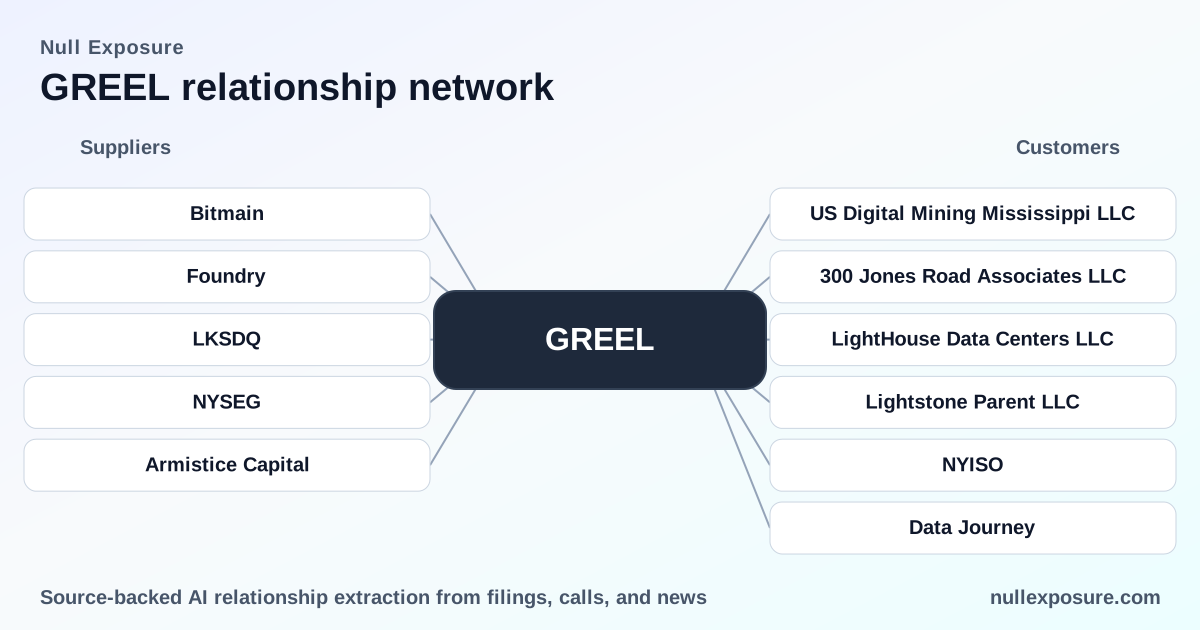
GREEL supplier map: who powers Greenidge and why it matters for investors
Greenidge Generation Holdings monetizes by pairing owned and leased power generation with large-scale cryptocurrency mining and, increasingly, data‑center services — selling mined Bitcoin and related digital-asset revenues while extracting value from otherwise underutilized energy capacity. The company funds growth through equipment procurement, project-level leases and occasional equity/debt injections; supplier relationships for mining rigs, fuel and grid partners are core to both operational throughput and margin capture. For a closer read on supplier risk and opportunity, visit https://nullexposure.com/.
How Greenidge runs the engine: energy + compute as a unified margin driver
Greenidge operates a vertically integrated model: it owns generation assets (and signs energy transport/purchase contracts), deploys and operates mining hardware, and sells either mined coins or hosting/computing services. Revenue hinges on three supply-side inputs: reliable power, high-volume mining hardware, and capital to scale capacity. That means counterparty exposure to rig manufacturers, regional utilities and capital providers translates directly into operating leverage.
The company’s public disclosures and reporting history show a mix of owned assets and multi-year leases that lock in capacity and energy economics; these contractual choices provide predictable operating scale but also concentrate vendor dependency. If you are evaluating supplier relationships, focus on contracting tenor, counterparty concentration and the degree to which equipment sourcing is global rather than domestic.
Visit https://nullexposure.com/ for an investor-ready view of supplier concentration and contractual terms.
Who Greenidge buys from and works with — relationship summaries
Bitmain
Greenidge doubled an order with Bitmain to 22,500 S19j Pro machines, signaling heavy procurement from one of the world’s largest ASIC manufacturers and a clear reliance on Bitmain for hashing capacity expansion (CoinDesk, Oct 22, 2021 — https://www.coindesk.com/business/2021/10/22/greenidge-generation-holdings-to-expand-acquire-sites-in-texas-south-carolina).
Foundry
Greenidge purchased thousands of Whatsminer M30S units through Foundry (2,300 units reported), diversifying rig makes while rapidly scaling deployed hashrate (CoinDesk, Jul 15, 2021 — https://www.coindesk.com/markets/2021/07/15/greenidge-buying-8300-bitcoin-mining-rigs-from-new-partner-foundry).
LSC Communications (site acquisition)
Greenidge acquired the former 175-acre LSC Communications printing plant in Spartanburg to convert to operational mining/compute capacity, reflecting a strategy of repurposing industrial sites for scale and multi-year expansion plans through 2025 (GoUpstate, Jan 25, 2022 — https://www.goupstate.com/story/news/local/2022/01/25/cryptocurrency-bitcoin-greenridge-generation-holdings-investment-jobs-spartanburg/9076405002/).
NYSEG
Greenidge is working with NYSEG on upgrades at its Dresden, NY facility and evaluating AI/HPC datacenter opportunities for ~60MW of capacity, signaling a pivot to higher-margin compute use cases beyond pure Bitcoin mining (miniChart, Mar 6, 2026 — https://www.minichart.com.sg/2026/03/06/greenidge-generation-2025-financial-results-debt-reduction-power-expansion-transition-to-ai-hpc-datacenters/).
Armistice Capital
Armistice provided a $6 million cash infusion to support Greenidge’s expansion plans, indicating direct investment interest from a New York-based fund as part of financing to scale operations (DataCenterDynamics, FY2024 — https://www.datacenterdynamics.com/en/news/greenidge-generation-raises-6-million-to-support-expansion-plans/).
Constraints and operating signals that shape supplier strategy
Company disclosures and reporting provide explicit operating signals that inform supplier risk and negotiating posture:
- Long-term capacity leases are part of the model. Management describes a 7.5 MW mining capacity lease in North Dakota with a five‑year term and an energy cost cited at $58.50/MWh, indicating management preference for multi-year, lock‑in arrangements to secure predictable power economics. This is a structural advantage for planning but increases exposure to a limited set of facility contracts.
- Supply chain is globally concentrated. Management notes that mining equipment is “almost entirely manufactured outside of the United States,” creating geopolitical and logistics exposure for rig procurement and inventory timing.
- North American energy partnerships are material. The company discloses contracts with Emera Energy covering natural gas purchases and NYISO bidding/sales activity — a direct line to regional fuel markets and wholesale power operations.
- Pipeline transport commitments exist. Greenidge reports a contract with Empire Pipeline Inc. for firm natural gas transportation capacity (up to 15,000 dekatherms/day), underlining fuel logistics as a determinative supplier relationship for thermal generation operations.
- Supplier roles are primarily service-provider and vendor relationships. Disclosures reference multiple external service providers (mining pools, hosting, security assessments) and one natural gas vendor that accounted for ~37% and ~27% of cost of revenue in 2024 and 2023 respectively, signalling meaningful vendor concentration in fuel and operational services.
- Relationship lifecycle is mixed: active and terminated agreements. Management reports ongoing use of third‑party mining pools and active banking vulnerabilities for crypto businesses, alongside a terminated major hosting services contract that previously accounted for material cost of revenue (9%/18% in 2024/2023), indicating a history of re-contracting and operational churn in hosting relationships.
These are company-level signals drawn from management disclosures and filings; they define the contracting posture (multi-year leases), concentration (few large fuel suppliers and global rig makers), criticality (power and rigs are indispensable), and maturity (shift toward data‑center services).
What this means for investors and supplier partners
- Concentration risk is real and actionable. Heavy orders with Bitmain and sizable purchases via Foundry reflect reliance on a small set of global hardware suppliers; procurement disruptions would materially affect mining throughput.
- Energy counterparty strength dictates margin stability. Contracts with Emera and pipeline capacity commitments are central to operating continuity; suppliers that can offer flexible fuel or transport terms capture strategic importance.
- Transition to AI/HPC reduces single-market exposure. Working with NYSEG to repurpose Dresden for AI/HPC compute is a positive diversification signal that could increase revenue per MW and reduce pure Bitcoin price sensitivity.
- Capital injections are tactical not transformational. The Armistice Capital infusion indicates external investor support but is modest relative to capital-intensive expansion needs; suppliers should price credit and delivery risk accordingly.
If you want a granular supplier-risk dashboard and contract-tenor view, explore the supplier profiles at https://nullexposure.com/.
Bottom line and recommended next steps
Greenidge’s supplier map shows a classic energy-plus-compute playbook: large, concentrated hardware orders, dependence on regional energy contracts, and a strategic tilt toward higher-value compute services. For investors and supplier counterparties, focus diligence on contract tenors, vendor concentration (especially in rigs and fuel), and the company’s ability to convert excess power into diversified compute revenue.
For an actionable supplier risk report and counterparty monitoring, go to https://nullexposure.com/ — the site provides the structured signals investors need when evaluating counterparties like Bitmain, Foundry, NYSEG and funding partners.