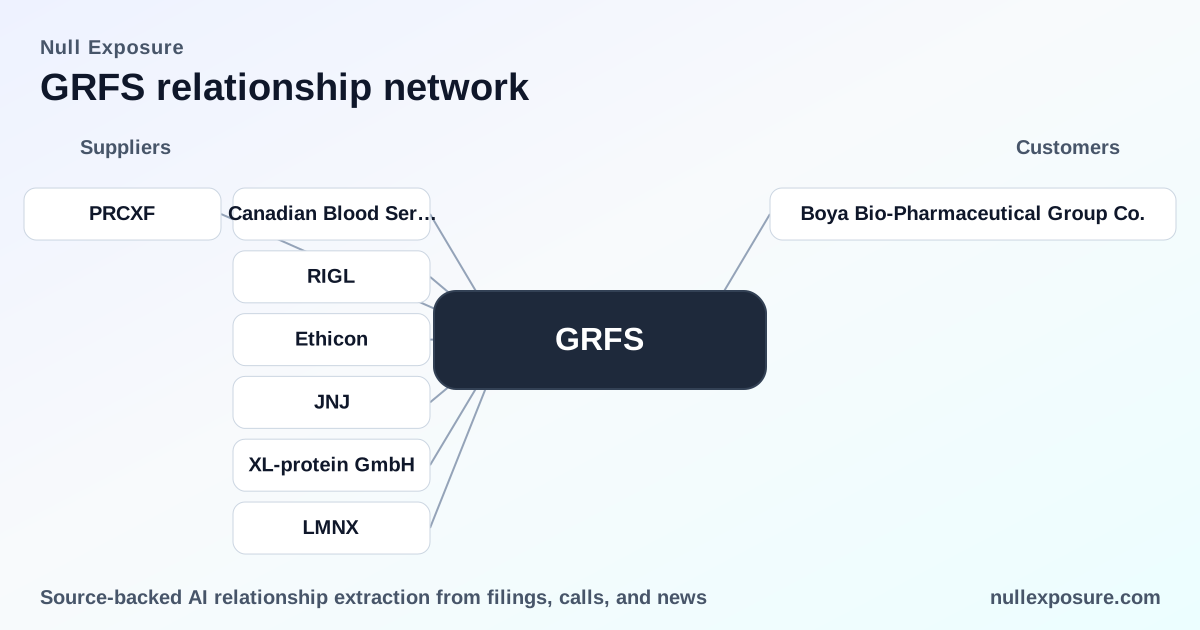
Grifols (GRFS): supplier relationships, strategic footprint, and risk map
Grifols is a vertically integrated manufacturer of plasma-derived medicines that operates by sourcing plasma, manufacturing biologics and licensing commercialization rights to third parties, monetizing through product sales, licensing fees and selective acquisitions that expand manufacturing and geographic reach. The company combines core plasma collection and fractionation with targeted partnerships—device, diagnostic and pharmaceutical licensing—to accelerate product rollouts and protect market access. For a concise supplier-risk briefing and relationship tracking, visit https://nullexposure.com/.
Why partnerships are central to Grifols’ economics
Grifols’ commercial model depends on three connected levers: stable plasma supply, high-capacity manufacturing, and strategic partnerships that commercialize or extend the shelf-life and reach of its products. The firm’s reported TTM revenue of $7.52B and EBITDA of $1.75B indicate material scale and positive operating leverage; licensing and distribution deals improve ROI on R&D and capital-intensive plants. Grifols leverages exclusivity arrangements and targeted asset acquisitions to protect margin and accelerate market entry across geographies.
- Contracting posture: Grifols pursues long-term, exclusive licenses and supply agreements (pharma licensing, device partnerships) and actively acquires complementary plasma assets to internalize supply and capability.
- Diversification: Partnerships span diagnostics, surgical devices, small-molecule licensing and biotech licensing, lowering single-segment concentration while keeping plasma sourcing central.
- Criticality: Plasma donor programs and North American plasma assets are strategically critical to revenue and margins; public controversies about donor compensation can influence reputation and access.
- Maturity: The company shows mature operating metrics—operating margin ~20% and established global operations—supporting negotiated, enterprise-level relationships rather than spot contracting.
For an investor-grade snapshot of supplier and partner exposures, see our coverage hub: https://nullexposure.com/.
Relationship-by-relationship: what each partnership means for GRFS
Canadian Blood Services — donor compensation controversy
A Globe and Mail report (covering FY2024) noted Grifols’ controversial partnership with Canadian Blood Services to pay plasma donors in Canada, a departure from the charity’s traditional voluntary model and a flashpoint for regulatory and reputational scrutiny. (Source: The Globe and Mail, March 2026.)
Rigel Pharmaceuticals — exclusive European rights to fostamatinib (FiercePharma)
Under an arrangement first struck with Rigel, Grifols holds exclusive rights to fostamatinib in Europe and Turkey, creating a pathway to commercialize the product in key markets and demonstrating Grifols’ role as a regional commercialization partner for specialty therapies (reporting references FY2022). (Source: FiercePharma, reported March 2026.)
Rigel Pharmaceuticals, Inc. — licensing and supply agreement (PR Newswire)
A PR Newswire release (FY2019) described an exclusive license and supply agreement with Rigel to commercialize fostamatinib in Europe and Turkey, establishing the contractual basis for the exclusivity and underlining Grifols’ capability to integrate external assets into its commercial engine. (Source: PR Newswire, 2019.)
Ethicon — device qualification for surgical sealant delivery
Medical Design & Outsourcing reported (FY2019) that Johnson & Johnson’s Ethicon secured FDA clearance for airless spray devices designed to deliver Grifols’ fibrin sealant, positioning Grifols’ therapeutic product within a device distribution channel that can speed surgical adoption. (Source: Medical Design & Outsourcing, 2019.)
Johnson & Johnson — global partnership to introduce Vistaseal fibrin sealant
As part of a global partnership announced in FY2019, Grifols introduced the Vistaseal fibrin sealant with Johnson & Johnson and Ethicon, a collaboration that combines Grifols’ biologic product with J&J’s global commercialization and device channels. This is a textbook example of manufacturing-plus-distribution partnering to capture surgical markets. (Source: Medical Design & Outsourcing, 2019.)
XL-protein GmbH — license, development and commercialization agreement for PASylation technology
A June 2025 GlobeNewswire release detailed a worldwide License, Development and Commercialization Agreement with XL-protein to develop a long-acting biopharmaceutical using PASylation, reflecting Grifols’ push into engineered biologics and pharmacokinetic optimization through external biotech IP. (Source: GlobeNewswire, June 2025.)
Luminex Corporation — diagnostic platform collaboration for red blood cell typing
A PR Newswire announcement (FY2018) covered FDA approval of Grifols’ ID‑CORE XT test that uses PCR combined with Luminex technology to precisely identify genetic markers for red blood cell antigens—illustrating Grifols’ activity in companion diagnostics and laboratory markets. (Source: PR Newswire, 2018.)
Green Cross — North American plasma asset acquisition
A 2020 financial press report noted Grifols’ agreement to buy North American plasma assets from South Korea’s Green Cross for $460 million, a strategic acquisition that expands Grifols’ plasma collection footprint and secures additional raw material capacity for plasma-derived therapies. (Source: Yahoo Finance UK, FY2020.)
What these relationships collectively reveal about operating posture
Taken together, the relationship set signals a deliberate strategy: secure supply, monetize proprietary therapeutics through exclusive regional rights, and partner with large device and diagnostic players to accelerate adoption. The mix of licensing (Rigel, XL‑protein), device delivery partnerships (Ethicon/J&J), diagnostics (Luminex) and acquisitions (Green Cross) reduces go-to-market friction and industrializes product launches.
Key company-level signals:
- Contracting is long-term and exclusivity-focused, favoring durable revenue streams over transactional sales.
- Concentration is moderate: no single partner dominates revenue, but plasma sourcing and donor programs remain critical operational inputs.
- Maturity is evident from $7.52B revenue TTM, $1.75B EBITDA, and positive operating margins, which supports large-scale supply and licensing deals.
- Risk vectors are operational and reputational (donor compensation controversy) as well as integration risk for acquired plasma assets.
Risk map and investor implications
Investors should weigh three principal dynamics. First, plasma supply is a single-thread criticality—any regulatory or reputational shock (e.g., donor compensation debates) can impair production and margin. Second, licenses and exclusivity are strategic value multipliers; successful commercialization through partners like J&J and Rigel enhances returns without doubling capital intensity. Third, acquisitions and biotech licenses increase pipeline optionality but introduce integration and execution risk (e.g., onboarding XL‑protein technologies).
- Key risks: plasma sourcing reputation, regulatory approval timelines for partnered products, and integration of acquired assets.
- Key strengths: diversified partnership set, established manufacturing scale, and a profitable operating profile.
Conclusion: how to use this relationship map
For investors and operators, Grifols’ relationship ecosystem is a mix of supply‑side control and demand‑side distribution partnerships that amplify product reach while concentrating operational risk around plasma supply. Monitor donor-program regulation and execution milestones on licensed products for the clearest short- to mid-term signals.
For ongoing tracking and supplier-risk briefings, visit our central resource at https://nullexposure.com/. To commission a tailored counterparty risk report on GRFS supplier relationships, start here: https://nullexposure.com/.