Graphex Group (GRFX): Supplier relationships, regulatory shifts, and what operators should price in
Graphex Group develops, manufactures and markets graphene products in mainland China and monetizes primarily through product sales to industrial and specialty customers; the company reports under IFRS for its Hong Kong-listed ordinary shares and maintains separate U.S. reporting arrangements for its ADSs. Revenue is meaningful (approximately $187.9M trailing twelve months), but Graphex operates at scale with negative operating and net margins, low market capitalization (~$20.1M) and constrained public liquidity, factors that shape counterparties’ negotiating leverage and counterparty risk. For a concise supplier-risk read on GRFX and comparable profiles, visit https://nullexposure.com/.
How Graphex runs as an operational counterparty — what matters to buyers and partners
Graphex’s operating model creates a specific commercial posture for suppliers and partners. Three company-level signals drive commercial terms and risk:
- Contracting posture: defensive and performance-focused. With negative EBITDA and net losses reported over the trailing period, Graphex will price procurement around working-capital flexibility and extended payment terms rather than supplier-financed growth.
- Concentration and liquidity constraints. Market capitalization (~$20.1M) and low institutional ownership (3.67%) indicate shallow public liquidity and limited financial cushioning, increasing the probability that suppliers will insist on advance payments, letters of credit, or tighter covenanting.
- Maturity and operational criticality. Graphex records solid top-line receipts (revenue TTM $187.85M) and positive gross profit, yet operating margin and profitability are negative, signalling a company that is scaling product sales but not yet converting to free cash flow — this elevates supplier diligence on contract exit and inventory recourse.
These characteristics translate into strong supplier negotiation leverage and a need for counterparty protections for any high-value or long-lead-time supply agreements.
The relationships that matter right now
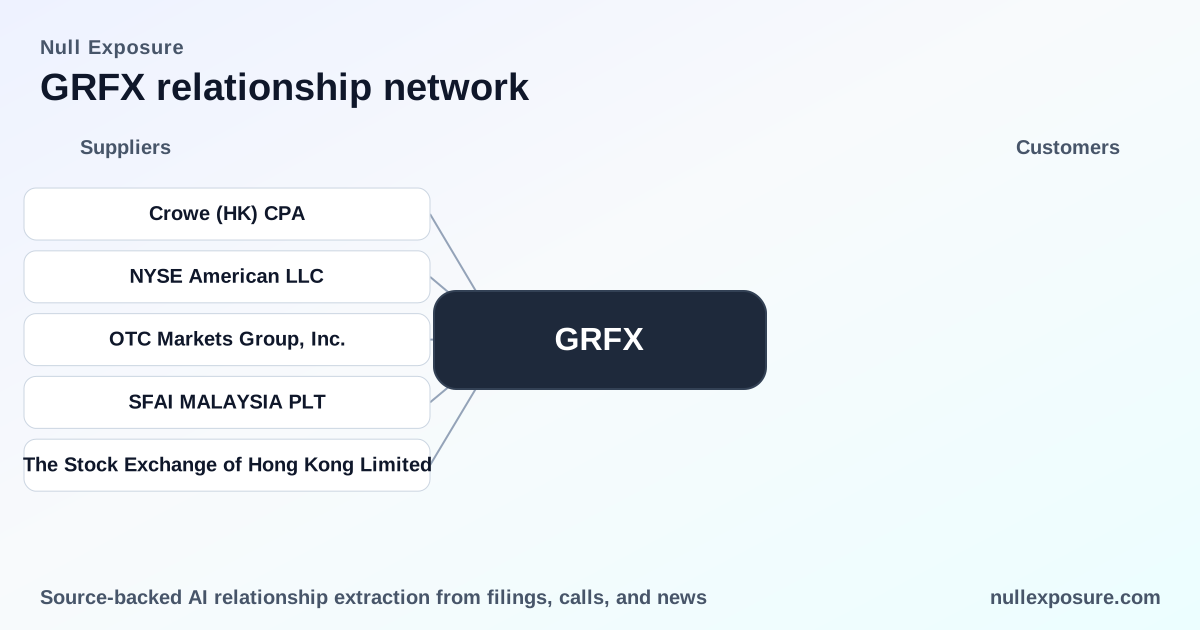
Below are every relationship mentioned in the source materials for GRFX, with a plain-English summary and a source reference.
- Crowe (HK) CPA — Graphex engages Crowe (HK) CPA to prepare and audit its financial statements under IFRS for its Hong Kong listing, demonstrating continued compliance with HKSE listing obligations. According to a GlobeNewswire press release (May 15, 2025), Graphex confirmed that Crowe (HK) CPA prepares the required IFRS audit filings for the Hong Kong traded ordinary shares.
- NYSE American LLC — The NYSE American issued a delisting letter and suspended trading of Graphex’s ADSs under the symbol “GRFX” effective May 14, 2025, removing that U.S. liquidity channel. The GlobeNewswire release (May 15, 2025) reports the NYSE American delisting action and the ADS suspension.
- OTC Markets Group, Inc. — Following the NYSE AMS action, Graphex’s ADSs were moved to trade on the OTC Expert Market operated by OTC Markets Group, reducing ADR liquidity and shifting trading venue dynamics. The GlobeNewswire announcement (May 15, 2025) documents the transfer to the OTC Expert Market.
- SFAI MALAYSIA PLT — Graphex engaged SFAI MALAYSIA PLT to serve as its independent PCAOB-registered accounting firm for U.S. GAAP consolidated financial statements, reflecting a deliberate change in U.S.-facing audit coverage. The company’s Form 6-K disclosure from March 4, 2025, and subsequent GlobeNewswire reporting (May 15, 2025) note SFAI’s engagement.
- The Stock Exchange of Hong Kong Limited — Graphex’s ordinary shares continue to trade on the Hong Kong exchange, preserving the company’s primary listing and the most significant public liquidity pool for ordinary shares. GlobeNewswire (May 15, 2025) confirms ongoing trading on the Hong Kong exchange.
What these relationships mean for counterparties and investors
The mix of audit firms, exchange actions and venue shifts creates a concrete commercial and regulatory profile for Graphex:
- Audit continuity plus dual-reporting complexity. Graphex’s use of Crowe (HK) for IFRS and SFAI for U.S. GAAP translates into a deliberate dual-reporting posture; this increases reporting complexity and the operational cost of compliance while providing suppliers and lenders with two lenses on the company’s financial health. The dual-auditor stance signals management’s attempt to maintain both Hong Kong listing compliance and a U.S. reporting channel despite ADS delisting.
- Trading venue shift compresses liquidity and raises counterparty risk. The NYSE American suspension and the move of ADSs to OTC Expert Market reduce transparency and institutional access for U.S.-based counterparties; Hong Kong remains the primary market for ordinary-share liquidity, which is material for counterparties assessing receivable transferability or using equity as credit support.
- Regulatory and reputational attention is elevated. Delisting actions and auditor switches attract scrutiny; counterparties should expect heightened disclosure requests and contract clauses addressing material adverse events or listing-status changes.
For an operational risk toolkit tailored to situations like this, see practical resources at https://nullexposure.com/.
Practical takeaway for procurement, credit and legal teams
- Price for liquidity risk: require prepayment, shorter payment cycles, or trade credit insurance for finished goods and components where substitution is limited.
- Lock in audit-verified performance milestones: demand quarterly financial covenant checks aligned with audited IFRS and U.S. GAAP disclosures.
- Preserve exit mechanics: include termination-for-listing-change clauses and explicit remedies for transfer of receivables in the event of ADR suspension.
Investor and operator action checklist
- Verify which currency and listing each counterparty will accept as collateral — Hong Kong-listed ordinary shares are the primary liquid instrument today.
- Confirm audits and look through both the IFRS (Crowe HK) and U.S. GAAP (SFAI) reports to reconcile working capital and cash-flows.
- Price contracts to reflect negative operating margins and constrained market capitalization: require step-in rights, performance bonds, or staged deliveries.
Final assessment and next steps
Graphex is a commercial-scale graphene manufacturer with real revenues and product-level gross profit, but the combination of negative operating profitability, a constrained market cap, and a U.S. ADS suspension materially increases commercial counterparty risk. Auditing relationships are in place to support dual reporting, and ordinary-share liquidity on the Hong Kong exchange remains intact — both are positive operational anchors. Counterparties should trade off the company’s production capability against elevated credit and liquidity risk and structure agreements accordingly.
For bespoke supplier-risk assessments, comparative market intelligence, and contract templates for counterparties working with firms like Graphex, visit our resource hub at https://nullexposure.com/ — or contact our team to commission a tailored exposure analysis.